
Non-FictionBusiness BriefLibrary Science
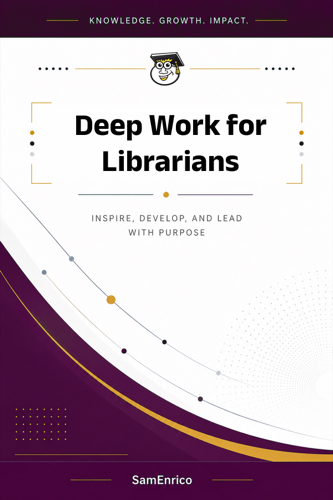
Deep Work for Librarians eBook
Protect collection development and research suppor
by Akin Farrah
Protect collection development and research support during quiet library hours.
Formats
Free sample
Chapter 1: The Fragmentation Epidemic--–- The reference desk clock read 2:47 PM on a Tuesday, which meant Sarah had already been interrupted seventeen times. She knew this not because she was counting—though by now she could have been—but because she had finally, desperately, started keeping a tally on a sticky note hidden under her keyboard. The tally was her secret shame, a private experiment she had begun after reading a study about how long it actually takes to recover focus after an interruption. The answer, she had learned, was not the thirty seconds most people assumed. It was closer to twenty-three minutes.
And at 2:47 PM, with seventeen tally marks and only four hours left in her shift, Sarah had essentially lost the entire day.She had not touched the collection development report. She had not begun the weeding analysis her director had requested three weeks ago. She had not even opened the folder labeled "Fall Acquisitions – URGENT." What she had done was answer eleven directional questions (bathroom, printer, elevator), respond to four circulation-related queries (overdue fines, lost card, renewals, holds), help one patron install a PDF viewer (she was fairly certain he had simply not clicked the download button), and field one truly bizarre question about whether the library carried microfilm of nineteenth-century Polish census records (it did not, but the search took her forty minutes). Each of these interactions was, on its own, perfectly reasonable. None of them was the work she had been hired to do.Sarah is not real.
But her Tuesday is real, and it is happening right now, in thousands of libraries across the country, to thousands of librarians who entered this profession because they loved books, or research, or the quiet hum of a reading room at dusk. They did not become librarians to troubleshoot printers. They did not spend two years in graduate school learning metadata schemas and collection development theory so that they could tell a sixth grader that the boys' bathroom is down the hall to the left. And yet, here they are. Here we are.This is the fragmentation epidemic, and it is the single greatest threat to the future of librarianship that no one is talking about.The Quiet Crisis Librarianship has a visibility problem, but not the one you think.
For decades, the profession has worried about being invisible—about budget cuts from administrators who do not understand what librarians actually do, about patrons who think the library is just a warehouse for books, about the slow erosion of the professional brand. And those concerns are real. But there is a different kind of invisibility that is far more damaging, and it is invisibility to ourselves. We have become so fragmented, so interrupted, so thoroughly colonized by the shallow work of public service that we no longer remember what we are capable of when we are left alone to think.Consider the data. A time-motion study conducted at a large academic library found that reference librarians switched tasks an average of every six minutes and forty-eight seconds.
Not because they were lazy or distracted, but because the environment demanded it. A phone rang. A student approached the desk. An email chimed. A colleague stopped by with a question about scheduling.
Each of these interruptions was, in isolation, minor. But the cumulative effect was devastating: the librarians in the study spent less than eleven percent of their time on work that required professional expertise. The remaining eighty-nine percent was consumed by what the researchers called "maintenance activities"—tasks that could have been performed by a well-trained work-study student or, in many cases, a politely worded sign.Another study, this one from the public library sector, tracked the cognitive load of children's librarians during storytime preparation. The researchers found that the average librarian was interrupted every four minutes and twelve seconds during planning time. The most common interruption?
The service desk calling to ask a question that the caller could have answered themselves if they had simply looked at the schedule posted on the wall. The second most common? Email notifications. The third? A well-meaning colleague popping in to say hello.These studies are not anomalies.
They are the rule. And they point to a conclusion that is uncomfortable for a profession that prides itself on accessibility and openness: the open door, the welcoming desk, the always-available librarian—these are not just virtues. They are also a trap.Shallow Work vs. Deep Work To understand the trap, we need a vocabulary for what has been lost. Cal Newport, the computer science professor who popularized the term "deep work," defines it as "professional activities performed in a state of distraction-free concentration that push your cognitive capabilities to their limit." Deep work is what creates new value, improves your skills, and produces output that is difficult to replicate.
It is the neurologist interpreting an MRI, the software architect designing a new database schema, the composer arranging a symphony. And it is the librarian conducting an evidence-based collection analysis, performing a systematic review for a medical student, or remediating a metadata schema that has not been updated in a decade.Deep work is hard. It is also rare. Newport estimates that knowledge workers spend less than ten percent of their time in a state of deep concentration. The rest is shallow work: logistical tasks, administrative busywork, and the endless back-and-forth of email and chat.
Shallow work is often necessary, but it does not move the needle. It does not produce the kind of output that justifies a master's degree and a professional salary.For librarians, the shallow work problem is uniquely acute. Unlike a software engineer who can close their office door or a writer who can decamp to a coffee shop, most librarians work in open, public spaces by design. The reference desk is not a private office. The collection development office, if it exists at all, is often a shared cubicle adjacent to a high-traffic area.
And even when a librarian manages to carve out a few minutes of solitude, the institutional culture often punishes it. A librarian with a closed door is a librarian who is not available. A librarian wearing noise-canceling headphones is a librarian who does not care about patrons. A librarian who does not answer email within ten minutes is a librarian who is failing at their job.This is the fragmentation epidemic in its purest form: a profession-wide collapse of the conditions necessary for expertise, driven by a culture that mistakes availability for effectiveness.The Real Cost of Interruption Let us be precise about what interruption costs, because precision is the only thing that will save us. The twenty-three-minute recovery time mentioned earlier comes from a 2014 study by Gloria Mark at the University of California, Irvine, who tracked knowledge workers in their natural environments.
Mark found that after an interruption, it took an average of twenty-three minutes and fifteen seconds to return to the original task with the same level of focus. During that recovery period, workers were more error-prone, less creative, and significantly more likely to switch to a different task altogether rather than resuming the original one.For librarians, the math is brutal. A…
This is the end of the free sample. Get the eBook to keep going. Buy now
About this book
Details
- Author
- Akin Farrah
- Publisher
- SamEnrico
- Language
- English
- Genre
- Non-Fiction, Business Brief, Library Science
- Released
- 2026-06-06
- Pages (approx.)
- 150
- Available as
- eBook, Audiobook

Read better in the ZLOADR app
Your eBooks on your phone or tablet. Sign in with your SamEnrico account and start reading.
More by Akin Farrah
 Norwegian Resistance Fishing FleetAkin Farrah$11.99
 The Inheritance DistributionAkin Farrah$11.99
 Remote Retreats Travel Booking GuideAkin Farrah$11.99
 Home Warranty vs Repair Savings BriefAkin Farrah$11.99
 The Lost Cargo of the *Santa Maria*: A 21st-Century Spice Route MysteryAkin Farrah$11.99
 The Last Oracle: How a 19th-Century Seer Predicted the Modern WorldAkin Farrah$11.99
 Cross Border Payment StrategiesAkin Farrah$12.99
 JEE Multiple Attempts GuideAkin Farrah$12.99
 Sales Associate CampingAkin Farrah$11.99
 Understanding Chromosome 1, Monosomy 1p34 P32Akin Farrah$17.99
 How to Start a Autism Teaching Business (Beginners Guide)Akin Farrah$11.99
You may also like
 Hong Kong Handover 1997Dunn Johnnie$11.99
 Zumba For Postnatal Recovery CourseNeal Christian$11.99
 Zumba for BeginnersLadner Nikia$11.99
 YouTube Comment Mining GuideHumes Pandora$12.99
 Worry Box MeditationCarlin Rudy$11.99
 Workplace Stress MeditationNguyen Lynn$11.99
 Workplace Stress and Sleep RepairHawley Ivory$11.99
 Workplace Perfectionism CureDelaney Jeffry$11.99
 Workplace Injustice Anger GuideWallen Isabelle$11.99
 Work Addiction and Burnout LinkGreenwood Ester$11.99
 Women in Yoga and WellnessBeattie Galina$11.99
 Women in Stand Up ComedyChun Evangeline$11.99