
Non-FictionBusiness BriefJournalism
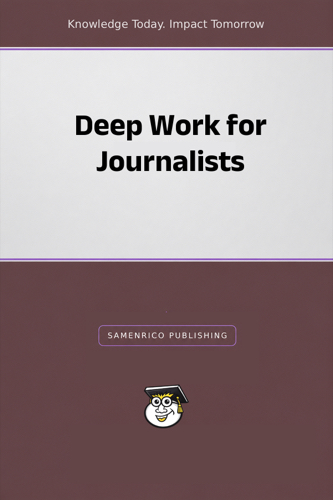
Deep Work for Journalists eBook
Protect investigative writing and source analysis
by Levin Reba
Protect investigative writing and source analysis from breaking news distractions.
Formats
Free sample
Chapter 1: The Rewired Reporter...–- Emma sat at her desk, three monitors glowing, Slack pinging, phone buzzing, and a breaking news alert flashing red in the corner of her screen. She had been trying, for the past forty-five minutes, to read a 147-page PDF of police disciplinary records. She had read exactly four pages. She remembered nothing from them.She was not lazy. She was not untalented.
She was, by any objective measure, one of the most promising investigative journalists at her midsized metro daily. Two years ago, she had exposed a city council member’s conflict of interest. Eighteen months ago, she had freed a wrongfully convicted man after uncovering suppressed witness statements. Six months ago, her editor had assigned her to investigate a pattern of suspicious no-bid contracts awarded to a construction company with ties to the mayor’s brother-in-law.She had all the documents. She had the leaked emails.
She had a source inside the zoning office willing to speak on background. She had everything she needed to write the story that could end a corrupt administration.But she could not focus.Every time she opened the PDF, a notification arrived. A source needed an answer. A competitor had just tweeted a scoop. Her editor wanted to know if she had seen the latest press release from the mayor’s office.
Her phone buzzed with a news alert about a shooting on the other side of the city—unrelated to her investigation, but urgent, because the newsroom’s policy was that everyone dropped everything for breaking news. By the time she returned to the PDF, she had forgotten what she was looking for. She would start over. Read the same paragraph three times. Check Twitter again.
Answer another email. Look up at the clock. Cry a little inside. Go home exhausted. Repeat the next day.Emma is not real.
But she is every investigative journalist I have ever met.The Problem That No One Wants to Name Journalism has a disease. It is not lack of talent. It is not lack of resources, though both are genuine crises. The disease is the systematic, structural, technologically accelerated destruction of the journalist’s ability to pay attention to anything for longer than ninety seconds.We have built newsrooms that are physiologically incompatible with the work that matters most. We have filled them with screens that beep, phones that buzz, feeds that refresh, and editors who believe that if someone is not interrupted every fifteen minutes, they must not be working.
We have confused reactivity with productivity, speed with accuracy, and the volume of output with the weight of impact.And we have done this while demanding that investigative journalists produce work that requires exactly the opposite: sustained, uninterrupted, cognitively demanding focus. You cannot triangulate sources while checking Twitter. You cannot spot a fraudulent transaction while your phone buzzes with news alerts. You cannot build a narrative that holds power accountable when your brain is being trained, minute by minute, to crave the dopamine hit of a new notification.This chapter is a diagnosis. It will not fix anything yet.
Before we can build solutions—and this book is full of them, from the Cognitive Entry Protocol to the Four-Hour Fortress to the Shutdown Complete Ritual—we must understand what has gone wrong inside the journalist’s skull. We must name the enemy. We must understand, at the level of neurons and stress hormones, why the modern newsroom is a machine for producing shallow work and consuming investigative potential.The Two Brains of the Modern Journalist Let us begin with a fundamental distinction that will organize this entire book. Every journalist has, competing for control of their attention, two neurological systems. I call them the Cortisol Loop and the Deep Pathway.The Cortisol Loop is your brain’s emergency response system.
It evolved to help your ancestors notice a rustle in the grass that might be a predator. It is fast, reactive, and stress-driven. When you hear a notification, see a breaking news alert, or feel your phone buzz, your brain releases cortisol—a stress hormone that heightens alertness, narrows focus to the immediate stimulus, and rewards you for reacting. This was useful on the savanna. It is useful when a shooting happens two blocks from your newsroom.
It is not useful when you are trying to verify a source’s claim about a no-bid contract.The Cortisol Loop is designed for short bursts of reactivity followed by rest. But the modern newsroom never lets it rest. Alerts arrive every few minutes. Slack pings are constant. The news cycle never sleeps.
Your brain, trapped in this loop, begins to treat everything as an emergency. You cannot distinguish between a genuine public safety crisis and a mildly interesting tweet. Your cortisol levels remain chronically elevated. You feel busy, even frantic. You are producing shallow work—headlines, summaries, reactions, retweets—but you are not producing accountability.The Deep Pathway is the other system.
It is slow, deliberate, and requires the absence of interruption. It is what allows you to read a 147-page PDF and remember what you read. It is what allows you to triangulate three contradictory sources and find the truth in the overlap. It is what allows you to look at a spreadsheet of campaign donations and spot the single anomalous transaction that reveals a bribe.The Deep Pathway requires sustained attention. It requires that your brain enter a state cognitive scientists call “flow”—where time disappears, where you are fully absorbed in the task, where your working memory is dedicated entirely to the problem at hand.
Entering flow takes time. Research suggests it takes between ten and twenty minutes of uninterrupted focus to reach a state of deep concentration. And it takes only a single interruption—a ping, a buzz, a coworker asking a question—to shatter it.Here is the tragedy: the Cortisol Loop and the Deep Pathway are neurologically incompatible. You cannot be in both at once. When your brain is flooded with cortisol from constant alerts, your prefrontal cortex—the part of your brain responsible for logical reasoning, long-term planning, and complex analysis—actually down-regulates.
Your brain shifts resources to the amygdala and the reactive fight-or-flight centers. You become faster at reacting and worse at thinking.The modern newsroom has been designed, probably without anyone intending it, to keep journalists trapped in the Cortisol Loop. The Deep Pathway is starved of the conditions it needs to function. And then we wonder why investigative journalism is dying.The Physiology of Distraction: What Happens Inside Your Skull Let me be more specific about what happens inside your brain when you are interrupted. This is not metaphor.
This is measurable biology.When you are engaged in deep work—analyzing a document, writing a paragraph, connecting two disparate facts—your brain is building what neuroscientists call a “cognitive map.” Neurons are firing in complex patterns, forming temporary connections between different pieces of information. Your working memory is holding multiple variables simultaneously. This is computationally expensive for your brain. It requires energy, focus, and the absence of competing inputs.Then a notification arrives. Your phone buzzes.
Your brain, trained by years of conditioning, reacts automatically. It releases a small pulse of cortisol. Your attention shifts to…
This is the end of the free sample. Get the eBook to keep going. Buy now
About this book
Details
- Author
- Levin Reba
- Publisher
- SamEnrico
- Language
- English
- Genre
- Non-Fiction, Business Brief, Journalism
- Released
- 2026-06-11
- Pages (approx.)
- 147
- Available as
- eBook, Audiobook

Read better in the ZLOADR app
Your eBooks on your phone or tablet. Sign in with your SamEnrico account and start reading.
More by Levin Reba
 Remote Retreats Neurodiversity InclusionLevin Reba$11.99
 The Wedding Planning DisputeLevin Reba$11.99
 Retirement Housing Partnership Deed GuideLevin Reba$11.99
 French Resistance Clandestine PressLevin Reba$11.99
 The Silk Road Kingpin: Inside the Rise and Fall of Ross UlbrichtLevin Reba$11.99
 Frozen Drift: The Miraculous Survival of the *Kuznetsov* CrewLevin Reba$11.99
 Understanding Chromosome 1 RingLevin Reba$17.99
 Budget Automation Tools GuideLevin Reba$12.99
 JEE Formula Sheet GuideLevin Reba$12.99
 Raycast Power User AutomationLevin Reba$11.99
 How to Become a Dial BrusherLevin Reba$11.99
You may also like
 Hong Kong Handover 1997Dunn Johnnie$11.99
 Zumba For Postnatal Recovery CourseNeal Christian$11.99
 Zumba for BeginnersLadner Nikia$11.99
 YouTube Comment Mining GuideHumes Pandora$12.99
 Worry Box MeditationCarlin Rudy$11.99
 Workplace Stress MeditationNguyen Lynn$11.99
 Workplace Stress and Sleep RepairHawley Ivory$11.99
 Workplace Perfectionism CureDelaney Jeffry$11.99
 Workplace Injustice Anger GuideWallen Isabelle$11.99
 Work Addiction and Burnout LinkGreenwood Ester$11.99
 Women in Yoga and WellnessBeattie Galina$11.99
 Women in Stand Up ComedyChun Evangeline$11.99