
Non-FictionBusiness BriefConsulting
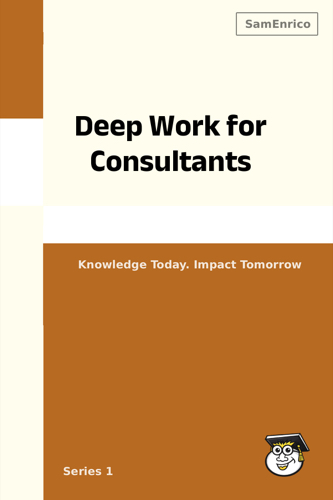
Deep Work for Consultants eBook
Uninterrupted analysis and deliverable creation be
Uninterrupted analysis and deliverable creation between client sites and calls.
Formats
Free sample
Chapter 1: The Busyness Trap--–- The email arrived at 6:47 PM on a Tuesday. Karen, a senior consultant at a global strategy firm, had just landed after a three-hour flight. She had forty-seven unread messages, two missed calls from her engagement manager, and a Slack thread demanding "quick thoughts" on a model she hadn't opened in four days. She answered the emails in the Uber. She took the calls in the hotel lobby.
She ate dinner with one hand while scrolling deliverables with the other. At 11:30 PM, she shut her laptop, exhausted, and realized she could not remember a single thing she had actually produced that day. She had been busy. She had not been effective.This is not a story of failure. Karen was promoted six months later.
She is now a manager. She works sixty-five hours per week, her team respects her responsiveness, and her clients appreciate that she never lets a question go unanswered for more than ninety minutes. By every metric of the consulting industry, Karen is a success. And that is precisely the problem.The consulting profession has built an elaborate reward system for the wrong behaviors. It celebrates the consultant who replies fastest, not the one who thinks deepest.
It elevates the manager who is always available, not the one who produces breakthrough analysis. It measures hours billed as if quantity were a proxy for quality. And in doing so, it has created a generation of professionals who are chronically busy and chronically shallow—experts at reaction, amateurs at production.This chapter will dismantle the central myth of consulting: that a packed calendar equals value creation. We will examine the cognitive science of why constant interruption destroys analytical capacity, quantify the hidden costs of the "always available" culture, and reveal why the very behaviors that earn praise from partners and clients are systematically undermining the quality of your work. By the end of this chapter, you will understand that busyness is not a badge of honor.
It is a defense mechanism against the fear of not looking valuable. And it is killing your potential to do work that matters.The Great Confusion: Activity Versus Achievement Walk into any consulting office on a Wednesday afternoon. What do you see? Laptops open. Faces illuminated by Slack threads.
Fingers moving constantly, not pausing. Phones buzzing. Eyes jumping from one notification to the next. The hum of activity is almost physical, a vibration in the air that signals importance and urgency. Everyone is moving.
Everyone is responding. Everyone is busy.Now ask a simple question: what is being produced?Not what is being processed. Not what is being discussed. Not what is being forwarded, summarized, or acknowledged. What new insight has been generated in the past three hours?
What complex problem has been solved? What deliverable has advanced from a rough draft to a defensible position? The answer, more often than not, is discouragingly little.This is the great confusion of knowledge work in general and consulting in particular. We have mistaken activity for achievement because activity is visible and achievement is not. Responding to an email produces a measurable output: a sent message.
Attending a call produces a line on a timesheet. Updating a status produces a notification that your manager can see. These are all real events. They all feel like work. And they all create the comforting illusion of progress.But genuine progress in consulting—the kind that wins complex engagements, survives partner stress tests, and produces recommendations that clients actually implement—does not look like activity.
It looks like stillness. It looks like a consultant staring at a spreadsheet without typing. It looks like a whiteboard covered in half-erased formulas. It looks like silence, interrupted only by the sound of thinking.The consulting industry has optimized for the visible at the expense of the valuable. We have built incentive systems that reward the shallow because shallow work is easy to measure.
Deep work, by its very nature, is invisible until it produces an artifact. And by the time the artifact appears, no one remembers the hours of stillness that created it.The Cognitive Cost of Context Switching To understand why busyness destroys depth, we must first understand how the human brain actually works. The brain is not a microprocessor capable of parallel processing. It is more like a single-core processor that creates the illusion of multitasking by switching between tasks extremely quickly. Each switch, however, carries a cost.Cognitive science research has consistently demonstrated a phenomenon called "attention residue." When you switch from Task A to Task B, your brain does not immediately let go of Task A.
A portion of your attentional resources remains stuck on the previous task, evaluating it, worrying about it, or simply lingering in the background of your awareness. The more complex Task A is, the more attention residue remains. And the more attention residue you carry, the less cognitive capacity you have for Task B.This is not a minor effect. Studies using functional magnetic resonance imaging (f MRI) have shown that the brain requires significant metabolic energy to disengage from one task and engage with another. The neural pathways activated by Task A do not simply shut off when you turn to Task B.
They continue to fire, competing with Task B for processing resources, for anywhere from a few seconds to several minutes.Now consider the typical consulting day. A consultant begins the morning by checking email. They read a question about a financial model, then switch to Slack to answer a question about a slide deck, then jump on a call to discuss client feedback, then return to the email they started with. Each switch carries a residue cost. Each shift leaves a wake of cognitive debris.
By 10:00 AM, the consultant has performed perhaps twenty separate task switches, each one degrading their ability to think clearly.The cumulative effect is staggering. Research has quantified the impact of context switching on effective intelligence. When knowledge workers are interrupted repeatedly throughout a day, their performance on complex analytical tasks drops by an average of 10 IQ points. To put that in perspective, a 10-point IQ reduction is roughly equivalent to losing a full night of sleep or consuming enough alcohol to reach a blood alcohol content of 0.05 percent. You would not drive in that condition.
Yet we expect consultants to build financial models in that condition.The Open Office Trap If context switching were purely a matter of personal discipline, the solution would be simple: stop switching. But the consulting environment is engineered to produce switching. Consider the physical spaces where most consulting work actually happens.Client sites are notoriously hostile to deep concentration. The typical arrangement is some variation of the "fishbowl"—a glass-walled conference room or a cluster of desks in an open area, designed for visibility rather than focus. Consultants are placed where clients can see them working, because visibility is assumed to correlate with value.
The result is a workspace that maximizes distraction.Every person who walks past your desk is a potential interruption. Every conversation in the next cubicle becomes an involuntary data stream entering your ears. Every phone call on the other side of…
This is the end of the free sample. Get the eBook to keep going. Buy now
About this book
Details
- Author
- Griggs Bernetta
- Publisher
- SamEnrico
- Language
- English
- Genre
- Non-Fiction, Business Brief, Consulting
- Released
- 2026-06-07
- Pages (approx.)
- 153
- Available as
- eBook, Audiobook

Read better in the ZLOADR app
Your eBooks on your phone or tablet. Sign in with your SamEnrico account and start reading.
More by Griggs Bernetta
 The Chronic Lateness TalkGriggs Bernetta$11.99
 Remote Retreats for NonprofitsGriggs Bernetta$11.99
 Long Term Care Insurance Housing GuideGriggs Bernetta$11.99
 Norwegian Resistance Sabotage CellGriggs Bernetta$11.99
 The Stargazer of Babylon: How a Forgotten Scholar Defied the CosmosGriggs Bernetta$11.99
 How to Start a Pouch Made of Leather or Leather Substitute Business (Beginners Guide)Griggs Bernetta$11.99
 End Of Year Budget SurplusGriggs Bernetta$12.99
 JEE Memory Techniques GuideGriggs Bernetta$12.99
 Public Health LawGriggs Bernetta$11.99
 Understanding Christmas DiseaseGriggs Bernetta$17.99
You may also like
 Hong Kong Handover 1997Dunn Johnnie$11.99
 Zumba For Postnatal Recovery CourseNeal Christian$11.99
 Zumba for BeginnersLadner Nikia$11.99
 YouTube Comment Mining GuideHumes Pandora$12.99
 Worry Box MeditationCarlin Rudy$11.99
 Workplace Stress MeditationNguyen Lynn$11.99
 Workplace Stress and Sleep RepairHawley Ivory$11.99
 Workplace Perfectionism CureDelaney Jeffry$11.99
 Workplace Injustice Anger GuideWallen Isabelle$11.99
 Work Addiction and Burnout LinkGreenwood Ester$11.99
 Women in Yoga and WellnessBeattie Galina$11.99
 Women in Stand Up ComedyChun Evangeline$11.99