
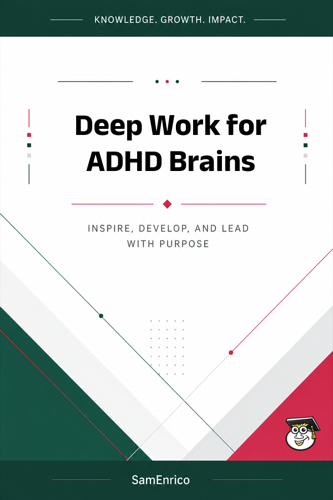
Deep Work for ADHD Brains eBook
Use body doubling and shorter 25 minute sprints fo
by Hall Frank
Use body doubling and shorter 25 minute sprints for attention challenges.
Formats
Free sample
Chapter 1: The Sprint Solution...--You have been lied to. Not maliciously, but systemically. For years, productivity gurus have sold you a single, devastatingly wrong idea: that deep work requires hours of uninterrupted concentration. They show you pictures of famous writers in secluded cabins, programmers in dark rooms for twelve hours, academics who disappear into libraries for entire afternoons. And every time you try to replicate this, you fail.
Not a little. Completely. You sit down with the best intentions, clear your calendar, shut your door, and within twenty minutes, you are reorganizing your bookshelf, researching the optimal humidity for houseplants, or staring at the wall while your brain plays a three-second loop of a song you hate.This is not a moral failure. It is not laziness. It is not a lack of willpower.
It is neuroscience.The traditional deep work model was built for the neurotypical brain—a brain that finds silence calming, long duration rewarding, and low stimulation sustainable. Your ADHD brain is wired differently. It craves novelty, urgency, and feedback. It is not broken; it is optimized for a different operating system. And the single most important thing you can learn is this: you do not need to focus for hours.
You need to master twenty-five minutes.This chapter dismantles the myth of the long haul and replaces it with something that actually works for your neurology. We will explore the science of why twenty-five minutes is your neurological sweet spot, how a ticking timer becomes kryptonite for time blindness, and why the simple presence of another person—even a stranger on a screen—can unlock focus you did not know you had. By the end of this chapter, you will never try to focus for four hours again. You will think in sprints.The Myth of the Marathon Let us name the enemy. The enemy is the cultural story that says real work requires long, uninterrupted hours.
This story is everywhere. Cal Newport's Deep Work—a brilliant book for neurotypical readers—argues for blocks of ninety minutes to four hours. High achievers on Linked In post about waking at 4 AM to get "four hours of deep work before the world wakes up." Every productivity influencer seems to agree: longer is better.For the ADHD brain, this is not just unhelpful. It is actively destructive.When you sit down for a four-hour block, three things happen almost immediately. First, dopamine crashes.
Your brain requires a baseline level of dopamine to sustain attention. Without novelty or urgency, that baseline drops. Boredom becomes physically uncomfortable—not metaphorically, but neurochemically. You feel an almost painful need to do anything else. Second, time blindness takes over.
You have no internal clock. After ten minutes, you genuinely cannot tell if you have been working for five minutes or fifty. This uncertainty breeds anxiety, which further impairs focus. Third, the Wall of Awful rises. Every past failure to sustain focus becomes ammunition for the voice that says, "See?
You cannot do this either."The result is not deep work. The result is shame, exhaustion, and a growing conviction that you are simply not cut out for serious cognitive labor.Here is the truth that changes everything: the marathon model is wrong for everyone, but it is catastrophic for you. Research on attention and cognitive load shows that even neurotypical brains experience significant attentional drift after forty-five to sixty minutes. The difference is that neurotypical brains recover more quickly and experience less emotional dysregulation during the drift. Your ADHD brain, with its heightened sensitivity to boredom and its tendency toward all-or-nothing thinking, turns that drift into a crisis.You do not need to train yourself to focus longer.
You need to train yourself to focus shorter, better, and more frequently.The Science of the Sprint Why twenty-five minutes? Why not twenty? Why not thirty? The answer lies in the neuroscience of the prefrontal cortex—the part of your brain responsible for executive functions like task initiation, impulse control, working memory, and sustained attention.The prefrontal cortex is metabolically expensive. It consumes glucose and oxygen at a high rate, and it fatigues faster than other brain regions.
For the ADHD brain, this fatigue is accelerated. Research suggests that the ADHD prefrontal cortex shows signs of depletion after approximately twenty to thirty minutes of sustained cognitive load. This is not a lack of effort; it is a biological reality.Twenty-five minutes sits at the sweet spot. It is long enough to make meaningful progress on almost any task. You can write a few paragraphs, answer a dozen emails, outline a chapter, clean a room, or make several phone calls in twenty-five minutes.
But it is short enough that your prefrontal cortex can sustain effort without hitting the wall of exhaustion.The twenty-five minute sprint is the unit of ADHD deep work.Consider what happens in a twenty-five minute sprint that does not happen in a four-hour block. First, the end is always in sight. Your brain can tolerate almost anything when it knows the pain will end soon. Second, you get frequent dopamine hits from completion. Every finished sprint is a win, and wins release dopamine.
Third, you can adapt to your energy level. A bad day requires only one sprint. A good day might string together four or five. The unit scales with you, not against you.The Pomodoro Technique—developed by Francesco Cirillo in the late 1980s—originally used twenty-five minute intervals for exactly these reasons. Cirillo was not studying ADHD, but he stumbled upon a duration that works remarkably well for the ADHD brain.
The technique has been validated by decades of user experience, and more recently by neuroimaging studies showing that brief, timed work intervals reduce cognitive load and improve task persistence.But here is where we depart from standard Pomodoro. For the neurotypical user, the timer is a convenience. For you, the timer is a treatment. It is not optional. It is not a suggestion.
It is the scaffolding that holds up the entire architecture of your focus.Kryptonite for Time Blindness Time blindness is one of the most underappreciated challenges of the ADHD brain. You do not experience time as a sequence of measurable units. You experience time as now and not now. A deadline that is three weeks away might as well be three years. A task that will take ten minutes feels the same as a task that will take two hours.
This is not a character flaw; it is a neurological difference in how the brain processes temporal information.Time blindness makes traditional productivity systems useless. To-do lists do not work because every item on the list exists in the same eternal "not now." Calendars do not work because blocks of time are abstract rectangles on a screen. Even alarms often fail because you can snooze them indefinitely.The ticking timer is different. It creates artificial urgency.When you set a timer for twenty-five minutes, something shifts in your brain. The abstract task becomes a concrete challenge.
You are no longer saying "write report." You are saying "complete as much of the report as possible before this red disk disappears." The timer introduces a scarcity principle: time…
This is the end of the free sample. Get the eBook to keep going. Buy now
About this book
Details
- Author
- Hall Frank
- Publisher
- SamEnrico
- Language
- English
- Genre
- Non-Fiction, Business Brief, ADHD
- Released
- 2026-06-11
- Pages (approx.)
- 148
- Available as
- eBook, Audiobook

Read better in the ZLOADR app
Your eBooks on your phone or tablet. Sign in with your SamEnrico account and start reading.
More by Hall Frank
 Annual Strategic BlockingHall Frank$11.99
 Procrastination BusterHall Frank$11.99
 Amazon Shopping Comparison GuideHall Frank$11.99
 Frank Sinatra Chairman VoiceHall Frank$11.99
 Congressional Baseball Game HistoryHall Frank$11.99
 Email Priority Inbox SetupHall Frank$11.99
 Scripting for ForgivenessHall Frank$11.99
 The Great Paris Jewel Heist: The Wrong Man’s TrialHall Frank$11.99
 The Merchant Princes of the Swahili Coast: Wealth, Trade, and Cultural FlourishingHall Frank$11.99
 How to Produce Pole Dancing KitsHall Frank$11.99
 Indian Stock Option Plan ComplianceHall Frank$12.99
 Compliance ChecklistHall Frank$12.99
You may also like
 Hong Kong Handover 1997Dunn Johnnie$11.99
 Zumba For Postnatal Recovery CourseNeal Christian$11.99
 Zumba for BeginnersLadner Nikia$11.99
 YouTube Comment Mining GuideHumes Pandora$12.99
 Worry Box MeditationCarlin Rudy$11.99
 Workplace Stress MeditationNguyen Lynn$11.99
 Workplace Stress and Sleep RepairHawley Ivory$11.99
 Workplace Perfectionism CureDelaney Jeffry$11.99
 Workplace Injustice Anger GuideWallen Isabelle$11.99
 Work Addiction and Burnout LinkGreenwood Ester$11.99
 Women in Yoga and WellnessBeattie Galina$11.99
 Women in Stand Up ComedyChun Evangeline$11.99