
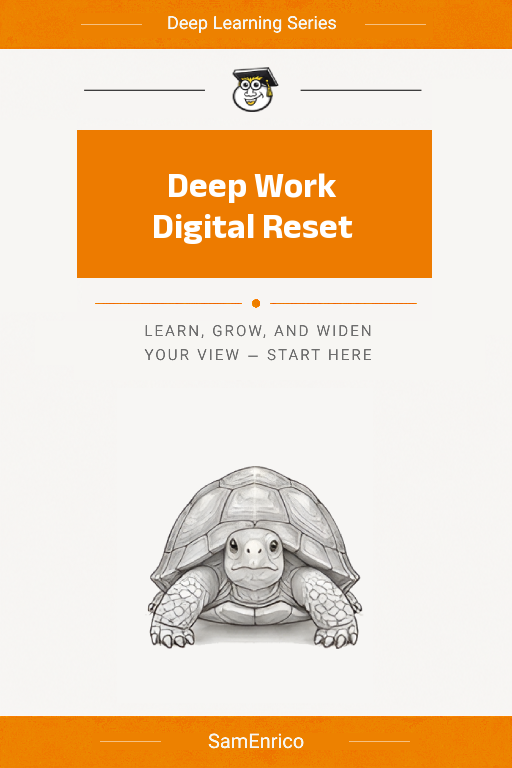
Non-FictionMental WealthFocus RecoveryMindset Blueprint
Deep Work Digital Reset eBook
Retrain your attention span after years of notific
by Ivey Tinisha
Retrain your attention span after years of notification addiction and context switching. Covers phone-free deep work blocks, single-tasking muscle building, and environmental triggers.
Formats
Free sample
Chapter 1: The Great Hijack--–- Your attention span is not broken. That is the first and most important lie you need to unlearn. You have been told, probably by well-meaning articles, productivity gurus, or your own exhausted inner voice, that you lack discipline, that you are addicted to your phone, that your brain has been permanently fried by social media. None of this is true. What has actually happened is far more insidious and far more fixable: your attention has been systematically trained to be weak by an environment that was designed, down to the color of the notification badge, to defeat you.
The difference between “broken” and “trained” is the difference between a dead muscle and a tired one. A dead muscle cannot be revived. A tired muscle, once you stop pulling on it, recovers and grows stronger. This book is about stopping the pull.The Myth of the Broken Brain Consider for a moment how you would feel about your physical fitness if every time you tried to run a mile, someone injected sedatives into your legs. You would not conclude that you were a bad runner.
You would conclude that you were being drugged. And yet, when it comes to your attention, you have been injected with sedatives thousands of times per day—not by a malicious actor with a syringe, but by an economic system that profits from your distraction. The attention economy, as scholars and journalists have named it, is a $200 billion industry built on a simple premise: if a company can keep your eyes on a screen for one more second, that company makes money. Not because you bought something necessarily, but because you saw an ad, or because you generated data, or because you trained their algorithm with your click. Your distraction is not a bug in the system.
Your distraction is the product.The genius of this system, and the reason you have internalized it as a personal failure, is that it hides its own architecture. You do not see the thousands of engineers at Google, Apple, Meta, and Tik Tok who run A/B tests to determine whether a red notification badge works better than a blue one, or whether a pull-to-refresh animation should take 1.2 seconds instead of 0.8 seconds to maximize the dopamine hit of the new content. You do not see the neuroscience labs that discovered that variable rewards—sometimes you get a like, sometimes you don’t—create the same neural firing patterns as a slot machine. You only see yourself, reaching for your phone for the thirtieth time in an hour, wondering what is wrong with you.Nothing is wrong with you. You are a healthy human brain responding exactly as any healthy human brain would respond to a super-stimulus designed to exploit your evolutionary wiring.
The same way a rat will press a lever for cocaine until it starves to death—not because the rat is broken, but because cocaine is a super-stimulus that hijacks the reward system—you will check your phone until you lose hours of your life, not because you are weak, but because the notification is a super-stimulus that hijacks your dopamine loops. This is not a metaphor. The same neurotransmitter, dopamine, is involved in both cases. The same brain regions, the nucleus accumbens and the ventral tegmental area, light up on f MRI scans. The only difference is that the cocaine comes in a little glass pipe, and the notification comes in a little glass screen.The $200 Billion Battlefield Let us name the enemy, because you cannot defend against an enemy you refuse to see.
The attention economy is not a conspiracy theory; it is a公开 stated business model. Every major social media company publishes quarterly earnings reports that show advertising revenue as their primary source of income. Advertising revenue is a direct function of user attention: more time on site, more ads shown, more money earned. Therefore, every feature, every algorithm, every design decision at these companies is optimized for a single metric: minutes of attention captured per user per day.This optimization takes forms both obvious and subtle. The obvious forms are familiar to anyone who has used social media: infinite scroll, autoplay videos, push notifications, the removal of chronological feeds in favor of algorithmically ranked content.
The subtle forms are more insidious precisely because they are invisible. For example, the “pull to refresh” animation on Twitter and Instagram creates a slot machine effect: you pull down, the screen reloads, and you wait half a second to see if there is something new. That half-second of anticipation, followed by the variable reward of either interesting or boring content, is neurologically identical to the pause between pulling the lever of a slot machine and seeing the wheels stop. The companies did not stumble into this design. They tested dozens of variations and chose the one that maximized compulsive checking.Even more insidious is the phenomenon that journalist Johann Hari popularized as “rage baiting.” In his book Stolen Focus, Hari documented how Facebook’s internal research found that angry emoji reactions were worth far more to their algorithm than likes.
Why? Because anger keeps you on the platform longer. When you are angry, you are more likely to comment, to share, to argue, to scroll further to find evidence for your side. The algorithm learned this not because a human programmed it to make you angry, but because the algorithm was optimizing for attention and discovered that anger was the most reliable path to that goal. So Facebook began showing you content that it predicted would make you angry—not because Mark Zuckerberg hates you, but because anger is profitable.
You are not being radicalized by accident. You are being radicalized because outrage sells.The Neuroscience of Distraction To understand why you cannot simply “decide” to focus, you need to understand what is happening inside your skull. The human brain evolved in an environment of scarcity—scarce food, scarce safety, scarce social connection—and it developed a set of attentional systems designed to constantly scan for threats and opportunities. This is why you can be deeply absorbed in a conversation and yet snap your head toward a sudden loud noise. Your brain is always running a background process that asks: Is there something more important or more dangerous than what I am currently doing?In the ancestral environment, this background process was adaptive.
The sudden rustle in the bushes might be a lion. The movement at the edge of your vision might be a ripe berry bush. But in the modern environment, the same background process has been weaponized. Every notification, every badge, every vibration triggers that ancient threat-detection system. Your brain treats an unread email notification the same way it once treated an unfamiliar footprint outside the cave: as a potential threat that requires immediate investigation.This is not a metaphor.
Neuroscientists have shown that the brain’s default mode network—the system that becomes active when you are at rest, daydreaming, or letting your mind wander—is constantly being interrupted by the salience network, which identifies stimuli as important. When a notification arrives, the salience network fires, the default mode network shuts down…
This is the end of the free sample. Get the eBook to keep going. Buy now
About this book
Details
- Author
- Ivey Tinisha
- Publisher
- SamEnrico
- Language
- English
- Genre
- Non-Fiction, Mental Wealth, Focus Recovery, Mindset Blueprint
- Released
- 2026-05-30
- Pages (approx.)
- 132
- Available as
- eBook, Audiobook

Read better in the ZLOADR app
Your eBooks on your phone or tablet. Sign in with your SamEnrico account and start reading.
More by Ivey Tinisha
 Public Assertiveness SkillsIvey Tinisha$11.99
 Morning Light Sleep Prep GuideIvey Tinisha$11.99
 Relationship Goal Setting GuideIvey Tinisha$11.99
 Phobia Comprehensive GuideIvey Tinisha$11.99
 Continuing Care Retirement Communities GuideIvey Tinisha$11.99
 The Lost Code of Hammurabi: Secrets of the First Legal RevolutionIvey Tinisha$11.99
 Desktop Support EngineerIvey Tinisha$11.99
 A Beginners Guide to Body Building (Volume 1)Ivey Tinisha$11.99
 Middle East B2B Buying GuideIvey Tinisha$12.99
 Understanding Intestinal Pseudo-obstructionIvey Tinisha$17.99
You may also like
 Hong Kong Handover 1997Dunn Johnnie$11.99
 Zumba For Postnatal Recovery CourseNeal Christian$11.99
 Zumba for BeginnersLadner Nikia$11.99
 YouTube Comment Mining GuideHumes Pandora$12.99
 Worry Box MeditationCarlin Rudy$11.99
 Workplace Stress MeditationNguyen Lynn$11.99
 Workplace Stress and Sleep RepairHawley Ivory$11.99
 Workplace Perfectionism CureDelaney Jeffry$11.99
 Workplace Injustice Anger GuideWallen Isabelle$11.99
 Work Addiction and Burnout LinkGreenwood Ester$11.99
 Women in Yoga and WellnessBeattie Galina$11.99
 Women in Stand Up ComedyChun Evangeline$11.99