
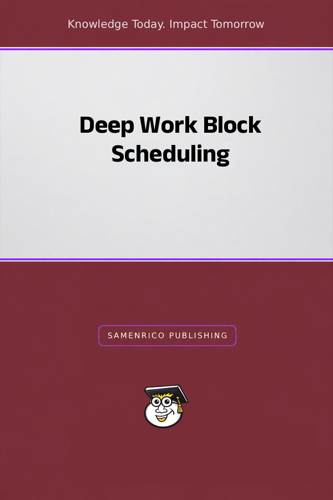
Deep Work Block Scheduling eBook
Protects 90-minute uninterrupted blocks for cognit
by Sams Willian
Protects 90-minute uninterrupted blocks for cognitively demanding tasks.
Formats
Free sample
Chapter 1: The 23-Minute Thief--The average knowledge worker sits down at their desk at 9:00 AM with a clear intention: finish the quarterly report, debug the login module, or write the first three pages of the proposal. By 5:00 PM, they have accomplished roughly one-third of what they planned. They stay late, skip lunch, and feel a vague sense of failure. Then they do it again tomorrow.This is not a failure of discipline. It is not a lack of talent.
It is not laziness or procrastination or any of the other self‑flags we wield against ourselves.It is theft.Every day, a silent thief walks into your office, sits on your shoulder, and picks your pocket. You do not see it happening. You cannot feel the weight leaving your wallet. But by 5:00 PM, you have lost between four and six hours of cognitive capacity. The thief's name is fragmentation, and it is the most expensive uncalculated cost in modern work.This chapter is the diagnosis.
Before we build the system that will protect your cognitive prime—the 90‑minute blocks that form the heart of this book—you need to understand exactly what you are fighting, how much it is costing you, and why your current strategies for "staying focused" have failed not because you are weak, but because you have been fighting biology with willpower.The Myth You Have Been Sold Let us begin with a simple experiment you can conduct right now. Think of a complex task you need to complete today—something that requires concentration, synthesis, and problem‑solving. Now imagine sitting down to do that task with your phone face‑up on the desk, email open in a browser tab, Slack pinging in the background, and a colleague who has an "open door" policy ten feet away.How long do you think you could maintain uninterrupted focus? Ten minutes? Fifteen?
If you are like the thousands of knowledge workers studied by researchers at the University of California, Irvine, your answer is approximately three minutes.Three minutes.That is the average time a modern office worker spends on any single task before switching—either because an external interruption arrives (email, Slack, a colleague) or because they self‑interrupt (checking their phone, opening a news tab, switching to a "quick" admin task). The average worker cycles through more than four hundred task switches per day. Four hundred times, they tear their attention away from one thing and throw it at another.And here is the lie you have been sold: that this is normal. That this is what work looks like. That being busy—answering emails, attending meetings, responding to pings—is the same as being productive.It is not.
It is the opposite of productive.The neuroscientist Earl Miller at MIT has spent decades studying how the brain handles multiple tasks. His conclusion is devastatingly clear: the human brain is not capable of true multitasking. What we call multitasking is actually rapid task‑switching. And every single switch carries a cost. When you move from Task A to Task B, your brain must disengage from A, suppress the neural networks that were active, activate the networks for B, and then—if you ever return to A—repeat the entire process in reverse.This is not free.
It feels free because the switches happen so quickly, but the metabolic cost is real. After just ninety minutes of continuous task‑switching, your brain's performance degrades as if you had pulled an all‑nighter. After four hours, your effective IQ drops by ten points. You become, measurably, less intelligent than you were when you walked in the door.The 23‑Minute Penalty The most devastating finding in the research on attention fragmentation comes from Gloria Mark, a professor at the University of California, Irvine, who has spent twenty years studying how knowledge workers actually spend their time. In a landmark study, Mark and her team equipped office workers with sensors that tracked every single task switch and interruption.
The results were staggering.When a worker was interrupted—by an email, a Slack message, a colleague stopping by—it took an average of twenty‑three minutes and fifteen seconds to fully return to the original task. Not to "start thinking about it again." To fully return to the same depth of focus, the same cognitive immersion, the same flow state they had before the interruption.Let that sink in. A two‑minute interruption—someone asking a "quick question," a notification badge appearing on your email icon—does not cost you two minutes. It costs you twenty‑five minutes. Two minutes for the interruption itself, plus twenty‑three minutes to recover.If you are interrupted ten times in a day, you have lost more than four hours.
Not to the interruptions themselves—to the recovery time. To the cognitive whiplash of constantly stopping and starting.If you are interrupted fifteen times, you have lost nearly six hours. That is not a bad day. That is a full workday of cognitive capacity, incinerated by "quick questions" and notification badges.And here is the cruelest part of the 23‑minute penalty: it applies whether the interruption is external or internal. When you interrupt yourself—when you check your phone "just to see" or open a news tab "for a second"—your brain pays the same recovery tax.
You are not taking a harmless break. You are stealing twenty‑three minutes from your future self.The Attention Residue Trap Sophie Leroy, a management professor at the University of Washington, discovered a related phenomenon she calls "attention residue." When you switch from Task A to Task B, a portion of your attention remains stuck on Task A. You are never fully present for Task B. Even if you try hard, even if you are disciplined, some cognitive sand remains in the gears.Attention residue explains why you can read an email three times and still not understand it. Why you can sit through a sixty‑minute meeting and remember nothing.
Why you can spend eight hours at your desk and feel like you accomplished nothing. Your attention was never fully there. It was always partly somewhere else, stuck on the previous task, waiting to return.The research on attention residue has profound implications for how we structure work. Leroy found that the more cognitively demanding Task A was, the more residue remained when switching to Task B. In other words, the tasks that matter most—the deep, complex, creative work that drives your career forward—are the ones that leave the most residue.
When you interrupt deep work to answer email, you are not just harming the deep work. You are poisoning the email, too. You are doing two things badly instead of one thing well.The Shallow Water Lie Let us name the enemy. In his book Deep Work, Cal Newport draws a distinction between two types of work. Deep work is professional activity performed in a distraction‑free zone that pushes your cognitive capacities to their limit.
It creates new value, improves your skills, and is hard to replicate. Shallow work is logistical, non‑cognitively demanding work that can be performed while distracted. It is easy to replicate, easy…
This is the end of the free sample. Get the eBook to keep going. Buy now
About this book
Details
- Author
- Sams Willian
- Publisher
- SamEnrico
- Language
- English
- Genre
- Non-Fiction, Self-Help, Deep Work
- Released
- 2026-06-09
- Pages (approx.)
- 146
- Available as
- eBook, Audiobook

Read better in the ZLOADR app
Your eBooks on your phone or tablet. Sign in with your SamEnrico account and start reading.
More by Sams Willian
 Personal Branding for RecruitersSams Willian$11.99
 Vacation Stress ManagementSams Willian$11.99
 Congressional Aides ConfessionsSams Willian$11.99
 Joni Mitchell Blue TapestrySams Willian$11.99
 Scripting for Sleep HypnosisSams Willian$11.99
 Meeting Stand Up VirtualSams Willian$11.99
 Focus Environment DesignSams Willian$11.99
 The Tide of Destiny: Prince Henry the Navigator and the Birth of the Modern WorldSams Willian$11.99
 The Siege of Chittorgarh: A Kingdom's Last Stand Against the Mughals (1567-1568)Sams Willian$11.99
 How to Produce Plumbing Repair KitsSams Willian$11.99
 Exploring Giclee Prints: Fine Art Digital PrintingSams Willian$11.99
 Ghana Market Product Research WorkbookSams Willian$12.99
You may also like
 Deep Work Scheduling HandbookRuby Ngoc$11.99
 Long Pomodoro for Deep WorkMetzler Man$11.99
 Deep Work Scheduling StrategiesSoares Raisa$11.99
 The Four-Hour Focus Block CourseLong Ray$11.99
 The 90 Minute Deep MorningMcnabb Apolonia$11.99
 Protect Deep Work BlocksGatlin Vannesa$11.99
 The Deep Work Schedule BlueprintHewitt Eddie$11.99
 Individual Contributor FocusLadner Kourtney$11.99
 Deep Work Interruption Protection CourseTorrence Steffanie$11.99
 Deep Work GoalsCasas Jada$11.99
 Deep Concentration GuideDanielson Terese$11.99
 Quadrant Two Deep Work FocusMontero Racheal$11.99