
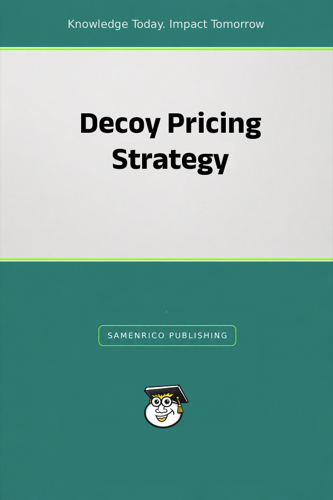
Non-FictionBusiness BriefDecoy Effect
Decoy Pricing Strategy eBook
Add inferior option to make target attractive.
Add inferior option to make target attractive.
Formats
Free sample
Chapter 1: The Popcorn Lie--–- The first time I realized that customers are not rational, I was holding a greasy bag of movie theater popcorn and feeling like a complete idiot.It was a Tuesday night in 2014. I had just finished a consulting project that was supposed to prove, once and for all, that my pricing model was superior to my competitor's. I had spreadsheets. I had regression analyses. I had a Power Point with seventy-three slides, each one a monument to my own quantitative arrogance.And then I walked past the concession stand.The prices were printed on a backlit menu board, the kind that glows with the warmth of a thousand manipulated decisions:Small: $4.00Medium: $6.50Large: $7.00I stopped walking.
I had a Ph D in behavioral economics—or at least, I had read enough blog posts to feel like I had one. I knew about bounded rationality. I knew about context dependence. I had even cited Dan Ariely in a client email that morning. And yet, standing there, I did exactly what the menu board wanted me to do.
I bought the large.Not because I was hungry. Not because the marginal utility of those extra two hundred calories justified the fifty-cent premium over the medium. I bought the large because it felt like a bargain. The medium was $6.50. The large was $7.00.
For fifty cents more, I was getting—what? A mountain of buttery, artificially flavored corn product. The small was irrelevant. The medium was the trap. And the large was the prize.I walked to my seat feeling smart.
That is the scariest part. I felt smart about a decision that had been engineered for me before I was born, refined by decades of concession stand data, and executed with no more effort than a cashier pressing a button labeled "L." The theater did not trick me. It simply understood something about my brain that I did not understand about myself.This book is about that understanding. It is about the invisible architecture of choice, the quiet power of the option that nobody wants, and the uncomfortable truth that your customers are not rational—and that is precisely why decoy pricing works.The Myth of the Rational Customer For more than two hundred years, economics was built on a beautiful lie. The lie was called Homo economicus—the rational economic man.
According to this fiction, every customer walks into every transaction with perfect information, unlimited cognitive capacity, and a stable set of preferences. They calculate marginal utility. They compare opportunity costs. They make decisions the way a computer runs a spreadsheet: inputs in, optimal output out.Here is the problem. You have never met this person.
I have never met this person. Even the economists who invented the model do not act like this when they buy popcorn.The truth, which emerged from the work of psychologists and behavioral economists like Daniel Kahneman, Amos Tversky, and Herbert Simon, is far messier and far more interesting. Humans are not rational. We are rationally irrational—meaning our irrationality follows predictable patterns that can be studied, measured, and, yes, exploited.Herbert Simon won a Nobel Prize for demonstrating that humans practice what he called bounded rationality. We do not have unlimited information.
We have whatever is in front of us. We do not have unlimited time. We have a decision to make before the movie starts. We do not have unlimited cognitive capacity. We have a brain that evolved to spot tigers, not to calculate price per ounce ratios in a darkened theater.Daniel Kahneman, another Nobel laureate, divided the mind into two systems.
System One is fast, automatic, emotional, and lazy. It sees a large popcorn for seven dollars and thinks, "That is only fifty cents more than the medium—what a deal!" System Two is slow, deliberate, logical, and exhausted. It wants to calculate the price per ounce, but it is busy thinking about whether you remembered to turn off the oven at home. System One almost always wins.This is not a bug. It is a feature.
Evolution did not optimize the human brain for accurate price comparisons. It optimized the human brain for survival. And survival favors fast decisions, emotional shortcuts, and social comparison over slow calculation. The problem is that modern commerce has figured out exactly how to hijack those shortcuts.The Context Dependence of Preference Here is the most dangerous sentence in this entire book: Your customers do not know what they want until you show them what they can compare it to.This is called context dependence. It is the principle that preferences are not stable properties of products but emerge from the set of options presented.
A seven-dollar popcorn is expensive in isolation. Put it next to a six-fifty medium, and it becomes cheap. Put it next to a four-dollar small, and it becomes expensive again. The popcorn did not change. The context changed.Let me give you a more consequential example.In 1983, Joel Huber, a marketing professor at Duke University, published a study that would change how pricing strategists think about choice.
He gave participants a set of beer options. Option A was a high-quality beer for a high price. Option B was a low-quality beer for a low price. When participants chose between just these two, about half chose A and half chose B. Classic trade-off.
Painful but balanced.Then Huber added a third option. Option C was a beer that was slightly worse than Option A on every dimension—lower quality, same high price. It was a decoy. It was not meant to be chosen. It was meant to make Option A look better by comparison.The result was shocking.
Option A's market share jumped from fifty percent to nearly eighty percent. Not because Option A changed. Not because the customers changed. Because the context changed. Option A now dominated Option C, and the human brain, desperate to avoid trade-off pain, latched onto that dominance like a lifeline.This is the attraction effect.
It is the empirical foundation of decoy pricing. And it works because the human brain is not a calculator. It is a comparison engine.The Three-Choice Trap Every successful decoy strategy rests on a simple structural insight: two options create paralysis, three options create clarity.Let me explain.When you present a customer with two options, you force them into a trade-off. Option X is better on Attribute A. Option Y is better on Attribute B.
To choose, the customer must sacrifice something they value. This activates the amygdala, the brain's fear and stress center. The customer experiences what neuroscientists call trade-off pain. They hesitate. They delay.
They leave the page. They buy nothing.When you present a customer with three options, and one of them is a decoy that is clearly worse than your target, something magical happens. The customer no longer has to make a trade-off. They simply have to recognize dominance. "This one is better than that one." The amygdala calms down.
The decision moves to the ventral striatum, the brain's reward center. The customer feels smart, confident, and satisfied.This is why pricing pages with exactly three tiers outperform pages with two tiers…
This is the end of the free sample. Get the eBook to keep going. Buy now
About this book
Details
- Author
- Shrader Alita
- Publisher
- SamEnrico
- Language
- English
- Genre
- Non-Fiction, Business Brief, Decoy Effect
- Released
- 2026-06-11
- Pages (approx.)
- 129
- Available as
- eBook, Audiobook

Read better in the ZLOADR app
Your eBooks on your phone or tablet. Sign in with your SamEnrico account and start reading.
More by Shrader Alita
 Android Digital Wellbeing FixShrader Alita$11.99
 Name Story Method GuideShrader Alita$11.99
 Gaslighting Recovery Relationship GuideShrader Alita$11.99
 The Wheelchair Ramp BuilderShrader Alita$11.99
 Compulsive Spending BudgetShrader Alita$11.99
 OKR Tracker JournalShrader Alita$11.99
 Silicon Shadows: The Unseen War of the Tech TitansShrader Alita$11.99
 The Silent Conspiracy: The Lost Letters of Agrippina the YoungerShrader Alita$11.99
 How to Produce JukeboxesShrader Alita$11.99
 A Collector's Handbook to the Lada 1300Shrader Alita$11.99
 API Confirmation of Funds PrimerShrader Alita$12.99
 AI Investment Portfolio AnalysisShrader Alita$12.99
You may also like
 Hong Kong Handover 1997Dunn Johnnie$11.99
 Zumba For Postnatal Recovery CourseNeal Christian$11.99
 Zumba for BeginnersLadner Nikia$11.99
 YouTube Comment Mining GuideHumes Pandora$12.99
 Worry Box MeditationCarlin Rudy$11.99
 Workplace Stress MeditationNguyen Lynn$11.99
 Workplace Stress and Sleep RepairHawley Ivory$11.99
 Workplace Perfectionism CureDelaney Jeffry$11.99
 Workplace Injustice Anger GuideWallen Isabelle$11.99
 Work Addiction and Burnout LinkGreenwood Ester$11.99
 Women in Yoga and WellnessBeattie Galina$11.99
 Women in Stand Up ComedyChun Evangeline$11.99