
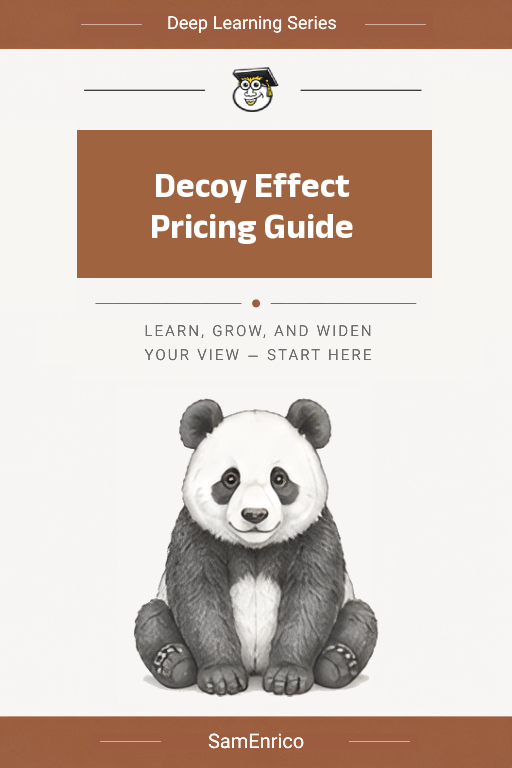
Non-FictionFirst 30 DaysBehavioral Economics
Decoy Effect Pricing Guide eBook
Add a third option that makes your target price lo
Add a third option that makes your target price look attractive and drives customer choice.
Formats
Free sample
Chapter 1: The Comparison Trap...--Imagine walking into a movie theater. You plan to buy a small popcorn. Then you see the menu:Small: $4.00Large: $7.00Which do you choose? Many people hesitate. The small feels cheap but small.
The large feels expensive but generous. Without a reference point, you fall into what behavioral scientists call the 2-option deadlock—a state of indecision where the brain cannot confidently choose between two options because neither clearly dominates the other.Now imagine a different menu:Small: $4.00Medium: $6.50Large: $7.00Suddenly, the decision becomes easy. The medium feels like a trap—only $0.50 cheaper than the large but significantly smaller. The large becomes the obvious choice. You buy the large, feel smart about it, and walk away satisfied.
The theater just used a decoy on you. And you thanked them for it.This is not an accident. It is not manipulation in the sinister sense. It is the decoy effect—the most powerful, most tested, and most misunderstood tool in pricing strategy. And whether you realize it or not, it shapes almost every purchasing decision you make.The $125 Question That Changed Everything In 2004, behavioral economist Dan Ariely walked into MIT’s Sloan School of Management with a simple experiment that would fundamentally change how we understand consumer choice.
He presented students with a subscription offer from The Economist magazine, which at the time offered three options:Web-only subscription: $59Print-only subscription: $125Print-and-web subscription: $125The results were astonishing. When given all three options, 84% of students chose the print-and-web bundle for $125. Only 16% chose the cheaper web-only option. Not a single student chose the print-only option—and why would they? It offered the same price as the bundle with fewer features.But here is where the experiment gets interesting.
Ariely then ran a second version of the test with only two options:Web-only: $59Print-and-web: $125With the print-only decoy removed, the results flipped dramatically. Only 32% of students chose the $125 bundle. The remaining 68% chose the cheaper web-only option.Same magazine. Same prices. Same students.
The only thing that changed was the presence of an option that nobody wanted. And that single, seemingly useless option drove a 52% swing in purchasing behavior.This is the decoy effect in its purest form. And it reveals something profound about the human brain: we do not know what we want until we see what it compares to.Why Your Brain Needs a Ruler The decoy effect works because of a fundamental limitation in human cognition. Your brain cannot determine absolute value. It can only determine relative value.
This is called reference dependence—the tendency to evaluate options not in isolation, but in comparison to nearby alternatives.Think about how you judge temperature. If you walk into a room that is 72 degrees Fahrenheit, you cannot tell me whether that is warm or cold without a reference point. If you just came from a 60-degree room, 72 feels warm. If you just came from an 85-degree room, 72 feels cool. The temperature hasn't changed.
Your reference point has.The same is true for prices, features, and value. A 100bottleofwineisexpensiveinagrocerystore.Itisabargainina Michelin−starredrestaurant.A100 bottle of wine is expensive in a grocery store. It is a bargain in a Michelin-starred restaurant. A 100bottleofwineisexpensiveinagrocerystore.Itisabargainina Michelin−starredrestaurant.A50 monthly subscription feels steep for a meditation app but cheap for enterprise software. The product hasn't changed.
The context has.This is why the decoy effect is so powerful. It does not change your product. It changes the context around your product. It places a ruler next to your offering so that customers can confidently measure its value.The 2-Option Deadlock: Why Two Choices Fail Most business owners believe that offering customers fewer choices is better. They have read about the "paradox of choice"—the famous study showing that consumers buy more jam when offered six varieties than when offered twenty-four.
And they have concluded that simplicity is the answer.They are wrong. Or rather, they are only half right.The paradox of choice applies when you offer too many options. But offering too few options creates a different problem: the 2-option deadlock.When customers face only two options, their brain enters a zero-sum calculation. Every positive attribute of Option A becomes a negative comparison to Option B. If Option A is cheaper, Option B must be overpriced.
If Option B has more features, Option A must be under-featured. There is no neutral ground. No safe compromise. No way to feel smart about the decision.This creates what psychologists call choice anxiety. The customer freezes.
They put the decision off. They walk away. Or worse, they default to the cheapest option—not because it is the best fit, but because it minimizes the risk of feeling foolish.The decoy solves this problem by giving the brain a third reference point—an option that is clearly inferior to one alternative but not to the other. This creates what economists call a dominance relationship. One option becomes objectively better.
The decision becomes easy. The customer feels smart. And they buy.The MIT Experiment That Proved the Point Ariely's MIT experiment did not stop with The Economist. He ran a second study that is even more relevant for business owners.He created three subscription options for an imaginary online magazine:Option A: $59 for 100 articles (web-only)Option B: $125 for 200 articles (print+web)Option C: $125 for 200 articles with a bonus gift Wait—that is not right. Let me correct that.
The actual experiment involved changing just one feature of the decoy. Ariely created:A cheap option: $59 for web-only access An expensive option: $125 for print+web access A decoy: $125 for print-only access (same price as expensive, fewer features)Then he ran a variation where the decoy changed slightly: $125 for print+web access with a free tote bag (same features as expensive, same price, but with an added low-value item).The result? The specific feature of the decoy determined which product became the target. When the decoy was print-only (inferior on features), customers flocked to the print+web bundle. When the decoy was print+web with a tote bag (superior on features but same price), customers flocked to the print+web without the tote bag.In other words, changing one feature of the decoy shifted 68% of buyers from one product to another.
The products themselves never changed. The prices never changed. Only the decoy changed.The Three Decoy Types You Must Know At this point, most books on pricing make a critical error. They treat all decoys as the same phenomenon. They are not.
Based on decades of research—from Huber, Payne & Puto's foundational 1982 study to Simonson & Tversky's 1992 replication—there are three distinct types of decoys. Each works differently. Each requires a different strategy. And confusing them will destroy your pricing architecture.Type 1: The Asymmetric Decoy The asymmetric decoy is what most people picture when they hear "decoy effect." It is an option that is inferior to your target on both price and features.Think back to The Economist. The print-only option (125)wasinferiortotheprint+webbundle(125) was inferior to the print+web bundle (125)wasinferiortotheprint+webbundle(125) on features (print+web had everything print-only had, plus web access).
Same price, but one was clearly better. Nobody chose print-only. But its presence made print+web look like a genius choice.When…
This is the end of the free sample. Get the eBook to keep going. Buy now
About this book
Details
- Author
- Mcmillan Maya
- Publisher
- SamEnrico
- Language
- English
- Genre
- Non-Fiction, First 30 Days, Behavioral Economics
- Released
- 2026-06-01
- Pages (approx.)
- 158
- Available as
- eBook, Audiobook

Read better in the ZLOADR app
Your eBooks on your phone or tablet. Sign in with your SamEnrico account and start reading.
More by Mcmillan Maya
 Gunpowder Trace AnalysisMcmillan Maya$11.99
 Pilot High Stress RecoveryMcmillan Maya$11.99
 Pre Competition Sleep HypnosisMcmillan Maya$11.99
 Bernadette Peters Diva LifeMcmillan Maya$11.99
 Joshua Nkomo Father ZimbabweMcmillan Maya$11.99
 Child Loss And ExerciseMcmillan Maya$11.99
 Birth Trauma And Infant LossMcmillan Maya$11.99
 The Iron Forges of Meroë: How Kushite Engineers Shaped the Ancient WorldMcmillan Maya$11.99
 The Forged Victory: How a Fake Painting Exposed Olympic CorruptionMcmillan Maya$11.99
 How to Produce Floor CleanerMcmillan Maya$11.99
 Newfoundland: Gentle Water GiantMcmillan Maya$11.99
 How to Become a Sales AttendantMcmillan Maya$11.99
You may also like
 Hong Kong Handover 1997Dunn Johnnie$11.99
 Zumba For Postnatal Recovery CourseNeal Christian$11.99
 Zumba for BeginnersLadner Nikia$11.99
 YouTube Comment Mining GuideHumes Pandora$12.99
 Worry Box MeditationCarlin Rudy$11.99
 Workplace Stress MeditationNguyen Lynn$11.99
 Workplace Stress and Sleep RepairHawley Ivory$11.99
 Workplace Perfectionism CureDelaney Jeffry$11.99
 Workplace Injustice Anger GuideWallen Isabelle$11.99
 Work Addiction and Burnout LinkGreenwood Ester$11.99
 Women in Yoga and WellnessBeattie Galina$11.99
 Women in Stand Up ComedyChun Evangeline$11.99