
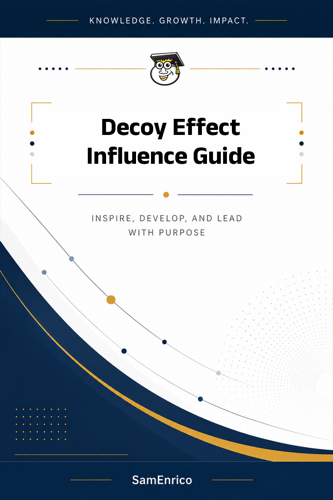
Decoy Effect Influence Guide
Add asymmetrically dominated option to steer choic
Add asymmetrically dominated option to steer choice toward target.
Formats
About this book
Free sample
Chapter 1: The Relativity Trap--–- The first time I watched someone fall for a decoy, I was sitting in a crowded movie theater with a greasy paper bag on my lap. The bag contained a large popcorn. I had paid $8 for it. The teenager next to me had paid $6 for a small. We had the exact same amount of popcorn left—roughly half a bag each—but I felt like I had won something.
He felt like he had lost. Neither of us knew that the medium popcorn, the $7.50 option neither of us even considered, had made the decision for us.This is the secret that the popcorn industry has known for decades, that subscription companies have turned into a science, and that real estate agents use to sell overpriced houses. The medium popcorn was not there to be bought. It was there to make the large look like a bargain. And it worked on me.
It worked on you. It works on everyone.The question this book answers is simple but disturbing: how often are your choices being made by options that someone placed there specifically to manipulate you?The Illusion of Independent Choice We like to believe that our preferences are stable, internal, and rational. When you walk into a store and choose one product over another, you probably assume that choice reflects something true about you—your taste, your values, your careful assessment of quality and price. This assumption is comforting. It is also wrong.Decades of research in behavioral economics have demonstrated that human preferences are remarkably fragile.
They are constructed in the moment, shaped by the context in which choices are presented, and heavily influenced by options that most people never even select. The most powerful of these context effects is called the Decoy Effect, and it works by exploiting a fundamental feature of how your brain processes information: you cannot evaluate anything in isolation.Consider a simple experiment. If I ask you whether a $100 sweater is expensive, you cannot answer. You need a comparison. A $50 sweater makes it expensive.
A $500 sweater makes it a bargain. Your brain automatically, instantly, and involuntarily compares every option to every other option…
This is the end of the free sample. Get the eBook to keep going. Buy now
Contents
- Chapter 1
- Chapter 2
- Chapter 3
- Chapter 4
- Chapter 5
- Chapter 6
- Chapter 7
- Chapter 8
- Chapter 9
- Chapter 10
- Chapter 11
- Chapter 12
Details
- Author
- Isaacson Sandy
- Publisher
- SamEnrico
- Language
- English
- Genre
- Non-Fiction, Self-Help, Decoy, Asymmetric
- Released
- 2026-06-10
- Pages (approx.)
- 135
- Available as
- eBook, Audiobook

Read better in the ZLOADR app
Your eBooks on your phone or tablet. Sign in with your SamEnrico account and start reading.
More by Isaacson Sandy
 WeChat Moment ComparisonIsaacson Sandy$11.99
 Influencer Disclosure For VapingIsaacson Sandy$11.99
 Perimenopause Anxiety Management ToolsIsaacson Sandy$11.99
 Affirmations for DivorceIsaacson Sandy$11.99
 Gilgamesh and the Storm God’s WrathIsaacson Sandy$11.99
 Understanding Juberg–hayward SyndromeIsaacson Sandy$17.99
 How to Become a Dot EtcherIsaacson Sandy$11.99
 Sovereign Wealth Fund GuideIsaacson Sandy$12.99
 You Are Not Your Job GuideIsaacson Sandy$12.99
 Medical AssociateIsaacson Sandy$11.99