
Non-FictionSelf-HelpBoundaries
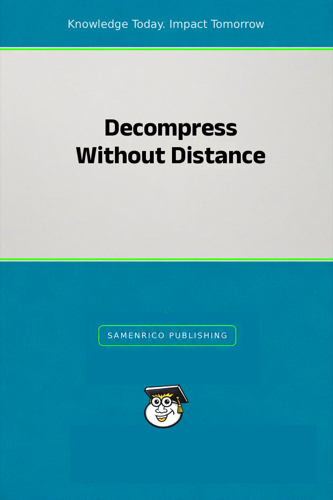
Decompress Without Distance eBook
Shows partners how to take personal space to relie
Shows partners how to take personal space to relieve stress without creating emotional distance.
Formats
Free sample
Chapter 1: The Tether Paradox...--It happens quietly, almost invisibly. One partner comes home from work already half-drained. The other partner, sensing the fatigue, tries to help—asking questions, offering comfort, moving closer. But the tired partner doesn't feel helped. They feel hunted.
So they retreat: a few inches to the other side of the couch, a muttered "I need a minute," a retreat to the bedroom with the door slightly ajar. The other partner follows, not out of malice but out of fear. The first partner withdraws further. And within twenty minutes, two people who love each other are sleeping on opposite edges of the same bed, neither sure how they got there.This is the Tether Paradox. And understanding it is the difference between a relationship that slowly suffocates and one that learns to breathe.The Scene You Know Too Well Let me paint a more detailed picture.
Sarah and Michael have been married for six years. They love each other. They chose each other. But on this particular Tuesday, Sarah has had a nightmare at work—a deadline moved up, a colleague threw her under the bus, her boss asked for a "quick chat" that lasted forty-five minutes and produced zero solutions. She walks through the front door at 6:47pm, already running on fumes.Michael has had a normal day.
Not great, not terrible. He's been looking forward to seeing Sarah. He's made dinner—nothing fancy, just pasta and a salad—and he wants to hear about her day. He wants to connect. That's what good husbands do, right?He asks, "How was work?"Sarah says, "Fine."Michael knows "fine" is never fine.
So he asks another question: "Did the meeting with your boss happen?"Sarah nods, starts unloading her bag.Michael persists: "What did they say?"And here's where the tether snaps. Sarah doesn't explode. She doesn't cry. She just goes quiet. She puts her bag down, walks to the bedroom, and closes the door.
Not a slam. A soft, deliberate click.Michael stands in the kitchen, holding a wooden spoon, feeling exactly like a child who has been sent to his room. He didn't do anything wrong. He asked about her day. He made dinner.
And now he's being punished with silence. Or so it feels.Twenty minutes later, he knocks on the bedroom door. "Can we talk?""Not right now," Sarah says."Then when?""I don't know. Just... not right now."Michael walks away, hurt and confused.
He texts his brother: "She's shutting me out again." His brother writes back: "That sucks, man. My wife does the same thing sometimes. Just give her space."Give her space. Michael has heard this advice before. He hates it.
Every time he gives her space, she takes more. Every time he backs off, she seems to disappear further into whatever cave she's crawled into. And every time he tries to reach out, she pulls away. There's no winning.Sarah, meanwhile, is lying in the dark, not angry at Michael but unable to explain why his questions felt like attacks. She knows he loves her.
She knows he was trying to help. But in that moment, his voice felt like another demand on her already-empty tank. She didn't want to talk. She wanted to dissolve. And the only way to dissolve was to be alone.
Not away from Michael specifically. Away from everyone. Away from language itself.Neither of them is wrong. Neither is cruel. Both are trapped.This is the Tether Paradox in action: the more one partner needs space, the more the other partner fears distance.
And the more the other partner fears distance, the more they pursue. And the more they pursue, the more the first partner needs space. The loop tightens until someone breaks.The Law of the Tether Here is the counterintuitive truth at the heart of this book: strategic separation creates stronger attraction. Not always, not automatically, but reliably when done with intention and care.Think of a sailboat moored to a dock. The tether—the rope connecting boat to dock—allows the boat to drift away.
The farther it drifts, the more tension builds in the rope. And when the boat reaches the limit of its tether, it doesn't float away forever. It swings back. The tension pulls it home.Most couples live as if the tether does not exist. They believe that closeness must be enforced moment by moment, inch by inch.
They share calendars. They check in by text every hour. They feel guilty taking solo weekends. They interpret their partner's desire to read alone as a rejection. They have slowly, lovingly, built a cage and called it commitment.But here is what the research actually shows: couples who maintain separate hobbies, separate friendships, and even separate vacations report higher relationship satisfaction than couples who do everything together.
The reason is not complicated. You cannot miss someone who never leaves. You cannot feel chosen by someone who has no other options. And you cannot bring anything new back into a relationship if you never leave to go get it.The tether requires slack. Not so much slack that the boat drifts into open water and never returns—but enough slack that the boat can move, can explore, can feel the pull of the rope and choose to follow it home.Why Togetherness Became a Trap We need to talk about how we got here.
Because the Tether Paradox is not your fault, and it's not your partner's fault. It is, in large part, a cultural inheritance.For the last several decades, Western relationship advice has been dominated by a single, seductive message: closer is better. Date night every week. Shared hobbies. Constant communication.
The "best friend" ideal—your partner should be your everything: your lover, your confidant, your co-parent, your social planner, your emotional support animal, and your weekend activity coordinator.This sounds beautiful. It is also impossible.No single human being can meet all of another human being's needs. Not because we are flawed, but because we are multiple. You need friends who share your obscure hobby. You need time alone to process your thoughts.
You need the freedom to be boring, or grumpy, or silent, without someone asking "what's wrong?" every thirty seconds. And none of these needs make you a bad partner.But the culture has taught us otherwise. We have internalized a terrifying equation: need for space = rejection of partner. If you want to be alone, the logic goes, you must not want to be with me. If you enjoy a weekend away, our relationship must be failing.
If you don't want to talk about your day, you must be hiding something.This equation is a lie. And it is destroying good relationships every
This is the end of the free sample. Get the eBook to keep going. Buy now
About this book
Details
- Author
- Vanover Lieselotte
- Publisher
- SamEnrico
- Language
- English
- Genre
- Non-Fiction, Self-Help, Boundaries
- Released
- 2026-06-09
- Pages (approx.)
- 139
- Available as
- eBook, Audiobook

Read better in the ZLOADR app
Your eBooks on your phone or tablet. Sign in with your SamEnrico account and start reading.
More by Vanover Lieselotte
 DBT For Parental EmotionVanover Lieselotte$11.99
 Assertiveness In JournalismVanover Lieselotte$11.99
 NASCAR Rivalry ManagementVanover Lieselotte$11.99
 Sleep Consolidation Memory GuideVanover Lieselotte$11.99
 Benzodiazepine Detox UseVanover Lieselotte$11.99
 Anger Communication GuideVanover Lieselotte$11.99
 Refugee Therapy Access ManualVanover Lieselotte$11.99
 The Plague Walls of Venice: Engineering a City Against the Black DeathVanover Lieselotte$11.99
 The Golden Stride: The Untold Story of Joana Coimbra's Olympic TriumphVanover Lieselotte$11.99
 How to Produce Football Face MasksVanover Lieselotte$11.99
 Understanding Cerebral Autosomal Dominant Arteriopathy With Subcortical Infarcts and Leukoencephalopathy (Cadasil)Vanover Lieselotte$11.99
 Stock Footage Channel Scalability PlanVanover Lieselotte$12.99
You may also like
 Hong Kong Handover 1997Dunn Johnnie$11.99
 Zumba For Postnatal Recovery CourseNeal Christian$11.99
 Zumba for BeginnersLadner Nikia$11.99
 YouTube Comment Mining GuideHumes Pandora$12.99
 Worry Box MeditationCarlin Rudy$11.99
 Workplace Stress MeditationNguyen Lynn$11.99
 Workplace Stress and Sleep RepairHawley Ivory$11.99
 Workplace Perfectionism CureDelaney Jeffry$11.99
 Workplace Injustice Anger GuideWallen Isabelle$11.99
 Work Addiction and Burnout LinkGreenwood Ester$11.99
 Women in Yoga and WellnessBeattie Galina$11.99
 Women in Stand Up ComedyChun Evangeline$11.99