
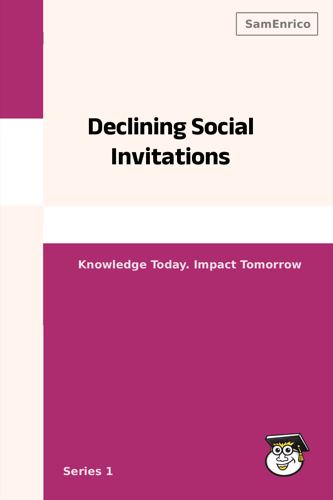
Declining Social Invitations eBook
Say no to events without guilt or elaborate excuse
Say no to events without guilt or elaborate excuses.
Formats
Free sample
Chapter 1: The Yes Hangover--The invitation arrives on a Tuesday afternoon. A text message, an email, a calendar notification—the medium doesn't matter. What matters is what happens next inside your body. Your chest tightens. Your stomach drops slightly.
You feel a flicker of annoyance, followed immediately by a wave of guilt for feeling annoyed at all. Someone thought of you. Someone wants you there. Someone went to the trouble of typing out an address, selecting a date, and sending you a little digital rectangle with two buttons: Accept or Decline.And already, without thinking, your finger hovers over Accept. Not because you want to go.
Not because the event sounds enjoyable. But because the alternative—clicking Decline, typing a response, explaining yourself—feels worse than just showing up.This is the moment that this book exists to dismantle.Let me ask you something honest. Think back to the last time you said yes to an invitation that you secretly dreaded. Maybe it was a coworker's housewarming party. Maybe it was a cousin's gender reveal.
Maybe it was a dinner with friends you like but for which you had absolutely no energy. You went. You smiled. You stayed the appropriate amount of time. And then you drove home, exhausted and vaguely irritated, wondering why you felt so drained by something that was supposed to be fun.That feeling has a name.
It's called the Yes Hangover.Defining the Yes Hangover The Yes Hangover is the specific cocktail of emotional and physical symptoms that follows a forced yes—an agreement to attend an event that you never genuinely wanted to attend. It is not the same as post-party tiredness, which comes from genuine enjoyment and social connection. The Yes Hangover is different. It tastes like resentment.Here is what the Yes Hangover feels like. In the days leading up to the event, you experience a low-grade dread.
It's not dramatic enough to cancel over, but it sits there, a small pebble in your shoe. You find yourself hoping something will come up—a flat tire, a sudden cold, literally anything that would get you off the hook without you having to take responsibility for your own no.During the event, you are physically present but mentally elsewhere. You scroll your phone under the table. You count the minutes until you can politely leave. You laugh at jokes you didn't hear and nod at stories you don't care about.
You are performing attendance, not participating in connection. And here is the cruelest part: the host has no idea. They see a full room and assume everyone is happy. Meanwhile, you are silently fuming at yourself for being there.After the event, the exhaustion hits. Not the pleasant tiredness of a good night out, but a bone-deep depletion that feels like you ran a errand you never wanted to run.
You crawl into bed and think, "Why did I do that?" And then, because you are a kind person who doesn't want to blame anyone else, you turn the resentment inward. You tell yourself you should have had more energy. You should have been more fun. You should have wanted to go.But here is the truth that this chapter exists to give you permission to hear: you didn't want to go. And that is not a moral failing.
That is data.The Hidden Transaction of Every Invitation Every invitation is a trade. When someone invites you to an event, they are offering you an experience. But accepting that invitation requires you to trade something in return. You trade your time. You trade your energy.
You trade the opportunity to do something else with that evening, that weekend, that vacation day. And unlike money, these resources are non-renewable. You cannot earn back a Saturday night. You cannot deposit more energy into an empty social battery.Most of us never think about this trade. We see the invitation, feel the guilt, and click Accept before we've consciously considered what we are giving up.
This is not an accident. The psychology of the yes is designed to bypass our rational brain. We are social animals, wired for belonging and rejection-averse by millions of years of evolution. Saying no to a social invitation triggers the same neural pathways as physical pain. Your brain would rather attend a mediocre party than risk being cast out of the tribe.But you are no longer a hunter-gatherer on the savanna.
Your survival does not depend on attending your coworker's barbecue. And yet your nervous system has not gotten the memo. So you say yes. You attend. You resent.
You recover. And then the next invitation arrives, and the cycle repeats.The Yes Hangover is not a sign that you are broken or antisocial or ungrateful. The Yes Hangover is a signal that your internal accounting system is working. It is your brain's way of saying, "The price you paid for that event was higher than the value you received." The problem is not that you feel the hangover. The problem is that you keep drinking.The Ledger Exercise Let me show you what I mean.
Take out a piece of paper, or open a note on your phone, and draw a vertical line down the middle. On the left side, write "What I Gained." On the right side, write "What I Lost."Now think of the last event you attended that you didn't want to go to. It could be anything—a birthday dinner, a baby shower, a networking happy hour, a family holiday. Fill in the left column with everything you gained by attending. Be honest.
Maybe you gained "avoided an awkward conversation." Maybe you gained "made my partner happy." Maybe you gained "didn't have to explain why I wasn't there." Write it all down.Now fill in the right column with everything you lost. Start with the obvious: the number of hours the event took, including travel time and recovery time afterward. Then add the less obvious: the energy you spent socializing when you had none to spare. The resentment that built up during the event. The quiet self-anger afterward for betraying your own needs.
The opportunity cost—the nap you didn't take, the book you didn't read, the conversation you didn't have with someone you actually wanted to see.Now look at the two columns. Which one is fuller? For most people, the loss column is drastically heavier. And yet you would do it again. You probably have done it again.
Because the fear of saying no—the fear of disappointing someone, of seeming rude, of being left out—feels heavier in the moment than the Yes Hangover feels in retrospect. Your brain weights immediate social risk more heavily than delayed exhaustion. It's a design flaw in human decision-making, and it's not your fault. But it is your responsibility to fix.Greg Mc Keown and the Essentialist Mindset The writer Greg Mc Keown, in his book Essentialism, offers a principle that changed how I think about every invitation I receive. He writes: "If you don't prioritize your life, someone else will."Let that land.
If you don't decide what matters to you—what deserves your time, your energy, your presence—someone else will decide for you.…
This is the end of the free sample. Get the eBook to keep going. Buy now
About this book
Details
- Author
- Maestas Ciera
- Publisher
- SamEnrico
- Language
- English
- Genre
- Non-Fiction, Self-Help, Social Skills
- Released
- 2026-06-08
- Pages (approx.)
- 130
- Available as
- eBook, Audiobook

Read better in the ZLOADR app
Your eBooks on your phone or tablet. Sign in with your SamEnrico account and start reading.
More by Maestas Ciera
 Neurobiology of Recurring DreamsMaestas Ciera$11.99
 Loneliness Swimming MastersMaestas Ciera$11.99
 Jefferson DeclarationMaestas Ciera$11.99
 Pancreatic Cancer HopeMaestas Ciera$11.99
 Senior Joy Finding GuideMaestas Ciera$11.99
 Construction Tech Capital GuideMaestas Ciera$11.99
 Preventing Legal BurnoutMaestas Ciera$11.99
 Hypnosis JournalMaestas Ciera$11.99
 The Velvet Heist: How a 19th-Century Socialite Outsmarted the British EmpireMaestas Ciera$11.99
 The Scholastic Citadels: How Western Universities Shaped the Modern WorldMaestas Ciera$11.99
 The Outback Odyssey: How Australia's Pioneers Tamed the WildernessMaestas Ciera$11.99
 Prompt Engineering for Real-Time Market MonitoringMaestas Ciera$11.99
You may also like
 Mistake Apology OvercorrectionWeeks Jamar$11.99
 Social Skills EQ DevelopmentGetz Cordie$11.99
 Teen Social Self Esteem GuideAguiar Charlette$11.99
 Small Talk Scripts for Social SuccessRaynor Ulysses$11.99
 Name Repetition MethodTimmons Nilda$11.99
 Social Fitness Training GuideSomers Arden$11.99
 Making Friends After 40Garza Frederick$11.99
 Declining Invitations GracefullyBarrios Matilda$11.99
 Building Social ConfidenceYoungblood Shery$11.99
 Assertiveness for Social SituationsDoughty Chastity$11.99
 AA NA Meeting Etiquette And Participation HandbookMarble Andre$11.99
 The Eye Contact Mastery GuideHager Gay$11.99