
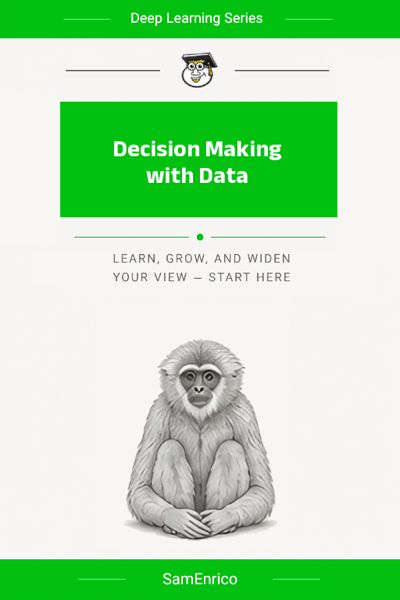
Decision Making with Data eBook
A Coursebook on Decision Making with Data
A Coursebook on Decision Making with Data
Formats
Free sample
Chapter 1: The Certainty Trap--–- Henry stepped into the conference room at 8:47 AM, coffee in hand, already certain of the answer. His e-commerce company had seen a 12% drop in conversions over the past three weeks, and the marketing team had assembled three possible explanations. Henry listened to the first proposal—a competitor’s aggressive discounting campaign—and nodded. He listened to the second—seasonal slowdown—and frowned. He didn't bother listening to the third.
"It's the new checkout flow," he announced. "I never liked that redesign. Roll it back by Friday."No one in the room checked the data. No one asked to see the A/B test results from the checkout change (which, as it turned out, showed no negative impact). No one pointed out that the competitor’s discounting campaign had started exactly one day before the conversion drop.
Henry was the Highest Paid Person in the Room, and his opinion carried the force of gravity. The checkout flow was rolled back. Conversions did not recover. Two weeks later, the competitor’s promotion ended, and conversions returned to baseline—proving that Henry had been wrong, that the data had been available all along, and that $340,000 in lost revenue had been entirely avoidable.Henry’s story is not a cautionary tale about stupidity or laziness. Henry was a smart, experienced, well-intentioned executive.
His mistake was not a lack of data. It was a lack of awareness about how his own mind works. Henry fell into what this chapter calls the Certainty Trap—the seductive, dangerous belief that you already know the answer before looking at the evidence.This book is about escaping that trap. It is about learning to make decisions with data—not as a mechanical, joyless exercise in spreadsheet-worship, but as a disciplined, practical, and surprisingly liberating way to navigate uncertainty. But before we can talk about data, we have to talk about you.
Because the biggest obstacle to better decisions is not bad data. It is your own beautifully flawed, wildly overconfident, bias-riddled human brain.The Paradox of Intuition Let’s start with a paradox. Human intuition is nothing short of miraculous. You can catch a ball without solving differential equations. You can walk into a room and instantly know whether the mood is tense or joyful.
You can glance at a face and read an emotional state in milliseconds. Your unconscious mind processes vast amounts of information in parallel, delivering rapid-fire judgments that keep you alive, socially connected, and functional in a chaotic world.Psychologists call this System 1 thinking. It is fast, automatic, emotional, and effortless. It is the voice that says “don’t trust that person” before you can articulate why. It is the feeling that a project will take three weeks, not six.
It is the snap judgment that a stock is about to rise or that a job candidate is a perfect fit. System 1 is the default operating system of the human brain, and for most of human evolutionary history, it was exactly what we needed. When a rustle in the bushes could mean a predator, the person who stopped to calculate probabilities became lunch. The person who reacted instantly survived.But there is another system. System 2 is slow, deliberate, analytical, and effortful.
It is the part of your brain that calculates a tip, checks the logic of an argument, or compares two mortgage rates. System 2 consumes energy—literally, glucose—and it tires easily. Most people cannot sustain focused System 2 thinking for more than a few hours a day. Your brain would much rather let System 1 handle things.The problem is that the modern world is not the savanna. The decisions you face as a manager, analyst, entrepreneur, or professional are not about spotting predators or choosing ripe fruit.
They are about probabilistic reasoning, causal inference, and trade-offs under uncertainty. These are tasks for which System 1 is spectacularly ill-equipped. And yet, because System 1 is fast and effortless, it constantly offers confident answers to questions it has no business answering.The paradox, then, is this: your intuition is both your greatest asset and your most dangerous liability. It is brilliant at routine, high-feedback environments where patterns are stable and consequences are immediate. It is disastrous in novel, high-stakes, statistical environments where patterns are noisy, feedback is delayed, and the cost of error is high.The key to decision-making with data is not to abandon intuition.
It is to learn when to trust it and when to override it. This chapter will give you the tools to make that distinction. But first, we need to understand exactly how System 1 leads you astray.The Rogues' Gallery of Cognitive Biases A cognitive bias is a systematic pattern of deviation from rational judgment. These are not random errors. They are predictable, replicable, and deeply ingrained features of how human minds work.
Over the past fifty years, behavioral economists and psychologists—most notably Daniel Kahneman and Amos Tversky—have catalogued dozens of these biases. This chapter focuses on the three that most frequently sabotage data-driven decisions, plus a fourth that deserves special attention because it combines several biases into a single dangerous habit.Bias 1: Confirmation Bias – The Mother of All Errors Confirmation bias is the tendency to search for, interpret, favor, and recall information that confirms your pre-existing beliefs. It is not merely that you prefer confirming evidence. It is that you actively avoid disconfirming evidence. You ask different questions.
You read different sources. You weigh the same evidence differently depending on whether it supports your position.In a classic study, Stanford researchers showed students pro-capitalism and pro-communism arguments. Students who supported capitalism rated the pro-capitalism arguments as highly persuasive and the pro-communism arguments as weak. Students who supported communism showed the opposite pattern. The same arguments, the same words, evaluated completely differently based on which side the reader was on.
Neither group realized they were biased.In business, confirmation bias shows up constantly. A product manager who believes a new feature will increase engagement will selectively notice the three users who loved it and ignore the 97 who ignored it. An executive who believes a competitor is the problem will attribute every sales dip to that competitor, even when internal data suggests a different cause. A marketing director who believes TV advertising is essential will find studies showing TV’s effectiveness and dismiss digital metrics as “noisy.”Confirmation bias is the mother of all errors because it is self-reinforcing. The more confident you become, the more you seek confirming evidence.
The more confirming evidence you find, the more confident you become. The cycle repeats until you are utterly certain and completely wrong.Bias 2: Anchoring – The Power of First Numbers Anchoring is the tendency to rely too heavily on the first piece of information you receive—the “anchor”—when making subsequent judgments. Even when the anchor is arbitrary, irrelevant, or obviously random, it exerts a gravitational pull on your thinking.The most famous demonstration of anchoring comes from Kahneman and Tversky, who asked participants to spin a wheel of fortune that landed on either 10 or 65. Then they asked: “What percentage of United Nations member states are African?” Participants who spun a 10 guessed an average of 25%. Participants who…
This is the end of the free sample. Get the eBook to keep going. Buy now
About this book
Details
- Author
- Griswold Travis
- Publisher
- SamEnrico
- Language
- English
- Genre
- Non-Fiction, Informative, Educational
- Released
- 2026-05-04
- Pages (approx.)
- 140
- Available as
- eBook, Audiobook

Read better in the ZLOADR app
Your eBooks on your phone or tablet. Sign in with your SamEnrico account and start reading.
More by Griswold Travis
 Medical Appointment AngerGriswold Travis$11.99
 Cape Town BEE Compliance GuideGriswold Travis$11.99
 Nightmare Rescripting For Nighttime Panic Attacks CourseGriswold Travis$11.99
 Bipolar And Social Rhythm TherapyGriswold Travis$11.99
 The Calorie Tracking App HandbookGriswold Travis$11.99
 The Bloodied Fields of Nördlingen: The Last Stand of the Protestant CauseGriswold Travis$11.99
 Excel Goal Seek Economics GuideGriswold Travis$12.99
 Employee vs Contractor Trap GuideGriswold Travis$12.99
 Understanding Prostaglandin Antenatal InfectionGriswold Travis$17.99
 How to Become a Optomechanical TechnicianGriswold Travis$11.99