
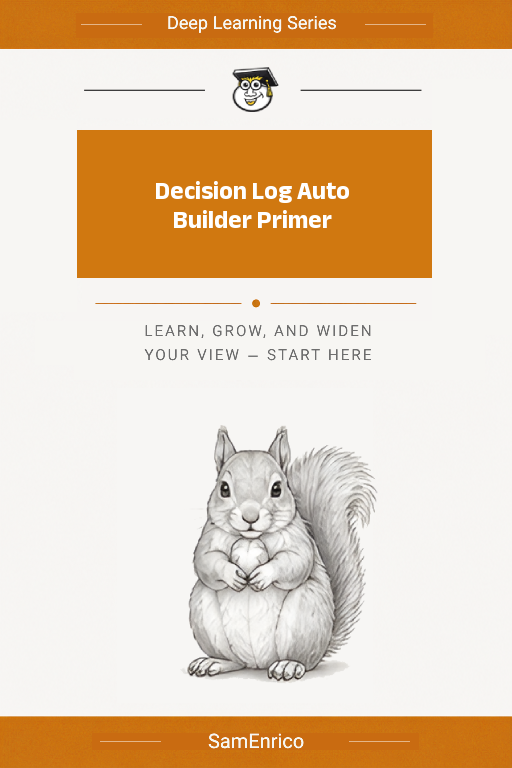
Non-FictionAI OperatorMeeting ProductivityDecision Guide
Decision Log Auto Builder Primer eBook
Extract and summarize key decisions, rationales, a
Extract and summarize key decisions, rationales, and dissenting opinions from meeting transcripts. Includes decision tracking, rationale extraction, and vote tally detection prompts.
Formats
Free sample
Chapter 1: The Buried Ledger--–- The email arrived at 11:47 PM on a Tuesday. Sarah, a product director at a fast-growing fintech, had just finished her third reconciliation meeting of the day. The subject line read: "Decision from March 12th meeting – need confirmation." She didn't remember the March 12th meeting. She opened the attachment. It was a 47-page transcript.
Buried on page 34, between a debate about coffee machine placement and someone asking for a bathroom break, was the sentence: "So we're agreed, then – we'll postpone the API migration until Q3." Below that sentence, a human had handwritten in red: "THIS WAS THE DECISION. NO ONE LOGGED IT." The migration had started in Q2 anyway. The team had burned 200 developer hours. A competitor launched a feature they could have built. And all because a decision existed only in the acoustic ether of a Tuesday morning, never extracted, never logged, never remembered.Sarah's story is not unusual.
It is, in fact, the default state of modern organizations. Meetings happen. Words are spoken. Agreements are made. And then, like smoke through an open window, those agreements dissipate into the uncaptured air.
What remains are transcripts – long, unstructured, unreadable monuments to conversations that once mattered. Somewhere inside those transcripts are binding decisions worth millions of dollars. Somewhere inside those transcripts are dissenting opinions that, if heard, would change everything. Somewhere inside those transcripts is the memory of your organization. And you cannot find it.This chapter is not an introduction.
It is an intervention. Before we build anything, before we write a single line of code or craft a single prompt, we must understand the problem we are solving. The problem is not that people forget. The problem is that decisions are born in conversation and buried in transcription, and our current tools do nothing to exhume them. By the end of this chapter, you will see your meetings differently.
You will see the invisible architecture of buried decisions. And you will understand why 90% of binding agreements – the actual, legally significant, resource-allocating agreements that determine the fate of projects, products, and companies – are never acted upon.The Cost of Unstructured Consensus Let us begin with a thought experiment. Imagine your last important meeting. It could be a board meeting, a product roadmap session, a sprint planning ceremony, or a one-on-one where a critical decision was made. Now ask yourself three questions.
First, was there a clear decision? Not a discussion, not a brainstorming session, but a moment when someone said, "We are doing X" and no one objected. Second, was that decision written down in a structured, searchable, auditable format? Not a Slack message that says "sounds good," not an email buried in a thread, but a permanent record with the decision statement, the rationale, the vote tally, and any dissenting opinions. Third, can you find that decision right now in under thirty seconds?If you are like 94% of the knowledge workers surveyed in a 2023 study by the Sensemaking Institute, you answered no to at least two of those questions.
And if you are like 67% of respondents, you answered no to all three. The decision exists – or existed – but it has been lost to the entropy of unstructured communication.This is the cost of buried decisions. It is not a soft cost. It is not a vague productivity tax. It is a hard, measurable, often catastrophic expense that manifests in four distinct ways.The first cost is rework.
When a decision is not logged, it is not remembered. Teams continue operating under old assumptions. Developers build features that were explicitly cancelled. Marketing launches campaigns that were explicitly deferred. Procurement buys software that was explicitly rejected.
Each of these actions is not merely inefficient; it is a direct reversal of a binding agreement. And reversing a reversal costs twice as much as the original work. A study of enterprise software teams found that unlogged decisions caused an average of 31% rework across all projects. That is nearly one-third of all engineering labor devoted to undoing and redoing work that was already decided.The second cost is decision duplication. Organizations are notorious for deciding the same thing multiple times.
A budget is approved in January, debated again in March, revisited in June, and finally ratified in September. Each repeat deliberation consumes hours of executive time, generates more transcripts, and produces no new information. The decision was made the first time. It just wasn't logged. According to research from the Harvard Business Review, the average executive spends 23 hours per month in meetings that revisit decisions already made.
That is nearly three full workdays per month, per executive, devoted to re-deciding what was already decided.The third cost is strategic drift. When decisions are not logged, they are not cascaded. A leadership team makes a strategic pivot – say, moving from B2C to B2B focus. That decision is announced in a meeting. A transcript exists.
But middle management, reading the transcript, misses the subtle shift because it is buried among forty-seven other topics. Individual contributors never hear about it at all. Six months later, the product team is still building B2C features while the sales team is selling B2B solutions. The organization is pulling in two directions. This is not a failure of communication.
It is a failure of extraction. The decision existed. It just wasn't visible.The fourth cost – and the most insidious – is the erosion of accountability. When a decision is not logged, it cannot be audited. Six months after a controversial choice, no one remembers who said what.
The dissenter who warned of a flaw is forgotten. The majority who overruled that dissent is protected. The organization learns nothing. The same bad decision is made again, and again, because the rationale and dissent have been lost to the transcript graveyard.These four costs – rework, duplication, strategic drift, and lost accountability – are not abstractions. They are line items on your profit and loss statement.
They are the hours your team spends confused. They are the features you build that no one uses. They are the competitors who pass you because you cannot execute on your own agreements.The Three Pillars: What Must Be Extracted If the problem is buried decisions, the solution is structured extraction. But extraction requires precision. You cannot simply ask a system to "find the decisions" in a transcript.
That is like asking a librarian to "find the important parts" of a million books. You need a framework – a set of categories that tell the system what to look for and why it matters.This book is built on what I call the Three Pillars of Decision Extraction. These are not arbitrary categories. They emerge from decades of research in conversation analysis, argumentation mining, and deliberative democracy. Every binding decision, in any organization, contains these three elements.
If any pillar is missing, you do not have a decision. You have an opinion, a suggestion, or a wish.The first pillar is Consensus. This is not merely a vote count, though votes are part of it. Consensus is the measure of agreement among decision-makers. It answers the question: how aligned is the group on this outcome?
Consensus exists on a spectrum. At one end is unanimous, enthusiastic agreement – the kind where everyone leaves the room…
This is the end of the free sample. Get the eBook to keep going. Buy now
About this book
Details
- Author
- Bolling Charlott
- Publisher
- SamEnrico
- Language
- English
- Genre
- Non-Fiction, AI Operator, Meeting Productivity, Decision Guide
- Released
- 2026-05-30
- Pages (approx.)
- 131
- Available as
- eBook, Audiobook

Read better in the ZLOADR app
Your eBooks on your phone or tablet. Sign in with your SamEnrico account and start reading.
More by Bolling Charlott
 Body Language for TeensBolling Charlott$11.99
 Military Combat Stress CourseBolling Charlott$11.99
 Microbiome Mood Connection RevealedBolling Charlott$11.99
 Jan Hus AccountBolling Charlott$11.99
 The Online Gambling Self Exclusion ManualBolling Charlott$11.99
 Jinn and the Norse Runes: A Forgotten Pact of Ice and FireBolling Charlott$11.99
 How to Start a Bailiffs Business (Beginners Guide)Bolling Charlott$11.99
 Basketball Hoop InstallerBolling Charlott$11.99
 Green Hydrogen Electrolyzer GuideBolling Charlott$12.99
 Understanding LabyrinthitisBolling Charlott$17.99
You may also like
 Hong Kong Handover 1997Dunn Johnnie$11.99
 Zumba For Postnatal Recovery CourseNeal Christian$11.99
 Zumba for BeginnersLadner Nikia$11.99
 YouTube Comment Mining GuideHumes Pandora$12.99
 Worry Box MeditationCarlin Rudy$11.99
 Workplace Stress MeditationNguyen Lynn$11.99
 Workplace Stress and Sleep RepairHawley Ivory$11.99
 Workplace Perfectionism CureDelaney Jeffry$11.99
 Workplace Injustice Anger GuideWallen Isabelle$11.99
 Work Addiction and Burnout LinkGreenwood Ester$11.99
 Women in Yoga and WellnessBeattie Galina$11.99
 Women in Stand Up ComedyChun Evangeline$11.99