

Non-FictionProfessional's Cheat Sheet
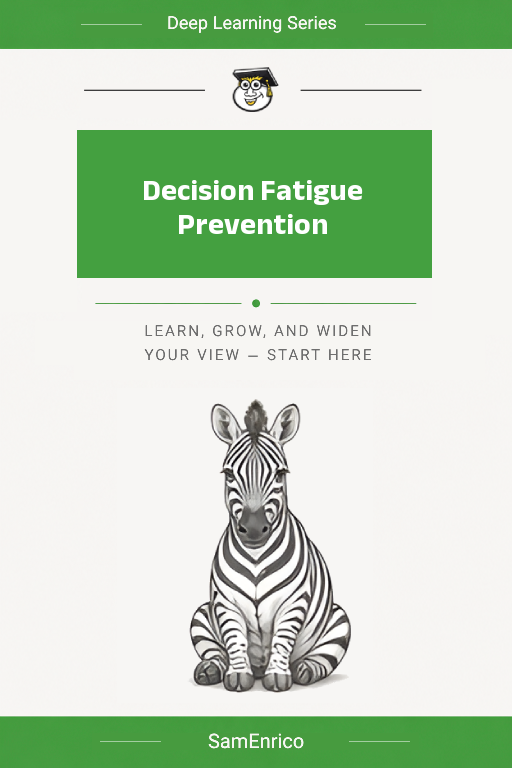
Decision Fatigue Prevention eBook
Batch similar decisions together to preserve menta
by Hutson Illa
Batch similar decisions together to preserve mental energy for what matters.
Formats
Free sample
Chapter 1: The Choice Leech--You are exhausted not because you lack discipline, but because you have been robbed.The thief has no face and leaves no fingerprints. It does not break into your home at night or pick your pocket on a crowded subway. Instead, it works in broad daylight, with your full permission, while you mistake its presence for normalcy. This thief is called the Choice Leech, and it has been feeding on your mental energy since the moment you woke up this morning.Before you finished brushing your teeth, the Choice Leech had already taken its first bite. Should you brush for two minutes or three?
Should you floss now or after? Should you replace the toothbrush head or wait another week? These micro-decisions seem insignificant in isolation. That is precisely how the Leech survives. A single drop of blood is not fatal.
But a thousand drops, day after day, year after year, will drain a body completely.The Choice Leech is not a literal parasite, of course. It is a name for something very real: the relentless accumulation of trivial decisions that modern life forces upon you without your consent. Every notification, every open browser tab, every "just one more email," every moment of indecision about what to eat, what to wear, what to watch, what to reply, what to prioritize, what to ignore—each one is a tiny incision. Together, they bleed you dry.This chapter is an intervention. Before we can solve decision fatigue, we must first name the enemy.
We must understand how the Leech operates, why it has grown so powerful in the digital age, and most importantly, how to recognize its presence in your own daily life. By the end of this chapter, you will never look at your morning routine, your email inbox, or your grocery store aisle the same way again.The 127 Decision Problem Let us begin with a simple exercise. Think back to yesterday. Starting from the moment your alarm went off, count every decision you made before lunch. Not the big ones—not "should I quit my job?" or "is this relationship working?" Just the small ones.
The mundane ones. The ones you do not even remember making.Did you decide when to wake up or when to hit snooze? Did you decide what to wear, what to eat, what to drink, what to listen to, what to read first? Did you decide which route to drive or train to take? Did you decide which emails to open and which to ignore?
Did you decide which task to start first at work? Did you decide which meetings to attend and which to decline? Did you decide what to say in that Slack message, that text reply, that quick comment to a colleague?Most people stop counting somewhere between thirty and fifty decisions before noon. But the true number is much higher. Researchers who have tracked knowledge workers using experience sampling methods—buzzing participants at random intervals to ask "what are you deciding right now?"—have found that the average professional makes approximately 127 conscious decisions per day that require active deliberation.
That number does not include the thousands of unconscious micro-decisions your brain processes automatically, like adjusting your posture or filtering background noise.One hundred and twenty-seven decisions. Each one requiring a tiny fraction of your finite cognitive energy. None of them, by themselves, particularly exhausting. But taken together, they represent a massive, unacknowledged tax on your mental capacity.Here is the problem that most productivity advice gets wrong: Willpower is not a renewable resource that grows stronger with use. It is a depletable resource that runs out.
Every decision you make, from the trivial to the profound, draws from the same well. By three o'clock in the afternoon, that well is nearly dry. The choices you make at four o'clock—about strategy, about creativity, about the people you love—are made by a brain that has already spent its best energy on deciding what to have for lunch and whether to answer that spam email.The Choice Leech thrives on this ignorance. It needs you to believe that small decisions do not matter, that willpower is infinite, that exhaustion is just laziness in disguise. Every one of those beliefs is false.
And every one of those false beliefs keeps you trapped.The Grocery Store Aisle Experiment In the late 1990s, a young graduate student named Sheena Iyengar conducted an experiment that would change how psychologists understand choice. She set up a tasting booth at a gourmet grocery store in Menlo Park, California. On some days, she displayed twenty-four varieties of jam. On other days, she displayed only six. Shoppers who passed by could taste as many samples as they wanted and received a coupon for one dollar off any jar they chose to buy.The results were shocking.
The booth with twenty-four jams attracted far more attention. Shoppers stopped, tasted, browsed. Nearly sixty percent of people who passed the large display paused to sample. But when it came time to buy, only three percent of those shoppers actually used their coupon. The booth with six jams attracted fewer initial glances—only forty percent of shoppers stopped.
Yet of those, nearly thirty percent made a purchase.More choices drew people in. Fewer choices closed the sale. The paradox is that we think we want unlimited options. We believe that more choice equals more freedom equals more satisfaction. But the research tells a different story.
Every additional option does not liberate you; it exhausts you. Your brain must evaluate each new possibility, compare it against the others, and make a judgment about whether it is better than what you already have. This happens even when you are not consciously deliberating. Your brain processes every jam jar, every salad dressing, every streaming option, every email subject line in your peripheral vision. The energy cost is real, and it adds up.Barry Schwartz, the psychologist who popularized this research in his book The Paradox of Choice, coined two terms that will be essential throughout this book: maximizers and satisficers.
Maximizers are people who need to examine every possible option to ensure they make the best possible choice. They read every review, compare every price, consider every alternative. By objective measures, maximizers do make better choices—they buy higher-rated products, get better deals, select more prestigious options. But they are also chronically less happy, more anxious, and more fatigued than their satisficing counterparts.Satisficers do something different. They set a threshold for "good enough" and choose the first option that meets it.
They do not need to see the other twenty-three jams once they have found one that tastes good and costs within their budget. They are not settling for mediocrity; they are strategically conserving their cognitive energy for decisions that actually matter. The satisficer knows that the difference between the sixth-best jam and the twenty-fourth-best jam is too small to justify the mental cost of finding it.The Choice Leech loves maximizers. Every extra option you consider is a meal for the Leech. Every hour you spend reading reviews, comparing prices, wondering "what if there is something better out there" is blood in the…
This is the end of the free sample. Get the eBook to keep going. Buy now
About this book
Details
- Author
- Hutson Illa
- Publisher
- SamEnrico
- Language
- English
- Genre
- Non-Fiction, Professional's Cheat Sheet
- Released
- 2026-05-30
- Pages (approx.)
- 127
- Available as
- eBook, Audiobook

Read better in the ZLOADR app
Your eBooks on your phone or tablet. Sign in with your SamEnrico account and start reading.
More by Hutson Illa
 Probiotics Decoded GuideHutson Illa$11.99
 Data Breach Apology Email ScriptsHutson Illa$11.99
 The Monk Who Died SmilingHutson Illa$11.99
 Acupuncture For Chemo BrainHutson Illa$11.99
 The TM Silent Retreat GuideHutson Illa$11.99
 Secular AA AlternativesHutson Illa$11.99
 Strength Training Anatomy GuideHutson Illa$11.99
 James BakerHutson Illa$11.99
 Product Team PressureHutson Illa$11.99
 The Alchemist of Padua: The Healing Hands of Girolamo FabrizioHutson Illa$11.99
 The Lost Voyages of the Chinese Treasure Fleet: Zheng He's Forgotten OdysseyHutson Illa$11.99
 Midnight in the Mediterranean: The Unsolved Murder of the Titanic’s TwinHutson Illa$11.99
You may also like
 Hong Kong Handover 1997Dunn Johnnie$11.99
 Zumba For Postnatal Recovery CourseNeal Christian$11.99
 Zumba for BeginnersLadner Nikia$11.99
 YouTube Comment Mining GuideHumes Pandora$12.99
 Worry Box MeditationCarlin Rudy$11.99
 Workplace Stress MeditationNguyen Lynn$11.99
 Workplace Stress and Sleep RepairHawley Ivory$11.99
 Workplace Perfectionism CureDelaney Jeffry$11.99
 Workplace Injustice Anger GuideWallen Isabelle$11.99
 Work Addiction and Burnout LinkGreenwood Ester$11.99
 Women in Yoga and WellnessBeattie Galina$11.99
 Women in Stand Up ComedyChun Evangeline$11.99