
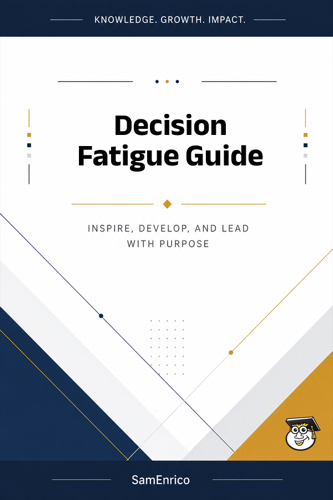
Non-FictionSelf-HelpDecision Making
Decision Fatigue Guide eBook
Simplifying choices to preserve mental energy for
by Elam Lanita
Simplifying choices to preserve mental energy for caregiving.
Formats
Free sample
Chapter 1: The 2:00 PM Collapse--–- The first time it happened, you thought you were getting sick. The second time, you thought you were losing your mind. The third time, you sat in your car in the pharmacy parking lot, engine running, air conditioning blasting, staring at nothing, because someone asked you a question as simple as “What do you want for dinner?” and you could not answer. Not because you didn’t have preferences. Not because you were hungry.
But because your brain had simply... stopped.This is not a character flaw. This is not burnout in the way your well-meaning friends mean when they say “You need a vacation.” This is a predictable, measurable, biological phenomenon called decision fatigue, and it is the single most under-recognized threat to every family caregiver in America today.Before we fix it—before we build systems, routines, and permission slips—you need to understand what is actually happening inside your skull. Because right now, you probably believe something that is not true. You believe that if you were stronger, smarter, or more organized, you wouldn’t feel this way.
You believe that other caregivers are handling it better. You believe that the exhaustion is your fault.It is not. And this chapter is going to prove it to you.The Anatomy of a Simple Question Let me describe a scene. It is 2:00 PM. You have been awake since 5:30 AM.
In the last eight and a half hours, you have:Decided whether to wake your loved one or let them sleep (and calculated the medication schedule against that decision)Decided which socks would not irritate their skin Decided how to phrase a question about bowel movements without humiliating them Decided whether the cough you heard was “call the doctor” bad or “watch and wait” bad Decided which pharmacy had the prescription ready Decided whether to fight the traffic or take the longer back road Decided what to say to the receptionist who looked at you with pity Decided how much of the insurance explanation to actually believe Decided whether to correct the nurse who used the wrong pronoun Decided to skip your own breakfast (that was a decision, even if it felt like passive surrender)Decided to postpone calling your sister back (again)Decided to ignore the headache behind your right eye Decided to keep smiling even though your jaw ached from the effort By my count, that is approximately 47 significant decisions before lunch. And then someone asks you, “What do you want for dinner?”That question is not about food. That question is the 48th decision. And your brain, which has been running a marathon since dawn, simply refuses to run another step.This is decision fatigue.The Science You Need to Know Decision fatigue was first named and studied by social psychologist Roy Baumeister in the late 1990s and early 2000s. His research revealed something counterintuitive: making decisions uses the same mental resources as exerting self-control.
Each choice you make—even small, trivial ones—drains a finite reservoir of cognitive energy. When that reservoir runs low, your brain starts taking shortcuts. And those shortcuts are rarely good ones.Here is what decision fatigue looks like in real time:Impulsivity. You buy the expensive prepared meal at the grocery store checkout because you cannot bear to calculate unit prices. You agree to a treatment plan you do not fully understand because explaining your confusion would require more words than you have left.
You snap at your loved one over something tiny—a dropped fork, a repeated question—and then hate yourself for it.Avoidance. You put off scheduling the specialist appointment. You do not open the insurance letter. You leave the discharge papers in the “to file” pile for the third week in a row. Avoidance feels like rest, but it is not.
It is your fatigued brain protecting itself from more decisions. The problem is that avoided decisions do not disappear. They compound. They grow fangs.Freezing. This is the 2:00 PM paralysis.
You stare at the menu. You stare at the pharmacy options. You stare at the blank line on the form labeled “Emergency Contact” because you genuinely cannot decide whether to list yourself (and risk missing the call) or your unreliable brother (and risk him ignoring it). Freezing is not laziness. Freezing is your prefrontal cortex waving a white flag.Reversion to default.
When you are too tired to choose, you choose whatever was chosen before. This is why exhausted caregivers order the same takeout, watch the same television show, and give the same non-answer to every question (“Whatever you want”). Defaults are not choices. Defaults are the absence of choice disguised as preference.Here is what Baumeister discovered that changed everything: the order of your decisions matters. The first decision you make today will be your best.
The tenth will be worse. The thirtieth will be significantly impaired. And the forty-eighth—the dinner question at 2:00 PM—will be made by a brain that is functionally drunk on depletion.This is not a metaphor. Studies have shown that decision-fatigued individuals perform similarly on cognitive tests to people with a blood alcohol level of 0.05 percent. You are not tired.
You are mentally intoxicated. And no one should be making caregiving decisions in that state.A Note on the Science (Updated for 2026)The original ego depletion research has been refined over the past decade. Early studies suggested that decision fatigue was directly tied to blood glucose—that making choices literally burned sugar in your brain, and eating restored your willpower. More recent and larger replication studies have complicated this picture. Glucose plays a role, but it is not the simple fuel gauge early researchers believed.
The current consensus in cognitive psychology is that decision fatigue is best understood as a cognitive load phenomenon.Think of your working memory as a desk. Every decision puts a file on that desk. Small decisions are index cards. Large decisions are thick binders. Eventually, the desk is so covered in files that you cannot find anything, cannot see the surface, cannot do the work of actually caring.
Decision fatigue is not running out of fuel. Decision fatigue is running out of desk space.This distinction matters for two reasons. First, it means eating a candy bar will not fix you (though proper nutrition helps overall cognitive function). Second, it means the solution is not more energy—it is fewer files on the desk. You cannot willpower your way out of a cluttered workspace.
You have to remove decisions entirely.That is what this entire book is about. But first, you need to understand why caregiving is uniquely devastating to your decision-making capacity. Because caregiving is not regular busyness. And if I treat it like it is, these strategies will fail you.Why Caregiving Is Different from Everything Else I want you to imagine two people. The first is a corporate executive.
She makes decisions about budgets, personnel, and strategy. She has a team of assistants, a calendar managed by someone else, and a salary that says her time is valuable. When she finishes a difficult decision, she closes her laptop and walks away. The decision does not…
This is the end of the free sample. Get the eBook to keep going. Buy now
About this book
Details
- Author
- Elam Lanita
- Publisher
- SamEnrico
- Language
- English
- Genre
- Non-Fiction, Self-Help, Decision Making
- Released
- 2026-06-07
- Pages (approx.)
- 149
- Available as
- eBook, Audiobook

Read better in the ZLOADR app
Your eBooks on your phone or tablet. Sign in with your SamEnrico account and start reading.
More by Elam Lanita
 Hypnotic Metaphor Language GuideElam Lanita$11.99
 Networking for Minorities in TechElam Lanita$11.99
 Menstrual Health NonBinary GuideElam Lanita$11.99
 Grade Pressure Relief CourseElam Lanita$11.99
 The Silent Plague: How Ancient India Unlocked the Secrets of GermsElam Lanita$11.99
 Laughing Shadows: The Carnival’s Last ClownElam Lanita$11.99
 Understanding Ectodermal Dysplasia Adrenal CystElam Lanita$17.99
 Indian Data Breach GuideElam Lanita$12.99
 Voiceover Cold Email ScriptsElam Lanita$12.99
 Database DeveloperElam Lanita$11.99
 How to Become a Car-dumper OperatorElam Lanita$11.99
You may also like
 Hong Kong Handover 1997Dunn Johnnie$11.99
 Zumba For Postnatal Recovery CourseNeal Christian$11.99
 Zumba for BeginnersLadner Nikia$11.99
 YouTube Comment Mining GuideHumes Pandora$12.99
 Worry Box MeditationCarlin Rudy$11.99
 Workplace Stress MeditationNguyen Lynn$11.99
 Workplace Stress and Sleep RepairHawley Ivory$11.99
 Workplace Perfectionism CureDelaney Jeffry$11.99
 Workplace Injustice Anger GuideWallen Isabelle$11.99
 Work Addiction and Burnout LinkGreenwood Ester$11.99
 Women in Yoga and WellnessBeattie Galina$11.99
 Women in Stand Up ComedyChun Evangeline$11.99