
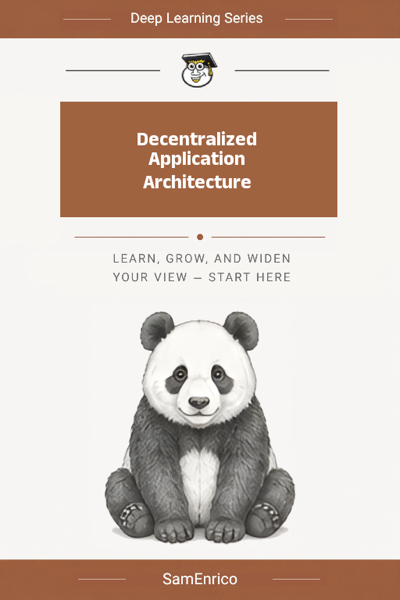
Decentralized Application Architecture Audiobook
A Coursebook on Decentralized Application Architec
A Coursebook on Decentralized Application Architecture
Formats
Free sample
Chapter 1: The Trust Inversion--The most dangerous assumption in software architecture is also the most invisible: the assumption that the server you talk to today will belong to the same people tomorrow, that it will follow the same rules, that it will not one day decide that your data is its product.Most developers never question this assumption because they have never seen it break. They have built careers on top of it. They have pushed code to production assuming that the database will always be there, that the API terms will not change overnight, that the company hosting their users' photos will not go bankrupt and delete everything. These are not technical guarantees. They are social contracts, and social contracts can be revoked.I learned this the hard way in 2017.
I had built a small but thriving community platform for independent bookstores. The idea was simple: local bookstores could list their events, readers could discover readings, and everyone could discuss books in forums. I built it on a standard Web2 stack: React frontend, Node backend, Postgre SQL database, all hosted on AWS. It cost me about $200 a month to run, and I had fifteen hundred bookstores using it. The platform made no money, but it made me happy.Then Amazon changed its affiliate API terms.
Overnight, the revenue stream that funded the platform's server costs disappeared. I tried to adapt. I added a small monthly fee for bookstores. Most of them left. I tried to add advertising.
Readers complained. Within six months, the platform was generating 40amonthandcosting40 a month and costing 40amonthandcosting200. I shut it down. The bookstores that had built their event listings on my platform lost years of historical data. Readers lost their discussion threads.
No one had done anything malicious. No one had broken any laws. But the platform was gone, and so was their data.That experience taught me something that no computer science course had ever mentioned: in centralized systems, the user does not own their data. The platform owner does. The user's ability to access their own information is a privilege granted by the platform, not a right enforced by the architecture.
And privileges can be revoked.Web3 did not invent decentralization. Bit Torrent had decentralized file sharing in 2001. Bitcoin proved decentralized value transfer in 2009. But it was Ethereum, launched in 2015, that introduced the concept of a decentralized application—a program that runs…
This is the end of the free sample. Get the Audiobook to keep going. Buy now
About this book
Details
- Author
- Pham Hortensia
- Publisher
- SamEnrico
- Language
- English
- Genre
- Non-Fiction, Informative, Educational
- Released
- 2026-05-09
- Pages (approx.)
- 121
- Available as
- eBook, Audiobook

Listen in the VoxFlicks app
Audiobooks and audio dramas wherever you go. Sign in with your SamEnrico account and press play.
More by Pham Hortensia
 Tech Imposter SyndromePham Hortensia$11.99
 Student Grit GuidePham Hortensia$11.99
 Dream Safe Container PracticePham Hortensia$11.99
 Gaming Disorder Diagnostic WorkbookPham Hortensia$11.99
 Follower Count Self Worth GuidePham Hortensia$11.99
 Financial Stress And Eating Disorders GuidePham Hortensia$11.99
 The Immunization Record KeeperPham Hortensia$11.99
 The Move and New School TraumaPham Hortensia$11.99
 ER Doctor Stress ProtocolPham Hortensia$11.99
 The Secret Sauce: How a College Dropout Built a Burger EmpirePham Hortensia$11.99
 The Invisible Network: How a Teen Hacker Exposed AT&T’s Dark SecretsPham Hortensia$11.99
 Quetzalcoatl’s Forbidden Flight: The Serpent God’s ExilePham Hortensia$11.99