
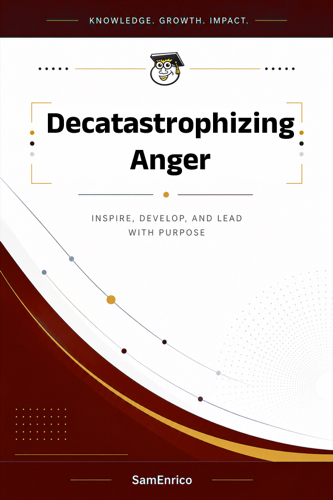
Non-FictionSelf-Help / Decatastrophizing
Decatastrophizing Anger eBook
Reduces worst-case scenario thinking that fuels ex
by Paul Rodney
Reduces worst-case scenario thinking that fuels extreme anger.
Formats
Free sample
Chapter 1: The Matchstick Lie...--–- The first time Marcus threw something in anger, he was seven years old. It was a plastic truck, hurled across the living room because his older brother had changed the television channel without asking. The truck shattered a ceramic lamp that had belonged to his grandmother. His mother screamed. His father came home early from work.
Marcus spent the evening in his room, convinced he was a monster. Thirty years later, as a newly certified anger management coach, Marcus would tell this story to every single client who walked through his door—not as an admission of failure, but as proof of a radical idea: the explosion was never the beginning.The common cultural narrative about anger is seductive in its simplicity. You are going about your day, feeling fine, and then—snap—something triggers you. A rude comment. A spilled coffee.
A partner who forgot to take out the trash. And suddenly, you are not fine. You are a volcano, erupting without warning, leaving ash and regret in your wake. This story is called the "Explosion Narrative," and it is the most expensive lie most people will ever believe.The Explosion Narrative does three things, all of them damaging. First, it absolves you of responsibility.
If anger is a sudden, uncontrollable eruption, then you are merely a victim of your own biochemistry. You cannot be blamed for a volcano. Second, it traps you in shame. Because if anger is an explosion, then every time you get angry, you have failed at being a calm, rational human being. And third, it blinds you to the actual cause.
By focusing all your attention on the final trigger—the match that lit the fuse—you ignore the long trail of kindling that has been accumulating for hours, days, or even years.This chapter dismantles the Explosion Narrative. It introduces a concept that will serve as the backbone for everything that follows: the Matchstick Fallacy. And it gives you your first and most essential tool—the skill of tracing your anger backward, from the explosion to the first whisper of catastrophe.If you master only one thing from this book, master this: anger is never sudden. It is always the final frame of a long movie. And once you learn to rewind that movie, you gain the power to change the ending.The Matchstick Fallacy: Why You Blame the Wrong Thing Let us begin with a simple experiment.
Think of the last time you lost your temper. Not a minor irritation—a real explosion. The kind where you said something you regretted, or slammed a door, or stormed out of a room. Got it? Now answer this question: what caused it?Most people answer with the final trigger.
"My partner made a sarcastic comment about my cooking." "My child spilled juice on the carpet five minutes before guests arrived." "A driver cut me off on the highway." "My boss sent a passive-aggressive email."These are matches. Small, fleeting, often trivial events. And they are almost never the true cause of the explosion.The Matchstick Fallacy is the cognitive error of mistaking the final trigger for the actual cause. It is called a fallacy because it is logically flawed, but more importantly, it is practically useless. If you believe the spilled juice caused your rage, then the only solution is to prevent spilled juice—which is impossible.
If you believe the sarcastic comment caused your explosion, then the only solution is to control your partner's mouth—which is both impossible and a recipe for relationship disaster.The truth is more inconvenient but far more empowering. The match—the spilled juice, the rude comment, the slow driver—is merely the last in a long chain of events. Before the match struck, there was kindling. Accumulated stress. Unmet expectations.
Physical exhaustion. And buried beneath the kindling, there was a catastrophic prediction—a quiet, often unconscious whisper from your brain that said, "This is going to be a disaster."Consider Sarah, a thirty-four-year-old marketing director who came to coaching after screaming at her nine-year-old daughter for forgetting her homework folder. Sarah was convinced she was a terrible mother with an uncontrollable temper. When I asked her to trace her anger backward, here is what she found:The explosion happened at 7:45 AM when her daughter said, "I left my folder at school." That was the match.But at 7:30 AM, Sarah had realized she was going to be late for an important presentation. At 7:00 AM, she had spilled coffee on her white blouse and had to change.
At 6:30 AM, she had woken up to a text from her boss asking for a report she had not yet finished. At 10:00 PM the night before, she had gone to bed later than usual because she was anxious about the presentation. And at 8:00 PM the previous evening, her husband had made an offhand comment about her "always being stressed," which she had interpreted as criticism.The kindling was everywhere. The match was a nine-year-old child being a nine-year-old child.When Sarah saw this timeline, she did not excuse her yelling. But she stopped believing she was a monster.
She saw, for the first time, that her anger was not a sudden explosion—it was the predictable outcome of a long-burning fire she had not noticed she was feeding.The Anatomy of a Catastrophic Prediction At the heart of every anger explosion is a prediction. Not a conscious, deliberate prediction—more like a reflex. Your brain, in milliseconds, looks at the present moment and asks: "What is about to happen?" And then it answers.For people who struggle with catastrophic anger, that answer is almost always the same: "Something terrible is about to happen, and I cannot stop it."This is the catastrophic prediction. It is the engine of the entire anger machine. And it usually operates below the level of conscious awareness.Let me give you an example.
James, a forty-two-year-old software engineer, came to coaching because he had thrown his laptop across his home office after a video call froze for the third time. When I asked him what he was thinking immediately before he threw the laptop, he said, "Nothing. I just snapped."But when we traced the anger backward, we found the catastrophic prediction hiding in plain sight. The video call froze at 2:15 PM. At 2:14 PM, James had been presenting a project to his entire team, including his boss.
At 2:13 PM, he had noticed his boss looked distracted. At 2:10 PM, he had received an email from a client complaining about a minor delay. And at 8:00 AM that morning, his wife had mentioned that their savings were lower than expected.The catastrophic prediction, voiced aloud for the first time, sounded like this: "If this video call freezes, my boss will think I am incompetent. If my boss thinks I am incompetent, I will not get the promotion. If I do not get the promotion, we will not be able to afford the house repairs.
If we cannot afford the house repairs, my family will be unsafe. If my family is unsafe, I have failed as a husband and father."This entire chain of reasoning happened…
This is the end of the free sample. Get the eBook to keep going. Buy now
About this book
Details
- Author
- Paul Rodney
- Publisher
- SamEnrico
- Language
- English
- Genre
- Non-Fiction, Self-Help / Decatastrophizing
- Released
- 2026-06-07
- Pages (approx.)
- 148
- Available as
- eBook, Audiobook

Read better in the ZLOADR app
Your eBooks on your phone or tablet. Sign in with your SamEnrico account and start reading.
More by Paul Rodney
 Walking Everyday GuidePaul Rodney$11.99
 The Davi Kopenawa BiographyPaul Rodney$11.99
 Migraine Aura MeditationPaul Rodney$11.99
 Random Stimulus IdeationPaul Rodney$11.99
 Gut Brain Axis And TraumaPaul Rodney$11.99
 Student Procrastination GuidePaul Rodney$11.99
 Sports Betting CompulsionPaul Rodney$11.99
 The Raven Mockers: Cherokee Spirits of the DyingPaul Rodney$11.99
 The Cairo Cipher: Decoding Egypt's First Serial KillerPaul Rodney$11.99
 Promotion Pitch Email TemplatesPaul Rodney$12.99
 Your First 30 Days Finding a Co-FounderPaul Rodney$12.99
 The Essential Guide to VocalPaul Rodney$11.99
You may also like
 Hong Kong Handover 1997Dunn Johnnie$11.99
 Zumba For Postnatal Recovery CourseNeal Christian$11.99
 Zumba for BeginnersLadner Nikia$11.99
 YouTube Comment Mining GuideHumes Pandora$12.99
 Worry Box MeditationCarlin Rudy$11.99
 Workplace Stress MeditationNguyen Lynn$11.99
 Workplace Stress and Sleep RepairHawley Ivory$11.99
 Workplace Perfectionism CureDelaney Jeffry$11.99
 Workplace Injustice Anger GuideWallen Isabelle$11.99
 Work Addiction and Burnout LinkGreenwood Ester$11.99
 Women in Yoga and WellnessBeattie Galina$11.99
 Women in Stand Up ComedyChun Evangeline$11.99