
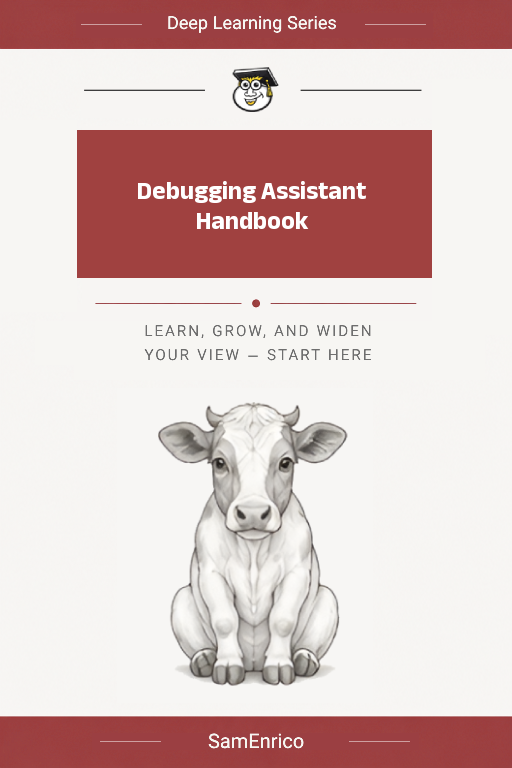
Non-FictionAI OperatorSoftware CraftDebug Guide
Debugging Assistant Handbook eBook
Use AI to trace errors, explain stack traces, and
Use AI to trace errors, explain stack traces, and suggest fixes for production bugs. Includes log analysis, root cause prompts, and fix verification test generation.
Formats
Free sample
Chapter 1: The Spelunking Crisis--–- It is 2:47 AM on a Friday. You are the on-call engineer for a payment processing system that handles $10 million in daily transactions. Your phone buzzes with a Pager Duty alert: error rate has spiked to 12% across the US-East region. You open Datadog. You see a wall of red.
You see stack traces you do not recognize. You see logs from twelve different microservices, each with its own timestamp format, each with its own idea of what constitutes a useful error message. You grep for “ERROR”. You find 847 results in the last five minutes alone. You scroll.
You squint. You suspect something about a connection pool, or maybe a recent deploy, or maybe that library update you approved yesterday. You have no idea. You are not stupid. You are not lazy.
You are simply drowning in data that is abundant in volume but scarce in signal.This is the spelunking crisis. And it is getting worse.Welcome to the Debugging Assistant Handbook. If you opened this book, you already know the pain I just described. You have spent hours—maybe days—chasing a bug that turned out to be a single off-by-one error, or a misconfigured timeout, or a null value that should never have been null. You have felt the unique humiliation of finally discovering the root cause was something you could have fixed in thirty seconds if only you had known where to look.
You have also felt the creeping fear that observability tools, despite their exponential growth, are not actually making you faster at debugging. They are making you faster at collecting evidence you do not have time to analyze.This book exists because that paradox demands a solution. The solution is not another dashboard. It is not another log aggregation platform. It is not another flame graph.
The solution is an AI-powered debugging assistant—a system that traces what happened, explains why it happened, and verifies that your fix actually works. This assistant does not replace your judgment. It amplifies it. It turns hours of log spelunking into minutes of automated root cause analysis. It reads stack traces the way a senior engineer reads a map.
It correlates logs across services the way a detective correlates witness statements. And it does all of this while staying firmly under your control.But before we build that assistant, we must understand why traditional debugging has failed. We must understand the crisis we are in. And we must commit to a new way of thinking about production failures—one where minimal evidence, not maximal data, becomes the goal.The Debugging Paradox: More Tools, Slower Resolution Let us start with a uncomfortable fact. The past decade has seen an explosion in observability tooling.
Datadog, Honeycomb, Sentry, Splunk, New Relic, Prometheus, Grafana, Jaeger, Tempo—the list grows longer every year. These tools are genuinely powerful. They collect more data than any human could reasonably process. They visualize request flows across distributed systems. They alert you the millisecond something goes wrong.
And yet, according to multiple industry studies including Google’s DORA reports and Puppet’s State of Dev Ops surveys, Mean Time To Resolution (MTTR) for production incidents has stagnated or increased at many organizations. We have more data. We are slower at using it.Why? Because the bottleneck has shifted. Ten years ago, the bottleneck was collecting the data.
You had to grep log files on individual servers. You had to SSH into machines and hope the logs were still there. Today, the bottleneck is cognitive. You have the data. You have too much of it.
The challenge is no longer acquisition. The challenge is sense-making.Consider what happens during a typical production incident. Your monitoring system fires an alert. You open your observability platform. You see a spike in error rates.
You see a stack trace. You see a trace ID. You click on the trace ID. You see a list of spans: service A called service B, which called service C, which called a database, which returned a timeout. You look at the logs for service C.
You see a connection pool exhaustion error. You check recent deploys. You find that someone increased the connection pool size yesterday. That seems counterintuitive—larger pool should mean fewer timeouts, not more. You spend twenty minutes being confused.
Then you realize the configuration change actually reduced the pool size because the configuration key was misinterpreted. The pool went from fifty to ten. You fix it. You deploy. You go back to sleep at 4:30 AM.
The whole process took two hours. The actual root cause was a single line change in a YAML file. The fix took ten seconds. The other one hour and fifty-nine minutes were spent finding the needle in the haystack.This is not an anomaly. This is the modal debugging experience for modern distributed systems.The Limits of Traditional Debugging Techniques Traditional debugging approaches fall into three categories, each with fatal flaws in production environments.Manual Log Analysis is what most engineers do by default.
You grep for error patterns. You look at timestamps. You correlate across services manually. This works when the system is simple—one service, linear request flow, low volume. In a microservices architecture with dozens or hundreds of services, manual log analysis breaks because the cognitive load exceeds human working memory.
You cannot keep twelve different log streams in your head simultaneously. You cannot manually correlate timestamps when services have clock skew. You cannot spot the pattern when the failure is intermittent and the logs are flooded with noise.Static Stack Trace Reading is the second common approach. You look at the exception message. You look at the line number.
You open the code. You read around that line. This works for crashes that are deterministic and local to a single function. It fails catastrophically for distributed failures where the exception propagates across service boundaries, or for concurrency bugs where the stack trace shows the symptom but the root cause is in a completely different thread or goroutine. A stack trace tells you where the program died.
It does not tell you why it got there.Tribal Knowledge is the third, and perhaps most dangerous, debugging technique. “Oh, that error? Jenny knows how to fix that.” “Check the runbook. Bob wrote it three years ago.” This knowledge is invisible, fragile, and creates bus-factor risks. When Jenny goes on vacation or Bob leaves the company, the knowledge leaves with them.
Tribal knowledge also resists scaling. What works for a team of five breaks for a team of fifty. What works for a single service breaks for a mesh of one hundred services.None of these techniques work reliably in production. They are all reactive, manual, and limited by human cognition. They are also the only techniques most engineers know.
Debugging is taught by osmosis, not by curriculum. You learn by breaking things and fixing them. You learn by suffering through 2 AM incidents. You learn by making mistakes. This is an apprenticeship model that does not scale.What is possible?
Imagine an alternative. Imagine you receive the same 2:47 AM alert. But instead of opening twelve log streams, you ask a question…
This is the end of the free sample. Get the eBook to keep going. Buy now
About this book
Details
- Author
- Gonsalves Thad
- Publisher
- SamEnrico
- Language
- English
- Genre
- Non-Fiction, AI Operator, Software Craft, Debug Guide
- Released
- 2026-06-01
- Pages (approx.)
- 148
- Available as
- eBook, Audiobook

Read better in the ZLOADR app
Your eBooks on your phone or tablet. Sign in with your SamEnrico account and start reading.
More by Gonsalves Thad
 Mindful Checklist MBSR Daily LogGonsalves Thad$11.99
 Daniel Prophet AccountGonsalves Thad$11.99
 Recovery Support Group GuideGonsalves Thad$11.99
 Workplace Stress for Social WorkersGonsalves Thad$11.99
 The Cognitive Restructuring for Body ImageGonsalves Thad$11.99
 Wayfinding Whispers: The Lost Voyage of the Navigators' GhostsGonsalves Thad$11.99
 Understanding Kohler DiseaseGonsalves Thad$17.99
 SaaS in Logistics GuideGonsalves Thad$12.99
 AirsoftingGonsalves Thad$11.99
 How to Start a Hobby in ShootingGonsalves Thad$11.99
You may also like
 Hong Kong Handover 1997Dunn Johnnie$11.99
 Zumba For Postnatal Recovery CourseNeal Christian$11.99
 Zumba for BeginnersLadner Nikia$11.99
 YouTube Comment Mining GuideHumes Pandora$12.99
 Worry Box MeditationCarlin Rudy$11.99
 Workplace Stress MeditationNguyen Lynn$11.99
 Workplace Stress and Sleep RepairHawley Ivory$11.99
 Workplace Perfectionism CureDelaney Jeffry$11.99
 Workplace Injustice Anger GuideWallen Isabelle$11.99
 Work Addiction and Burnout LinkGreenwood Ester$11.99
 Women in Yoga and WellnessBeattie Galina$11.99
 Women in Stand Up ComedyChun Evangeline$11.99