
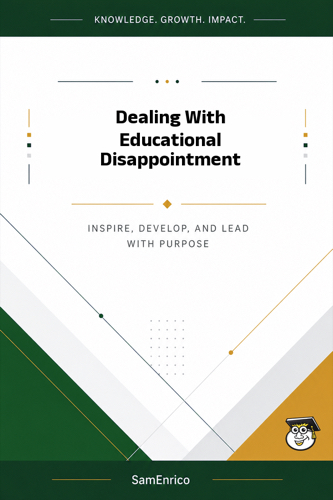
Non-FictionSelf-HelpAcademic Psychology
Dealing With Educational Disappointment eBook
When degrees, grades, or academic paths don't work
by Teal Jae
When degrees, grades, or academic paths don't work out.
Formats
Free sample
Chapter 1: The Silent Setup--–- Every educational disappointment begins with a promise you didn’t know you were given. The promise whispers that if you follow the path—good grades, the right school, the proper degree—the door will open. It whispers that failure is a detour, not a destination. It whispers that your worth can be measured in credit hours and grade points, and that the system is designed for people exactly like you.The promise is a lie.Not because the system is malicious. Not because your parents or teachers intended to deceive you.
But because the promise was never actually a promise at all. It was an assumption, unspoken and unexamined, passed down through generations of families who believed that education was the great equalizer, the ladder out of poverty, the ticket to a stable middle-class life. For some people, in some eras, for some professions, that assumption held true. But assumptions are not contracts. And when an assumption fails, it does not owe you an apology.This chapter is about the architecture of that failure.
It is about the hidden curriculum that nobody teaches but everyone absorbs, the three psychological traps that turn minor setbacks into identity crises, and the uncomfortable truth that you were set up to feel devastated—not because you are weak, but because you were never taught how to fail.The Hidden Curriculum Every school has two curricula. The first is written in course catalogs, syllabi, and learning objectives. It includes algebra, literature, biology, history, and the other subjects that appear on transcripts. This curriculum changes slowly, debated by committees and shaped by accreditation boards. It is the official story of what education means.The second curriculum is never written down.
It is transmitted through the architecture of the school day, the language of grading, the rituals of advancement and rejection, and the countless small interactions between students, teachers, and parents. This hidden curriculum teaches students what success looks like, how to pursue it, and what it means when they fall short.The hidden curriculum of modern education contains several powerful lessons, none of which appear in any textbook:Lesson One: Speed is intelligence. The student who finishes the test first is often praised, while the methodical thinker is rushed. Timed exams, rapid-fire homework, and accelerated tracks all reinforce the message that faster equals smarter. The slow processor learns that they are defective.Lesson Two: Compliance is virtue.
Raising your hand, following instructions, turning work in on time, and never challenging authority—these behaviors are rewarded with grades and approval. The curious student who asks “why” too many times, the creative student who colors outside the lines, the independent student who questions the assignment—they are penalized. Schools do not produce thinkers. They produce compliant workers.Lesson Three: One correct answer exists. Every multiple-choice question, every fill-in-the-blank worksheet, every standardized test reinforces the belief that problems have single correct solutions.
The real world, of course, operates in shades of gray, with trade-offs and incomplete information. But the hidden curriculum teaches students to freeze when faced with ambiguity.Lesson Four: Failure is final. Perhaps the most destructive lesson of all. Students receive grades that average together everything they have done all semester, with no opportunity to demonstrate growth after a poor start. One bad exam can sink a final grade.
One failed class can delay graduation. The message is clear: mistakes are not learning opportunities. Mistakes are permanent stains.Taken together, these hidden lessons produce graduates who are terrified of ambiguity, dependent on external validation, incapable of learning from failure, and convinced that speed and compliance are the highest intellectual virtues. Then the real world—messy, ambiguous, indifferent to speed, and full of problems with no single correct answer—hits them like a truck.The Three Psychological Traps The hidden curriculum is reinforced by three psychological traps that shape how students interpret their experiences. These traps are not inevitable.
They are learned, which means they can be unlearned. But first, you have to see them.Trap One: The Perfectionism Trap Perfectionism is not the same as striving for excellence. Excellence asks, “How good can I be?” Perfectionism demands, “I must be flawless, and any flaw invalidates everything.”The hidden curriculum breeds perfectionism through its grading systems. An A is excellent. A B is acceptable but disappointing.
A C is failure. A D or F is catastrophic. When a single letter grade can determine your GPA, your class rank, your eligibility for scholarships and programs, and your parents’ approval, the stakes feel impossibly high. Students learn to fear anything less than perfection because anything less than perfection feels like the end of the world.The perfectionism trap is most visible in high-achieving students, the ones who have always been told they are gifted, special, destined for greatness. These students have internalized their achievements as part of their identity.
When they eventually encounter a challenge they cannot master immediately, when they receive a grade lower than they have ever received before, the experience does not feel like a setback. It feels like an identity crisis. If I am not the perfect student, who am I?Trap Two: The Approval Addiction Trap Humans are social animals. We crave belonging, approval, and recognition. This is not a flaw.
It is a feature of our evolutionary history. But the hidden curriculum weaponizes this natural desire by tying approval directly to performance.The student who brings home good grades receives parental praise, teacher recognition, and social status. The student who struggles receives interventions, meetings, and the subtle disappointment that says, “We expected more from you.” Over years of this conditioning, students learn to pursue grades not because they love learning but because they need approval. The transcript becomes a report card on their worth as human beings.The approval addiction trap is most visible when the sources of approval disappear. Parents who were once deeply involved in every academic decision may step back after high school.
Teachers who once provided daily feedback are replaced by professors who do not know your name. The straight-A student who thrived on validation suddenly finds themselves adrift, still chasing grades but no longer sure why.Trap Three: The Linear Path Trap The linear path trap is the belief that success follows a straight line: good elementary school leads to good middle school leads to good high school leads to good college leads to good job leads to good life. Each step is a prerequisite for the next. Falling off the path at any point means falling behind permanently.This trap is reinforced by the structure of education itself. You cannot take Calculus II without passing Calculus I.
You cannot graduate without completing required credits. You cannot apply to medical school without the prerequisite courses. The system is designed as a ladder, and ladders have no room for detours.But real life is not a ladder. It is a jungle gym, a maze, a series of overlapping networks where sideways moves and backward steps are often more valuable than forward progress. The student who fails Organic Chemistry might discover a talent for public health policy.
The student who drops out of a Ph D program might build a successful business. The student who never goes…
This is the end of the free sample. Get the eBook to keep going. Buy now
About this book
Details
- Author
- Teal Jae
- Publisher
- SamEnrico
- Language
- English
- Genre
- Non-Fiction, Self-Help, Academic Psychology
- Released
- 2026-06-09
- Pages (approx.)
- 138
- Available as
- eBook, Audiobook

Read better in the ZLOADR app
Your eBooks on your phone or tablet. Sign in with your SamEnrico account and start reading.
More by Teal Jae
 The Remote Work Schedule BlueprintTeal Jae$11.99
 Night Stalker Citizen ArrestTeal Jae$11.99
 The Office Chair StretchTeal Jae$11.99
 Franchising Your Local Brand Across Borders Legal HandbookTeal Jae$11.99
 Wings of the Arctic: The Great Snow Goose OdysseyTeal Jae$11.99
 The Unseen Hand: How a 19th-Century Librarian Revolutionized DemocracyTeal Jae$11.99
 Understanding Crohn's DiseaseTeal Jae$17.99
 JPO Patent Fee GuideTeal Jae$12.99
 Closing Scripts First SaleTeal Jae$12.99
 How to Start a Bread Baking Including Rolls Business (Beginners Guide)Teal Jae$11.99
 Reception TeacherTeal Jae$11.99
You may also like
 Hong Kong Handover 1997Dunn Johnnie$11.99
 Zumba For Postnatal Recovery CourseNeal Christian$11.99
 Zumba for BeginnersLadner Nikia$11.99
 YouTube Comment Mining GuideHumes Pandora$12.99
 Worry Box MeditationCarlin Rudy$11.99
 Workplace Stress MeditationNguyen Lynn$11.99
 Workplace Stress and Sleep RepairHawley Ivory$11.99
 Workplace Perfectionism CureDelaney Jeffry$11.99
 Workplace Injustice Anger GuideWallen Isabelle$11.99
 Work Addiction and Burnout LinkGreenwood Ester$11.99
 Women in Yoga and WellnessBeattie Galina$11.99
 Women in Stand Up ComedyChun Evangeline$11.99