

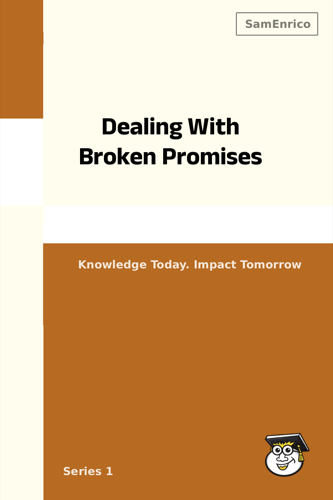
Dealing With Broken Promises eBook
Recover trust after someone lets you down repeated
by Laws Felisha
Recover trust after someone lets you down repeatedly.
Formats
Free sample
Chapter 1: The Thousand Cuts--The first time they broke a promise, you barely noticed. You told yourself it was nothing—traffic, a long day, a simple mistake. The second time, you felt a small pinch, but you dismissed it. By the tenth time, the pinch had become a dull ache. By the fiftieth, you stopped believing your own excuses.
And now, somewhere past the hundredth broken promise, you cannot remember what it feels like to wake up without a knot in your stomach.This chapter is not about the single, catastrophic betrayal that destroys a life in one afternoon. Books about infidelity, embezzlement, or a partner who vanishes overnight are important, but they address a different wound—a traumatic amputation. This book is about the death by a thousand cuts. It is about the partner who says "I'll be home by six" and walks through the door at eight, every Tuesday. The colleague who promises "the report will be on your desk by Friday" and delivers it the following Wednesday, every month.
The parent who says "I'll come to your game" and texts an excuse from the parking lot, every season. The friend who says "I'll call you tomorrow" and reappears in two weeks, every time.Each cut alone is survivable. You would feel silly calling a therapist over a late dinner or a missed phone call. But a thousand cuts? That is not silly.
That is a slow, methodical erosion of your sense of reality, your trust in your own judgment, and your ability to feel safe in a relationship. This chapter names the wound, explains why it hurts differently than a single betrayal, and gives you the first tool to see the pattern clearly.The Addiction That Looks Like Love Here is the first truth that will sound wrong but is clinically accurate: you may be addicted to this person, not in love with them. The two feelings can coexist, but the addictive component is what keeps you trapped.Let me explain the neuroscience. When a person keeps a promise reliably—every time, like clockwork—your brain experiences a steady, predictable release of dopamine. That feels good, but it does not create obsession.
Predictable rewards are pleasant but not addictive. You do not obsess over your morning coffee arriving at 7:00 AM; you simply enjoy it.But when a person keeps a promise sometimes and breaks it most of the time, something different happens. Your brain enters a state called intermittent reinforcement. This is the same mechanism that makes slot machines irresistible. A slot machine pays out randomly—sometimes after ten pulls, sometimes after a hundred, sometimes after one.
Your dopamine system does not get bored; it gets excited. Each pull could be the one. The uncertainty is what hooks you.Now apply this to your relationship. They promised to be home by six. You wait.
Six comes. Nothing. Six-thirty. Nothing. Your anxiety rises.
Seven o'clock. You have already imagined the worst. Seven-fifteen. The door opens. They have a reasonable excuse—traffic, a late meeting, their phone died.
And here is the crucial moment: they are home now. The relief floods your system. That relief is dopamine. You have just been reinforced for enduring two hours of anxiety. Your brain learns: if I wait long enough, the reward comes.This is why you cannot leave.
It is not because you are weak, codependent, or lacking self-respect. It is because your neurochemistry has been hijacked by a person who keeps you in a state of unpredictable anticipation. You are not hoping for them to change; you are addicted to the potential of their change. The slot machine does not pay out every time, but you keep pulling the lever because this time could be different.The clinical term for this is "trauma bonding," though that phrase is often misunderstood. Trauma bonding does not mean you are bonded by shared pain.
It means you become chemically attached to a person who alternates between reward and deprivation. Every broken promise is a deprivation. Every kept promise is a reward. The cycle creates a bond that feels like love but behaves like addiction.One of my clients, whom I will call Nadia, came to therapy after eight years with a partner who promised to quit drinking "this time" at least thirty times. She said to me, "I know he won't change.
I have known that for five years. But I cannot leave." When I asked her what she felt when she imagined leaving, she said, "Like I am withdrawing from a drug." She was correct. Her brain had adapted to the cycle of hope and disappointment. The hope felt like love. It was not.
It was a neurological trap.The Cumulative Fatigue That Mimics Depression You may have noticed that you are not just sad or angry. You are exhausted in a way that sleep does not fix. This is not depression, though it can look like it. This is cumulative fatigue syndrome—a term I use to describe the specific weariness that comes from managing unpredictable disappointment.Consider the cognitive load of living with a chronic promise-breaker. Every morning, you wake up and scan the horizon: What promise might be broken today?
Do I remind them? Do I stay silent and see what happens? If I remind them, am I nagging? If I do not remind them, am I setting them up to fail? You are running a mental simulation of every possible outcome before breakfast.
This is not anxiety disorder; this is an appropriate response to an unpredictable environment. But it is exhausting.Research on decision fatigue shows that the human brain has a limited capacity for making choices and managing uncertainty each day. By the time you have made ten micro-decisions about whether to trust this person, you have depleted your cognitive reserves. The result is a foggy, heavy feeling that makes you want to lie down. You are not lazy.
You are not weak. You are running a background operating system that consumes 80 percent of your mental bandwidth.Then there is the emotional accounting. Each broken promise requires you to do three pieces of work: first, you must feel the disappointment. Second, you must decide whether to express it or suppress it. Third, you must recalibrate your expectations for the next time.
This happens dozens of times per month. By the end of the year, you have processed hundreds of disappointments. That is not resilience; that is attrition.Nadia described it this way: "It is like carrying a backpack filled with rocks. Every broken promise is one more rock. At first, I did not notice the weight.
After the first year, my shoulders hurt. After the third year, I started walking hunched over. Now, I cannot stand up straight. But I have carried these rocks for so long that I forgot they are not part of my body."The cumulative fatigue also explains why you may have lost interest in hobbies, friendships, and activities you once loved. You do not have the bandwidth.
The relationship has become a full-time job of managing uncertainty. You are not depressed in the clinical sense—you are depleted. And depletion looks like depression, feels like…
This is the end of the free sample. Get the eBook to keep going. Buy now
About this book
Details
- Author
- Laws Felisha
- Publisher
- SamEnrico
- Language
- English
- Genre
- Non-Fiction, Self-Help, Trust
- Released
- 2026-06-06
- Pages (approx.)
- 145
- Available as
- eBook, Audiobook

Read better in the ZLOADR app
Your eBooks on your phone or tablet. Sign in with your SamEnrico account and start reading.
More by Laws Felisha
 Sleep Memory Consolidation GuideLaws Felisha$11.99
 Citation Rules for Websites and Social MediaLaws Felisha$11.99
 UK VAT Annual Accounting Scheme Enrollment PrimerLaws Felisha$11.99
 Fiverr Buyer Request StrategyLaws Felisha$11.99
 Career Portfolio vs Single JobLaws Felisha$11.99
 B52 Stratofortress PilotLaws Felisha$11.99
 Meeting Sanity GuideLaws Felisha$11.99
 Laci Peterson Gas Station VisitLaws Felisha$11.99
 The Sleepwalking Spy: The Unseen Cold War Between DreamsLaws Felisha$11.99
 The Opium Tide: How a Victorian Doctor’s Miracle Cure Became a Global PlagueLaws Felisha$11.99
 Red Tails Over Berlin: The Tuskegee Airmen's Secret Mission in the SkyLaws Felisha$11.99
 Nft CurationLaws Felisha$11.99
You may also like
 Hong Kong Handover 1997Dunn Johnnie$11.99
 Zumba For Postnatal Recovery CourseNeal Christian$11.99
 Zumba for BeginnersLadner Nikia$11.99
 YouTube Comment Mining GuideHumes Pandora$12.99
 Worry Box MeditationCarlin Rudy$11.99
 Workplace Stress MeditationNguyen Lynn$11.99
 Workplace Stress and Sleep RepairHawley Ivory$11.99
 Workplace Perfectionism CureDelaney Jeffry$11.99
 Workplace Injustice Anger GuideWallen Isabelle$11.99
 Work Addiction and Burnout LinkGreenwood Ester$11.99
 Women in Yoga and WellnessBeattie Galina$11.99
 Women in Stand Up ComedyChun Evangeline$11.99