
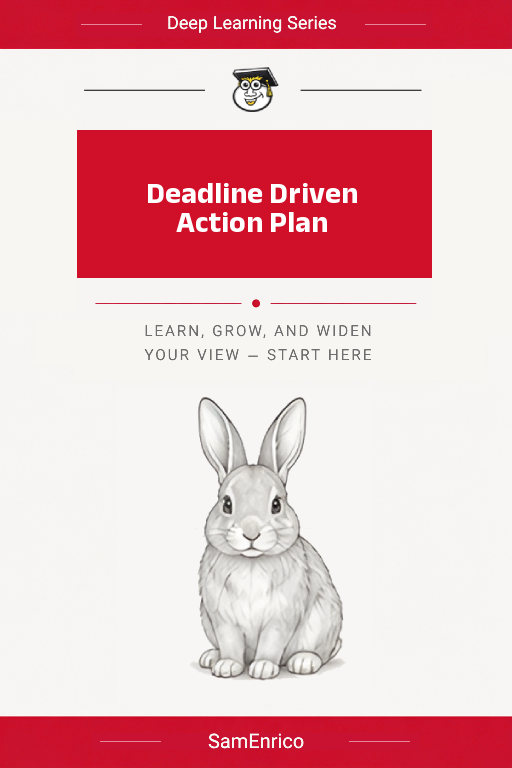
Non-FictionMental WealthAction BiasAccountability Guide
Deadline Driven Action Plan eBook
Use external accountability and artificial urgency
by Freund Londa
Use external accountability and artificial urgency to ship work before it's perfect. Covers accountability partner agreements, public commitment scripts, and post-submission anxiety management.
Formats
Free sample
Chapter 1: The Perfectionism Trap--The email had been sitting in her drafts folder for eleven months.Sarah, a senior product manager at a mid-sized tech company, had rewritten her proposal for a new customer feedback system forty-seven times. Each revision was marginally better than the last. Each one felt necessary. Each one delayed submission by another week. When her boss finally asked about the project, Sarah said she was “still gathering requirements.” She wasn’t lying.
She had gathered 120 pages of requirements, three competitive analyses, and a spreadsheet with eighteen tabs. What she had not gathered was a single sign-off, a single user test, or a single dollar of revenue.Across town, her former classmate Marcus had launched two imperfect products in the same eleven months. The first one crashed on launch day. The second one had a typo in the welcome email that customers mocked on Twitter for three days. But Marcus had also acquired 4,000 users, collected $12,000 in subscription revenue, and received 200 pieces of customer feedback that told him exactly what to build next.
When Sarah finally submitted her proposal, the company had already shifted strategic priorities. The project was shelved. All those months of polishing had produced nothing but a very beautiful file that no one opened.This is the perfectionism trap.It is not a quirk. It is not a sign of high standards. It is a sophisticated, neurologically reinforced avoidance strategy that disguises itself as diligence.
And until you recognize it for what it is, you will continue to mistake planning for progress, research for action, and preparation for production.Why Your Brain Lies to You About Readiness The human brain did not evolve to write proposals, launch products, or submit creative work. It evolved to conserve energy and avoid social rejection. Perfectionism hijacks both of these ancient systems.When you sit down to plan—to outline, to research, to organize files, to create the perfect folder structure—your brain releases dopamine. This is the same neurotransmitter associated with reward, motivation, and pleasure. Planning feels productive because your brain cannot distinguish between the anticipation of a reward and the reward itself.
The dopamine hit from imagining a completed project is chemically similar to the hit from actually completing it. This is why you can spend six hours organizing your desktop and feel exhausted and virtuous, having done absolutely nothing that moves a project forward.The problem is not that planning is bad. The problem is that planning is safe. It triggers no fear of judgment because no one sees your outline. It invites no criticism because there is nothing to criticize.
It costs you nothing except time. And because time is abundant in the present moment, your brain happily trades it for the warm glow of perceived progress.Meanwhile, the act of shipping—of sending your work to another human being—triggers a completely different neurological response. The anterior cingulate cortex and the insula, regions associated with pain and error detection, activate when you anticipate social evaluation. Your brain literally treats the prospect of someone reading your draft the same way it treats the prospect of touching a hot stove. This is not a metaphor.
Functional MRI studies show that social rejection activates the same neural pathways as physical pain.Perfectionism, then, is not a commitment to excellence. It is a pain-avoidance strategy. You are not waiting until your work is good enough. You are waiting until the anticipated pain of sharing it falls below the pain of continued preparation. And because preparation has no pain at all, you will wait forever.The Hidden Cost of Waiting for Ideal Conditions Most people understand that perfectionism delays work.
What they do not understand is that perfectionism destroys the very conditions that would make their work better.Consider the hidden costs of waiting for “ready”:First, you lose feedback loops. Every piece of work you do not ship is a piece of work that cannot be improved by external input. The graphic designer who waits until a logo feels perfect before showing a client has no idea whether the client would have preferred a completely different direction. The writer who polishes a chapter for six weeks without a reader has no idea which paragraphs confuse, bore, or delight. Feedback is not a nice-to-have after you finish.
Feedback is the primary mechanism by which work gets better.Second, you miss market windows. Timing is not everything, but it is something. The product that launches six months late into a saturated market fails even if it is technically superior. The job candidate who waits until their portfolio is “complete” misses the hiring cycle. The entrepreneur who waits until the pitch deck is perfect watches a competitor with an uglier deck close the round.
Perfect work delivered too late is worthless.Third, you erode creative confidence. Every project you fail to ship reinforces a dangerous identity: “I am someone who does not finish things.” This identity becomes self-fulfilling. After three unfinished projects, you stop starting new ones because you already know how they will end. The perfectionist trap does not just delay your current work. It prevents you from attempting future work at all.Fourth, you incur opportunity cost.
While you polish one portfolio piece for six months, someone else ships eighteen imperfect pieces, lands four clients, and builds a reputation. The comparison is not between your perfect work and their imperfect work. It is between your perfect work and all the work they did while you were polishing. Quantity has a quality all its own.The Case Study That Changed Everything In 2019, a research team at the University of Chicago conducted a study that should terrify every perfectionist. They asked two groups of ceramic students to make pots.
Group A was told they would be graded on the quantity of pots they produced. Group B was told they would be graded on the quality of a single pot. At the end of the semester, the best pots—judged by independent experts—came from Group A. The quantity group had spent the semester making pot after pot, learning from each mistake, iterating rapidly. The quality group had spent the semester planning, researching, and polishing a single pot that was, in the end, technically proficient but unremarkable.This study has been replicated across domains: writing, coding, design, sales, and even surgery.
In every case, the practitioners who produced more volume—even when that volume contained errors—outperformed those who focused on getting a single output perfect.Let me tell you about two real-world copywriters I have coached. Both had similar portfolios, similar rates, and similar experience when we started.Writer A decided to focus on building one “masterpiece” case study. She interviewed six clients, wrote fourteen drafts, hired a designer for the PDF, and spent two months on layout. The final case study was gorgeous. It generated zero new clients because no one read a forty-page PDF.Writer B decided to ship one case study per week for two months.
Each was written in two hours. Each was ugly—plain text, no design, occasional typos. But each week, she sent the case study to five prospects. By week six, she had landed two clients.…
This is the end of the free sample. Get the eBook to keep going. Buy now
About this book
Details
- Author
- Freund Londa
- Publisher
- SamEnrico
- Language
- English
- Genre
- Non-Fiction, Mental Wealth, Action Bias, Accountability Guide
- Released
- 2026-06-01
- Pages (approx.)
- 133
- Available as
- eBook, Audiobook

Read better in the ZLOADR app
Your eBooks on your phone or tablet. Sign in with your SamEnrico account and start reading.
More by Freund Londa
 Governor's Tourism CampaignFreund Londa$11.99
 Storytelling Influence GuideFreund Londa$11.99
 Influencer Disclosure For LawyersFreund Londa$11.99
 The Perimenopause Symptom Tracking WorkbookFreund Londa$11.99
 Affirmations for Chronic PainFreund Londa$11.99
 The Bitcoin Billionaire: How a Mysterious Crypto Pioneer Built a Fortune in the ShadowsFreund Londa$11.99
 Kite BoardingFreund Londa$11.99
 India Investment Surge GuideFreund Londa$12.99
 Understanding Jejunal AtresiaFreund Londa$17.99
 How to Become a Tuber-machine-operator HelperFreund Londa$11.99
You may also like
 Hong Kong Handover 1997Dunn Johnnie$11.99
 Zumba For Postnatal Recovery CourseNeal Christian$11.99
 Zumba for BeginnersLadner Nikia$11.99
 YouTube Comment Mining GuideHumes Pandora$12.99
 Worry Box MeditationCarlin Rudy$11.99
 Workplace Stress MeditationNguyen Lynn$11.99
 Workplace Stress and Sleep RepairHawley Ivory$11.99
 Workplace Perfectionism CureDelaney Jeffry$11.99
 Workplace Injustice Anger GuideWallen Isabelle$11.99
 Work Addiction and Burnout LinkGreenwood Ester$11.99
 Women in Yoga and WellnessBeattie Galina$11.99
 Women in Stand Up ComedyChun Evangeline$11.99