
Non-FictionSelf-HelpConflict Resolution
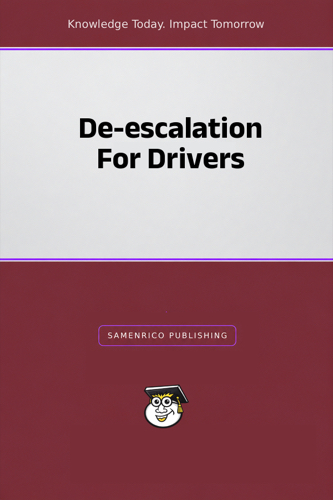
De-escalation For Drivers eBook
Teaches non-confrontational responses to aggressiv
Teaches non-confrontational responses to aggressive drivers and how to avoid escalation.
Formats
Free sample
Chapter 1: The Invisible Cage--–- The first time I almost died on the road, I was seven years old, sitting in the back seat of my mother’s Honda Civic, eating a peanut butter sandwich, and completely unaware that the man in the pickup truck behind us had just pulled a gun from his glove compartment.My mother didn’t know either. Not at first. She was a calm driver by nature—a former nurse who had seen real emergencies and refused to confuse traffic with tragedy. But that afternoon, merging onto the interstate, she had done something unforgivable in the eyes of the man behind us. She had changed lanes without signaling.
A mistake. A human moment that lasted less than two seconds.The pickup truck swerved around us on the right, cut back in front with inches to spare, and then the driver’s arm came out the window. Not a wave. Not a finger. A dark metal object that caught the afternoon sun.
My mother saw it. I didn’t. She later told me that she pulled over immediately, shaking so hard she couldn’t unbuckle her seatbelt. The truck kept going. We never saw him again.That was thirty years ago.
And nothing has changed—except that it has gotten worse.According to the most recent data from the National Highway Traffic Safety Administration and AAA, road rage incidents have increased by nearly 40 percent over the past decade. In 2023 alone, more than 1,200 people were killed in accidents directly attributed to aggressive driving behaviors—tailgating, unsafe lane changes, speeding twenty miles over the limit, and what researchers call “confrontational driving.” Another 15,000 were injured. And those are just the cases that make it into official reports. For every shooting, every crash, every fistfight in a parking lot, there are thousands of near-misses that never get recorded.Here is the truth that no one tells you in driver’s education: the most dangerous part of driving is not weather, not mechanical failure, not even drunk drivers. It is the ordinary, otherwise reasonable human being who gets behind the wheel and transforms into someone unrecognizable.This book is about why that happens.
And more importantly, it is about how to survive it.The Psychology You Were Never Taught Every driver’s education course in America teaches you how to operate a vehicle. You learn about following distance, blind spots, turn signals, parallel parking, and the precise number of feet required to stop at sixty miles per hour. What no course teaches you is the psychology of the road—the invisible forces that turn polite neighbors into screaming strangers and loving parents into vengeful pursuers.There is a reason for this omission, and it is not simple negligence. The psychology of driving is unsettling. It forces us to confront something about ourselves that we would rather not acknowledge: that the person we become behind the wheel is not a different person.
It is us. Unmasked. Freed from the social consequences that normally keep our worst impulses in check.Consider this experiment, conducted by researchers at the University of California, Irvine in 2019. Psychologists placed cameras in the vehicles of thirty ordinary commuters—teachers, accountants, retail managers, stay-at-home parents. The participants were told the cameras were for a traffic safety study.
The researchers were actually measuring something else: the gap between how participants described themselves (“I am a patient person”) and how they actually behaved when they thought no one was watching.The results were striking. Eighty-three percent of participants engaged in at least one act of aggressive driving during their two-week commute. Seventy-one percent yelled or cursed at another driver, even though their windows were up and the other driver could not hear them. Forty-two percent made an obscene gesture. Twelve percent deliberately blocked another driver from changing lanes.
And when the researchers interviewed the participants afterward, showing them clips of their own behavior, the most common response was not shame. It was surprise. “I don’t remember doing that,” they said. “That doesn’t sound like me.”But it was them. The only difference was the cage.The Disinhibition Effect In psychology, the term “disinhibition” refers to the phenomenon in which individuals engage in behaviors they would normally suppress, due to the absence of social accountability.
You have experienced this yourself in smaller ways. Think about the last time you shouted at your television during a sports game—something you would never do to a referee in person. Think about the anonymous online review you wrote, sharper and more cutting than anything you would say to a manager’s face. Think about the text message you sent that you would never have spoken aloud.The car is the ultimate disinhibition machine.When you are inside a moving vehicle, several psychological barriers collapse simultaneously. The first is visual anonymity.
Unless you are driving a highly distinctive vehicle with visible customizations, no one knows who you are. Your license plate is a string of numbers. Your face, behind glass and at speed, is a blur. This anonymity removes the fear of social judgment—the single most powerful force regulating human behavior in public spaces.The second collapsed barrier is temporal distance. In a face-to-face confrontation, consequences are immediate.
If you shout at someone in a grocery store, they may shout back, or call security, or—in extreme cases—physically confront you. In a car, the encounter is measured in seconds. You may never see that driver again. The probability of repercussion approaches zero, and the human brain is exquisitely sensitive to probability. When the risk feels low, restraint vanishes.The third barrier is spatial encapsulation.
Your vehicle is a metal bubble. It separates you from the outside world not just physically but psychologically. Research from the University of Hawaii’s Traffic Safety Institute found that drivers were significantly more likely to honk aggressively, tailgate, and make obscene gestures when their windows were rolled up than when they were rolled down. The glass itself—that thin transparent barrier—was enough to create an “us versus them” mentality, as if the driver were watching a movie rather than participating in shared public space.Together, these three forces create what I call the Invisible Cage—the psychological space in which otherwise decent people become capable of extraordinary hostility.Territoriality on Asphalt There is a second psychological force at work, older and more primal than anonymity. It is called territoriality, and it is shared by every animal with a central nervous system.Territoriality is the instinct to defend a physical space against intruders.
In humans, this instinct manifests in countless small ways: the way you feel irritated when someone stands too close to you in an elevator, the way you claim your regular seat at a coffee shop, the way you resent a houseguest who overstays their welcome. These are not rational calculations. They are limbic responses, driven by the oldest parts of your brain.In a car, territoriality goes into overdrive.Your vehicle is not just transportation. It is an extension of your body. The space immediately around it—the buffer zone that other drivers invade when they follow too closely or cut you off—is perceived as personal territory.…
This is the end of the free sample. Get the eBook to keep going. Buy now
About this book
Details
- Author
- Weddle Carmella
- Publisher
- SamEnrico
- Language
- English
- Genre
- Non-Fiction, Self-Help, Conflict Resolution
- Released
- 2026-06-10
- Pages (approx.)
- 144
- Available as
- eBook, Audiobook

Read better in the ZLOADR app
Your eBooks on your phone or tablet. Sign in with your SamEnrico account and start reading.
More by Weddle Carmella
 The Yoga for Back Pain WorkbookWeddle Carmella$11.99
 Chipper Cash Venture ExitWeddle Carmella$11.99
 HRT History And Women's Health Initiative HandbookWeddle Carmella$11.99
 Circular Economy InvestmentWeddle Carmella$11.99
 The Ice Angels of St. Moritz: Pioneers of Winter Olympic MedicineWeddle Carmella$11.99
 Sweet Sorghum HarvestingWeddle Carmella$11.99
 PayPal Transaction Search GuideWeddle Carmella$12.99
 Understanding Pernambuco ViadimWeddle Carmella$17.99
 How to Become a Spout WorkerWeddle Carmella$11.99
You may also like
 Hong Kong Handover 1997Dunn Johnnie$11.99
 Zumba For Postnatal Recovery CourseNeal Christian$11.99
 Zumba for BeginnersLadner Nikia$11.99
 YouTube Comment Mining GuideHumes Pandora$12.99
 Worry Box MeditationCarlin Rudy$11.99
 Workplace Stress MeditationNguyen Lynn$11.99
 Workplace Stress and Sleep RepairHawley Ivory$11.99
 Workplace Perfectionism CureDelaney Jeffry$11.99
 Workplace Injustice Anger GuideWallen Isabelle$11.99
 Work Addiction and Burnout LinkGreenwood Ester$11.99
 Women in Yoga and WellnessBeattie Galina$11.99
 Women in Stand Up ComedyChun Evangeline$11.99