
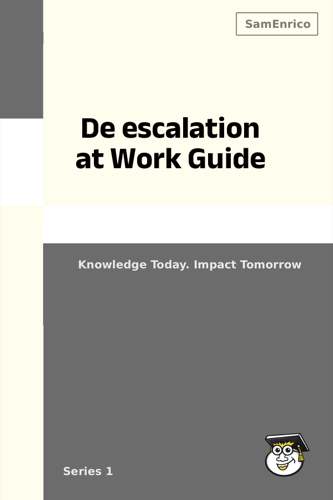
Non-FictionSelf-HelpDe-escalation
De escalation at Work Guide eBook
Cool down heated moments with colleagues using pro
Cool down heated moments with colleagues using proven verbal techniques.
Formats
Free sample
Chapter 1: The $47,000 Whisper--–- The conference room on the 14th floor had floor-to-ceiling windows that made everyone feel important, a coffee machine that cost more than most people’s first cars, and a silence so thick you could have cut it with a dull butter knife. Two weeks earlier, that same room had been loud enough to register on the building’s noise complaint log. A senior product manager named Elena had looked across the table at a senior engineer named Marcus and said, with a smile that wasn’t a smile, “Well, that’s what happens when engineering designs something without reading the customer feedback.” Marcus had not rolled his eyes. He had not taken a deep breath. He had not excused himself to the bathroom.
Instead, he had slammed both palms on the polished oak table—a sound that sent coffee sloshing over the rim of three mugs—and shouted, “You want to do my job? Fine. I’ll be in my office. Alone. For the rest of the quarter.” He had walked out, and the door had not slammed.
It had closed with a quiet, terrifying click. That was the sound the team remembered. Not the shout. The click.The missed deadline came eight days later. The silent treatment lasted twelve.
Elena and Marcus, who had once grabbed lunch together twice a week, now communicated exclusively through Slack messages that began with “Per my last message” and ended with no punctuation. Three other team members updated their Linked In profiles to “open to work” within ten days of the blow-up. None of them had been involved in the original argument. They had simply watched it happen. They had felt the temperature drop.
They had started whispering in the hallway, choosing sides, rehearsing their own exit strategies. The project—a feature launch that was supposed to generate an estimated $1.2 million in new revenue—shipped three weeks late with a critical bug that cost $47,000 in emergency fixes and lost customer goodwill. The bug had nothing to do with Elena or Marcus. It had everything to do with the fact that nobody on the team had felt safe enough to say, “Hey, I think we missed something.”This is not a story about bad people. Elena was not a villain.
Marcus was not a monster. They were two exhausted, overworked, moderately sleep-deprived professionals who had one bad minute. That minute cost $47,000, three job searches, and a silence that turned a team into a collection of strangers sharing a Wi-Fi network. And here is the part that should terrify you: that minute was completely preventable.The Myth of the “Difficult Person”We have a cultural story about workplace conflict that goes something like this: some people are just difficult. They have bad tempers, fragile egos, or a mysterious inability to handle feedback.
The solution, according to this story, is to avoid those people, manage around them, or—if you have enough seniority—manage them out. This story is seductive because it lets the rest of us off the hook. If conflict is caused by difficult people, then the rest of us are simply innocent bystanders, collateral damage in someone else’s emotional explosion.This story is also almost entirely wrong.What the research actually shows—and what you will see demonstrated in every chapter of this book—is that workplace conflict is not primarily a personality problem. It is a systems problem, a communication problem, and, most critically, a biology problem. The vast majority of heated moments at work do not happen because someone is a sociopath or a narcissist or a “toxic person.” They happen because two human beings, with normally functioning brains, walked into a situation that triggered an ancient threat response designed to protect them from saber-toothed tigers, not from passive-aggressive emails about quarterly projections.The truth is that you have likely been the “difficult person” in someone else’s story.
Not because you are cruel or unreasonable, but because you were tired, or hungry, or stressed, or defending something that felt important. And the person you were arguing with was doing the exact same thing. This reframing is not an excuse for bad behavior. It is the prerequisite for fixing it. You cannot de-escalate a conflict you refuse to understand.Let me tell you about a study that changed how I think about workplace arguments.
Researchers followed 238 teams across four different industries for eighteen months, tracking every reported conflict and measuring its aftermath. They found that the average cost of a single escalated argument—including lost productivity, turnover, sick days, and rework—was $47,000 for a mid-sized team. But here is what made their jaws drop: the actual argument itself lasted an average of ninety seconds. Ninety seconds of raised voices cost an average of $47,000 and weeks of collateral damage. The math is staggering.
Every second of escalation costs roughly $522 in hidden organizational expense. That is not an opinion. That is a number.The good news is that the inverse is also true. Teams that learned and consistently used the techniques in this book reduced their conflict recovery time—the period between a heated moment and a return to full productivity—by an average of 75 percent. Some teams cut it by more than 90 percent.
They did not eliminate conflict. They did not turn everyone into a serene, emotionally enlightened meditation instructor. They simply learned how to have the same arguments without destroying their relationships in the process. That is what this book is for.The Hidden Toll No One Talks About Let me walk you through the actual, line-item cost of a heated moment. Not the theoretical cost.
The one you can track on a spreadsheet.Direct Productivity Loss. The argument itself takes time. But that is the smallest line item. The real loss comes afterward. Research from the University of North Carolina found that employees spend an average of 2.8 hours per week dealing with conflict—not in the conflict itself, but in the aftermath: replaying conversations, venting to colleagues, drafting and deleting angry emails, avoiding the other person, and mentally rehearsing what they should have said.
That is 145 hours per employee per year. For a team of ten people making an average of $40 per hour, that is nearly $60,000 in paid hours that produced absolutely nothing.The Shadow Conversation Tax. This is the one that kills teams. When Elena and Marcus had their blow-up, the rest of the team did not keep working. They stopped.
They texted each other. They created a private Slack channel without the two of them. They asked “What happened?” and “Whose side are you on?” and “Should we go to HR?” They spent roughly eleven collective hours over the following two weeks talking about the conflict instead of working on the product. That is eleven hours of engineering and product management time that generated zero revenue. The shadow conversation is always more expensive than the original argument, and it almost never shows up on any official report.The Turnover Multiplier.
Here is the number that keeps HR professionals awake at night. According to the Society for Human Resource Management, the average cost of replacing an employee is six to nine months of their…
This is the end of the free sample. Get the eBook to keep going. Buy now
About this book
Details
- Author
- Skinner Adella
- Publisher
- SamEnrico
- Language
- English
- Genre
- Non-Fiction, Self-Help, De-escalation
- Released
- 2026-06-06
- Pages (approx.)
- 135
- Available as
- eBook, Audiobook

Read better in the ZLOADR app
Your eBooks on your phone or tablet. Sign in with your SamEnrico account and start reading.
More by Skinner Adella
 Stress Muscle Tension LinkSkinner Adella$11.99
 International Franchise Diversity And InclusionSkinner Adella$11.99
 Virtual Colonoscopy GuideSkinner Adella$11.99
 The Emotion Regulation for TeachersSkinner Adella$11.99
 The Habsburg Star: Vienna’s Celestial LegacySkinner Adella$11.99
 Trusts and CTA ObligationsSkinner Adella$12.99
 Invoice Factoring Egypt GuideSkinner Adella$12.99
 Understanding Rosenberg–chutorian SyndromeSkinner Adella$17.99
 How to Start a Accident and Emergency Service (private Sector) Business (Beginners Guide)Skinner Adella$11.99
 National Sales ManagerSkinner Adella$11.99
You may also like
 Hong Kong Handover 1997Dunn Johnnie$11.99
 Zumba For Postnatal Recovery CourseNeal Christian$11.99
 Zumba for BeginnersLadner Nikia$11.99
 YouTube Comment Mining GuideHumes Pandora$12.99
 Worry Box MeditationCarlin Rudy$11.99
 Workplace Stress MeditationNguyen Lynn$11.99
 Workplace Stress and Sleep RepairHawley Ivory$11.99
 Workplace Perfectionism CureDelaney Jeffry$11.99
 Workplace Injustice Anger GuideWallen Isabelle$11.99
 Work Addiction and Burnout LinkGreenwood Ester$11.99
 Women in Yoga and WellnessBeattie Galina$11.99
 Women in Stand Up ComedyChun Evangeline$11.99