
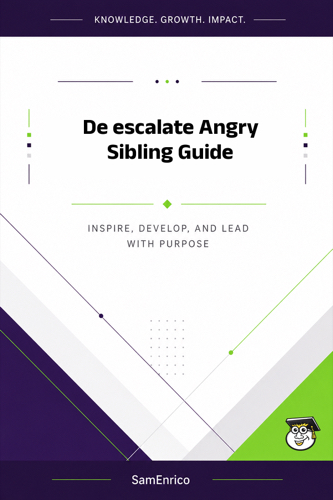
De escalate Angry Sibling Guide eBook
Reduce rivalry and conflict between adult brothers
Reduce rivalry and conflict between adult brothers and sisters.
Formats
Free sample
Chapter 1: The 50% Rule...--–- Margaret, a 54-year-old hospital administrator, and her brother David, a 58-year-old cardiologist, had not spoken in eleven months. The war began over their mother's final months—who visited more, who paid for the private aide, who got the good china. But the battle lines were drawn decades earlier, in a suburban kitchen where Margaret was told she was "too sensitive" and David was told he was "the man of the house." Last Thanksgiving, the truce collapsed. David said, "You always think you're the only one who cared about Mom." Margaret threw a glass of wine at the wall and screamed, "You weren't even there." She has not seen her brother since. When she walked into my office, she was not asking for reconciliation.
She was asking for permission to hate him forever. Instead, I asked her a different question: "What were you feeling right before you threw the glass?" She paused. Then she said something that changed everything: "I was ten years old again. And he was taking my toy."That moment—the sudden, inexplicable regression from competent adult to wounded child—is the subject of this chapter. If you have ever found yourself shouting at a sibling about something objectively trivial (a parking spot, a text message, a remembered insult from 1987) while feeling a rage that seems wildly disproportionate to the trigger, you have experienced what neuroscientists call emotional memory reactivation.
You were not fighting about the parking spot. You were fighting about every parking spot, every slight, every moment of being overlooked, from the last forty years. And until you understand why that happens, no de-escalation technique in this book will work. You cannot calm a fire you refuse to see.The Neurology of Regression: Why You Suddenly Become Ten Years Old Let us begin with a simple fact: your brain does not distinguish between past and present danger. It distinguishes only between safe and not safe.
The amygdala, a small almond-shaped cluster of neurons deep in the temporal lobe, acts as the brain's smoke detector. It scans incoming sensory information for threats. When it detects a familiar pattern—a raised voice, a sneering tone, a specific posture of contempt—it sounds the alarm before your conscious mind has even processed what is happening. This is called low-road processing, a term coined by neuroscientist Joseph Le Doux. The low road is fast, automatic, and unconscious.
It takes approximately 50 milliseconds for the amygdala to respond to a threat cue. By comparison, the high road—the slower, rational pathway that runs through the prefrontal cortex—takes about 500 milliseconds. In that nearly half-second gap, you have already reacted.Here is what this means for sibling conflict. Your sibling knows exactly which buttons to push because they helped install them. They know the tone of voice that makes you feel small.
They know the exact phrasing ("Oh, here we go again") that bypasses your adult reasoning and triggers the child brain. And here is the cruel irony: they are not doing it consciously most of the time. They are on their own low road, reacting to their own ghosts. Two adults stand in a kitchen, and neurologically, both are ten years old. This is what this chapter calls the history autopilot—the default setting where familiar conflict patterns run on autopilot, bypassing conscious choice.Consider the data.
A landmark longitudinal study published in the Journal of Family Psychology followed 246 sibling pairs over 25 years. The single strongest predictor of adult sibling conflict was not current finances, not proximity, not even major betrayals. It was perceived parental favoritism reported at age 12. Those who believed—accurately or not—that a parent preferred their sibling were 4.7 times more likely to report high levels of conflict at age 40. Notice the word perceived.
It does not matter if the favoritism was real. The belief alone rewired the brain's threat circuitry. Every subsequent interaction with that sibling was filtered through the lens of "You got more than me." This is the first ghost: the ghost of unfairness.The Three Ghosts That Haunt Every Sibling Relationship Through decades of clinical work and research synthesis, this book identifies three universal ghosts that underlie nearly every adult sibling conflict. These are not diagnoses or personality types. They are patterns of stored emotional memory that activate the history autopilot.
You may recognize one, two, or all three in your own story.Ghost One: The Ghost of Unfairness This is the most common ghost. It forms when a child perceives that resources—attention, praise, time, money, privileges—are distributed unequally. The child does not need to be objectively correct. A highly sensitive child may perceive unfairness in a situation that another child would not notice. But the emotional memory is stored regardless.
As an adult, this ghost is triggered by any situation that feels like unequal distribution: who got the better holiday gift, who the parent calls more often, who is trusted with the family finances. The adult response is not about the present inequality. It is about every inequality. This is why a sibling can become enraged over a $50 difference in a birthday check—it is never about $50. It is about forty years of feeling second-best.Ghost Two: The Ghost of Invisibility This ghost forms when a child's emotional needs are consistently overlooked.
The child learns that their feelings do not matter, that their distress is an inconvenience, that they are expected to manage their own sadness while their sibling receives comfort. As an adult, this ghost is triggered by being interrupted, dismissed, or having their concerns minimized. The classic trigger phrase is "You're too sensitive"—a sentence that has launched more sibling wars than any other. The adult response is disproportionate rage at being silenced. But the rage is not about the present interruption.
It is about every time they were told to be quiet, to stop crying, to toughen up. The ghost of invisibility says: I will be heard now, even if I have to scream.Ghost Three: The Ghost of Frozen Roles This ghost forms when a family assigns rigid roles to children that persist into adulthood without anyone noticing. The "responsible one" is still expected to organize every holiday and manage every parent crisis. The "reckless one" is still treated as unreliable even if they have been sober for a decade. The "golden child" is still resented even if they never asked for the role.
The "black sheep" is still blamed even if they have done nothing wrong in years. These roles are like invisible scripts that siblings read from automatically. The ghost of frozen roles says: I am not who you think I am, but I will act out the part anyway because it is easier than fighting you every single day.These three ghosts are not mutually exclusive. Most adult sibling conflicts involve all three, swirling together in a toxic fog. The daughter who is always the caretaker (frozen role) may feel invisible when her efforts go unacknowledged (ghost of invisibility) and then explode over an unequal division of labor (ghost of unfairness).
Understanding the ghosts does not excuse the behavior. It explains the behavior. And explanation is the first step toward intervention.The…
This is the end of the free sample. Get the eBook to keep going. Buy now
About this book
Details
- Author
- Andrews Jennifer
- Publisher
- SamEnrico
- Language
- English
- Genre
- Non-Fiction, Self-Help, Sibling Rivalry
- Released
- 2026-06-12
- Pages (approx.)
- 140
- Available as
- eBook, Audiobook

Read better in the ZLOADR app
Your eBooks on your phone or tablet. Sign in with your SamEnrico account and start reading.
More by Andrews Jennifer
 The Multi Echelon Safety StockAndrews Jennifer$11.99
 Senior Center ConfidenceAndrews Jennifer$11.99
 Russian Human Trafficking RingsAndrews Jennifer$11.99
 Dealing with Angry Boss GuideAndrews Jennifer$11.99
 British Empire Museum CritiqueAndrews Jennifer$11.99
 Overcoming Procrastination for Data ScientistsAndrews Jennifer$11.99
 House Symbolism in Jungian DreamsAndrews Jennifer$11.99
 The Silk Scrolls of Tang China: How a Forgotten Illustrator Shaped Children's StoriesAndrews Jennifer$11.99
 Breaking the Curse: The Rise of Middle Eastern Track LegendsAndrews Jennifer$11.99
 The Photographer's Guide to Photo OpAndrews Jennifer$11.99
 Jasmine: Flower Harvesting For TeaAndrews Jennifer$11.99
 How to Start a Hobby in CalligraphyAndrews Jennifer$11.99
You may also like
 New Sibling Dream ReactionsCoble Leonila$11.99
 Comparison To Siblings Self Worth WorkbookMa Shaina$11.99
 The Competitive Sibling RivalrySlaughter Laurice$11.99
 Parental Anger And Sibling FightsBond Ka$11.99
 Teen Sibling Comparison StopFloyd Leslie$11.99
 Parental Favoritism ScarsBrandenburg Lida$11.99
 Sibling Fight Parental Anger GuideNoel Jackelyn$11.99
 The Comparison Sibling WoundAponte Kit$11.99
 Sibling Fights Parent AngerLarge Janessa$11.99
 New Sibling Dream ThemesPinkerton Digna$11.99
 The Sibling Dream GuideChin Enola$11.99
 Parental Favoritism Scar HealingDouglass Muoi$11.99