
Non-FictionSelf-HelpFlashbacks
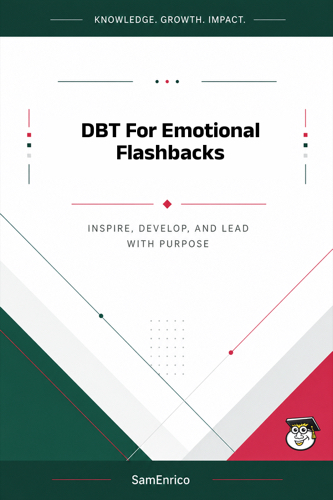
DBT For Emotional Flashbacks eBook
Ground yourself when past trauma feelings flood th
by Skelton Dale
Ground yourself when past trauma feelings flood the present.
Formats
Free sample
Chapter 1: The Time Travel Paradox...--–- You are standing in the grocery store, reaching for a can of beans, when a man two aisles over clears his throat. Nothing threatening. Just a throat clearing. But suddenly your heart is pounding so hard you can hear it in your ears. Your chest feels tight.
Your vision narrows. You are flooded with a wave of terror so complete, so absolute, that you abandon your shopping cart where it stands and walk—almost run—out of the store. In the parking lot, you sit in your car, shaking, tears streaming down your face, unable to explain to yourself what just happened. The man did nothing wrong. The store was safe.
There was no danger. And yet your body reacted as if you were about to die.This is not a breakdown. This is not a sign that you are crazy. This is not evidence that you are “too sensitive” or “dramatic” or “broken.” This is an emotional flashback.And until you learn what that is, it will continue to run your life.The Mystery That Brings You Here If you have picked up this book, chances are you have experienced moments like the one described above. Perhaps your version looks different.
Maybe you don’t run—maybe you freeze. Maybe you don’t feel terror—maybe you feel a crushing, inexplicable shame that tells you everyone in the room hates you, even though no one has said a word. Maybe you don’t leave the grocery store—maybe you suddenly feel three years old, small, helpless, and convinced that you are about to be abandoned, even though you are a thirty-five-year-old adult standing in line to buy milk.The common thread is this: something happens in the present—a sound, a smell, a look, a tone of voice—and suddenly you are no longer in the present. You are somewhere else. You are someone else.
You are a younger, more vulnerable version of yourself, flooded with feelings that belong to a different time and place.This is the central mystery of emotional flashbacks. Unlike the classic PTSD flashbacks you see in movies—where a veteran hears a car backfire and vividly re-experiences a battlefield explosion with full visual and auditory hallucinations—emotional flashbacks have no visual component. There is no movie playing in your mind. There is no image of the person who hurt you. There is no replay of the traumatic event.
Instead, there is only the feeling.And that is what makes them so confusing, so disorienting, and so difficult to recognize.When you have a visual flashback, at least you know what is happening. You can say to yourself, “I am having a flashback. I am seeing something that isn’t there.” But when you have an emotional flashback, you have no such clarity. You just feel terrible. You feel afraid, or ashamed, or enraged, or hopeless.
And because there is no accompanying image to clue you in, your brain does what brains do: it searches for an explanation. It looks around the present moment for a reason why you feel this way. And when it cannot find one—because the present moment is actually safe—it does something much more damaging.It blames you.“See?” your brain whispers. “There is no danger. There is no reason to feel this way.
Which means the problem is you. You are broken. You are overreacting. You are crazy.”This is the cruelest trick of the emotional flashback. It creates a feeling that belongs to the past, then convinces you that the feeling is a reflection of your present reality—or worse, a reflection of who you are.Classic PTSD vs.
C-PTSD: Why Your Flashbacks Have No Pictures To understand emotional flashbacks, you first need to understand the difference between two related but distinct conditions: Post-Traumatic Stress Disorder (PTSD) and Complex Post-Traumatic Stress Disorder (C-PTSD).PTSD is typically caused by a single, identifiable traumatic event. A car accident. A natural disaster. A physical assault. A military combat experience.
In PTSD, the traumatic memory is often stored in the brain as a kind of “hot spot”—a vivid, sensory-rich recording that can be triggered by reminders of the event. When that recording plays back, it plays back with full sensory details: images, sounds, smells, physical sensations. This is the classic flashback. It has pictures. It has a beginning, a middle, and an end.
And crucially, the person having it usually recognizes, at some level, that they are re-experiencing something that already happened.C-PTSD is different. C-PTSD is caused by prolonged, repeated trauma, usually occurring over months or years, often during childhood. Chronic abuse. Neglect. Living with a volatile, unpredictable caregiver.
Being trapped in a situation where you cannot escape and cannot fight back. In these circumstances, your brain does not just form a few hot-spot memories of specific events. It forms an entire template of survival.Your nervous system learns, over time, that the world is dangerous. That people cannot be trusted. That you are small, helpless, and at the mercy of others.
That your needs will not be met. That asking for help is pointless or dangerous. That your feelings are wrong. That you are bad.These lessons are not stored as single memories. They are stored as emotional truths—deep, pre-verbal, bodily convictions about who you are and how the world works.
And when something in the present vaguely resembles the conditions of your past trauma, your nervous system does not replay a specific memory. It replays the entire emotional template.You do not remember the time your father screamed at you for spilling milk. You simply feel, suddenly and overwhelmingly, that you are about to be screamed at. That you have done something wrong. That you are in trouble.
That you need to make yourself small, disappear, apologize, fix it, make it better, make it stop.You do not remember the years of being left alone, hungry, and crying in your crib. You simply feel, suddenly and overwhelmingly, that you are going to be abandoned. That you are alone. That no one is coming. That you need to cling, to please, to perform, to earn love or else you will die.This is the time travel paradox.
Your body has learned to survive by predicting danger. And it predicts danger by scanning the present for any pattern that matches the past. When it finds a match—even a loose one, even an unconscious one—it sends you back. Not to a specific memory. But to a specific feeling.You feel five years old in a thirty-year-old body.
Not because you are weak. But because your nervous system is doing exactly what it evolved to do: protect you from harm.The Amygdala Hijack: Why You Can’t Think Your Way Out To understand why emotional flashbacks feel so overwhelming—and why you cannot simply “talk yourself down” in the middle of one—you need to understand a little bit about how your brain processes threats.Deep in the center of your brain, tucked behind your eyes, sits a small, almond-shaped cluster of neurons called the amygdala. The amygdala is your brain’s alarm system. Its job is…
This is the end of the free sample. Get the eBook to keep going. Buy now
About this book
Details
- Author
- Skelton Dale
- Publisher
- SamEnrico
- Language
- English
- Genre
- Non-Fiction, Self-Help, Flashbacks
- Released
- 2026-06-10
- Pages (approx.)
- 155
- Available as
- eBook, Audiobook

Read better in the ZLOADR app
Your eBooks on your phone or tablet. Sign in with your SamEnrico account and start reading.
More by Skelton Dale
 The Single Tasking PrioritySkelton Dale$11.99
 Pelvic Floor for Professional SingersSkelton Dale$11.99
 Breath Meditation For DrivingSkelton Dale$11.99
 The Environmentalist Who Cleaned RiverSkelton Dale$11.99
 Breaking Inherited Low Self WorthSkelton Dale$11.99
 Pomodoro For BudgetingSkelton Dale$11.99
 Antwerp Heist Lecture NotesSkelton Dale$11.99
 The Great Fire Insurance Fraud of 1883: A Colonial ConspiracySkelton Dale$11.99
 The Battle of Nagae: The Yamato Dynasty's Last StandSkelton Dale$11.99
 A Collector's Handbook to the Fairthorpe ZetaSkelton Dale$11.99
 How to Produce Antiseptic Hand CleanerSkelton Dale$11.99
 Mastering The Art of KuntawSkelton Dale$11.99
You may also like
 Hong Kong Handover 1997Dunn Johnnie$11.99
 Zumba For Postnatal Recovery CourseNeal Christian$11.99
 Zumba for BeginnersLadner Nikia$11.99
 YouTube Comment Mining GuideHumes Pandora$12.99
 Worry Box MeditationCarlin Rudy$11.99
 Workplace Stress MeditationNguyen Lynn$11.99
 Workplace Stress and Sleep RepairHawley Ivory$11.99
 Workplace Perfectionism CureDelaney Jeffry$11.99
 Workplace Injustice Anger GuideWallen Isabelle$11.99
 Work Addiction and Burnout LinkGreenwood Ester$11.99
 Women in Yoga and WellnessBeattie Galina$11.99
 Women in Stand Up ComedyChun Evangeline$11.99