
Non-FictionSelf-HelpScheduling
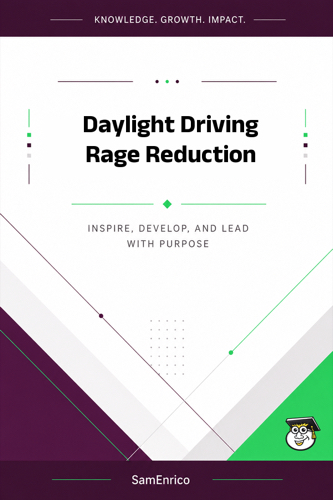
Daylight Driving Rage Reduction eBook
Schedule trips during less congested hours to mini
Schedule trips during less congested hours to minimize anger triggers.
Formats
Free sample
Chapter 1: The 6-Second Bomb--The moment your brain decides to commit an act of road rage takes less time than it takes to sneeze.Six seconds. That is the entire window between a trigger—someone cutting you off, braking without reason, or drifting into your lane—and the full physiological cascade that can lead to screaming, tailgating, aggressive maneuvering, or worse. In six seconds, you transform from a reasonable, functioning adult into someone your mother would not recognize. In six seconds, a lifetime of emotional regulation evaporates like water on hot asphalt.Here is what most anger management courses will never tell you: those six seconds are not a failure of character. They are not evidence that you are secretly a monster.
They are biology. Your brain is wired to protect you, and in traffic, that ancient wiring mistakes a slow driver for a predator and a tailgater for a threat to your life. The result is the same chemical flood our ancestors experienced when facing a saber-toothed cat—cortisol, adrenaline, narrowed focus, and a body primed for combat.The only problem? You are sitting in a climate-controlled metal box moving at seventy miles per hour. There is no saber-toothed cat.
There is only another human being who is probably just as tired, just as late, and just as unaware of you as you are of them.This chapter dismantles the anatomy of driving rage. It names the ten most common triggers and reveals why they cluster during specific hours. It walks you through the biological explosion that happens inside your skull and explains why traditional advice—“just breathe,” “count to ten,” “let it go”—so often fails. Most importantly, it draws a critical distinction that will shape the rest of this book: the difference between prevention and intervention.Prevention means you never light the fuse. Intervention means you try to defuse the bomb after it is already hissing.
One requires strategy. The other requires superhuman willpower. This book is about the first option—but for the times when prevention fails, we will give you real tools, not platitudes.By the end of this chapter, you will understand why you rage, when you are most vulnerable, and whether you are a candidate for prevention (schedule shifting), intervention (emergency protocols), or both. More importantly, you will never again blame yourself for being weak. You will blame your schedule.The Ten Most Common Triggers (And Why They Love Rush Hour)Let us begin with a simple observation that sounds obvious but is almost never discussed in anger management literature: triggers are not evenly distributed throughout the day.If you drive at 3:00 AM, you will rarely encounter tailgaters, slow left-lane drivers, or aggressive gestures.
If you drive at 11:00 AM on a Tuesday, you might see construction or distracted drivers, but the density of triggers is low. However, if you drive between 7:00 and 9:00 AM or between 4:00 and 7:00 PM on a weekday, you enter what traffic psychologists call the trigger-dense zone—where the frequency of provoking events multiplies exponentially.Here are the top ten rage triggers, ranked by how reliably they provoke anger in drivers. Each one spikes dramatically during peak hours.1. Tailgating The driver behind you who sits so close that you can count the bugs on their bumper. This trigger is almost nonexistent in light traffic and omnipresent in dense traffic.
Why? Because in congested conditions, following distance shrinks as a survival strategy—but what feels necessary to one driver feels like aggression to another.2. Being Cut Off When someone swerves into your lane without signaling or with minimal space. In free-flowing traffic, this happens rarely. In stop-and-go traffic, it happens constantly.
The psychological insult is not just the maneuver but the perception of disrespect.3. Slow Left-Lane Drivers The driver who parks in the passing lane at or below the speed limit. This trigger is uniquely American and uniquely infuriating because it violates an unwritten social contract: left lane for passing, right lane for cruising. During peak hours, left-lane camping increases because drivers are desperate to feel like they are making progress.4. Honking The horn is supposed to be a warning device.
In traffic, it becomes a weapon. A single honk can escalate a neutral situation into a confrontation. During peak hours, honking frequency triples, often for offenses as minor as a two-second delay at a green light.5. Aggressive Gestures The finger, the stare, the exaggerated shake of the head. These are social punishments delivered from a distance.
They are more common in congested traffic because drivers feel anonymous and therefore emboldened.6. Construction Delays Nothing makes a driver feel more powerless than a lane closure that reduces three lanes to one. Construction is unpredictable, often poorly signed, and almost always timed for weekday daylight hours—exactly when you are trying to get to work or home.7. Parking Conflicts The circling, the stolen spot, the person who takes forty-five seconds to back into a space while five cars wait. Parking rage is a subset of driving rage, and it peaks during the same congested windows as road rage.8.
Merging Battles The zipper merge is a beautiful theory. In practice, merging becomes a battle of wills, with drivers blocking each other, speeding up to close gaps, and honking at anyone who dares to merge “too early” or “too late.”9. Sudden Braking The brake lights ahead that flash without warning, forcing you to slam your own brakes and spill your coffee. In dense traffic, sudden braking cascades backward like a wave, creating miles of phantom jams.10. Distracted Drivers The person texting, applying makeup, eating a bowl of cereal, or watching a movie on their dashboard-mounted tablet.
Distraction is maddening because it feels preventable. During peak hours, distracted driving actually increases as drivers try to “multitask” their way through gridlock.Notice a pattern? Every single one of these triggers becomes more frequent as traffic density increases. This is not a coincidence. Congestion does not just slow you down—it fills the road with provocations.
The Angry Driver is not a personality type. The Angry Driver is a person who has been exposed to thirty triggers in thirty minutes.The Physiological Cascade: Your Brain on Rage To understand why schedule shifting works and why “just breathe” often fails, you need to understand what happens inside your body between the trigger and the reaction.Step One: The Perception of Threat Your brain processes the world through two parallel systems. The prefrontal cortex is the CEO—rational, slow, deliberate. The amygdala is the security guard—fast, reactive, and prone to overreaction. When you see brake lights flash ahead, both systems activate.
The prefrontal cortex says, “Traffic is slowing. I should ease off the gas.” The amygdala says, “DANGER.”In a calm state, the prefrontal cortex modulates the amygdala. But when you are already tired, already late, and already frustrated, the amygdala seizes control. It does not distinguish between a predator and a slow driver. It only distinguishes between “safe” and “not safe.” A sudden lane change registers as a threat.
A tailgater registers as a predator closing in.Step Two: The Chemical Flood Once the amygdala sounds the alarm, your body releases two chemicals: cortisol and adrenaline. Cortisol is the long-term stress…
This is the end of the free sample. Get the eBook to keep going. Buy now
About this book
Details
- Author
- Jorgenson Ivana
- Publisher
- SamEnrico
- Language
- English
- Genre
- Non-Fiction, Self-Help, Scheduling
- Released
- 2026-06-09
- Pages (approx.)
- 149
- Available as
- eBook, Audiobook

Read better in the ZLOADR app
Your eBooks on your phone or tablet. Sign in with your SamEnrico account and start reading.
More by Jorgenson Ivana
 Cooperative Poultry GuideJorgenson Ivana$11.99
 Deep Ocean Pressure EffectsJorgenson Ivana$11.99Deep Ocean Pressure EffectsJorgenson Ivana$11.99
 Open Office Noise SurvivalJorgenson Ivana$11.99
 Depression in Men GuideJorgenson Ivana$11.99
 The Ripper Letters: Jack the Ripper and the Birth of True Crime SensationalismJorgenson Ivana$11.99
 Printing Press OperatorJorgenson Ivana$11.99
 How to Start a Chrome Tanning Business (Beginners Guide)Jorgenson Ivana$11.99
 Synchrony Financial SWOTJorgenson Ivana$12.99
 Express Entry Profile HandbookJorgenson Ivana$12.99
 Understanding Ornithine Aminotransferase DeficiencyJorgenson Ivana$17.99
You may also like
 Hong Kong Handover 1997Dunn Johnnie$11.99
 Zumba For Postnatal Recovery CourseNeal Christian$11.99
 Zumba for BeginnersLadner Nikia$11.99
 YouTube Comment Mining GuideHumes Pandora$12.99
 Worry Box MeditationCarlin Rudy$11.99
 Workplace Stress MeditationNguyen Lynn$11.99
 Workplace Stress and Sleep RepairHawley Ivory$11.99
 Workplace Perfectionism CureDelaney Jeffry$11.99
 Workplace Injustice Anger GuideWallen Isabelle$11.99
 Work Addiction and Burnout LinkGreenwood Ester$11.99
 Women in Yoga and WellnessBeattie Galina$11.99
 Women in Stand Up ComedyChun Evangeline$11.99