
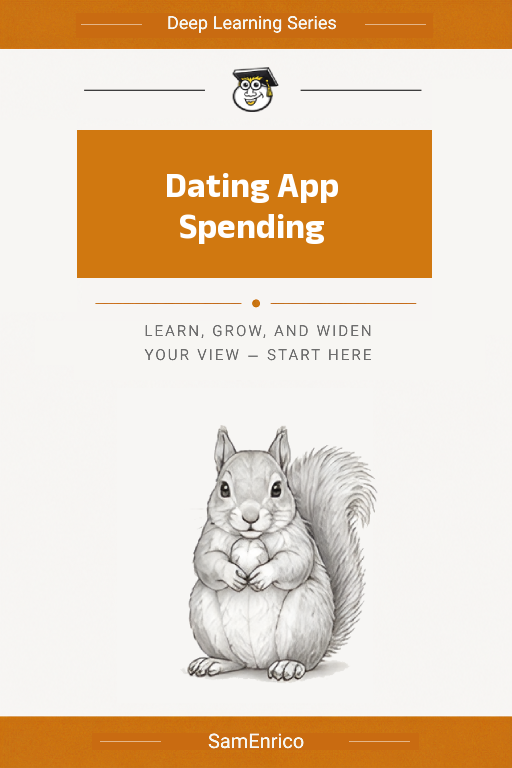
Non-FictionConsumer Mind ReportDating
Dating App Spending eBook
Examine premium subscription adoption, virtual gif
Examine premium subscription adoption, virtual gifts, and in-app purchase behavior on Tinder, Hinge, Bumble.
Formats
Free sample
Chapter 1: The Frustrated Middle...--–- It begins, as it always does, with a number you did not expect to see. Not the number of matches, not the number of dates, and certainly not the number of relationships. The number that matters—the one the apps do not want you to calculate—is the one sitting in your credit card statement at the end of each month, buried between the coffee runs and the grocery delivery. For Jake, a 31-year-old marketing manager in Chicago, that number was 147.For Maria,a29−year−oldnursein Phoenix,itwas147. For Maria, a 29-year-old nurse in Phoenix, it was 147.For Maria,a29−year−oldnursein Phoenix,itwas89.
For David, a 34-year-old teacher in Austin, it was $312. None of them knew these numbers before they were asked to add them up. None of them had any idea how much they were spending on the simple, desperate, and endlessly renewable act of swiping right.This is the invisible economy of modern romance. It is not the economy of flowers, dinners, or movie tickets—the traditional costs of courtship that have been studied by anthropologists and lamented by poets for centuries. This is a new economy, one that exists entirely inside a six-inch screen, mediated by algorithms that you cannot see, designed by product managers you will never meet, and priced by data scientists who know more about your loneliness than your closest friends do.
In 2025, the global dating app industry generated over $6.97 billion in revenue. That is more than the box office receipts for every Hollywood movie released that year. It is more than the combined annual budgets of the National Endowment for the Arts, the National Endowment for the Humanities, and the Corporation for Public Broadcasting. It is a sum large enough to buy a small country's national debt, and it comes almost entirely from a single source: people like you, sitting alone in their apartments, paying for the privilege of being rejected faster.The industry's growth is staggering. From 6.97billionin2025,analystsprojectthemarketwillreach6.97 billion in 2025, analysts project the market will reach 6.97billionin2025,analystsprojectthemarketwillreach12.26 billion by 2030, a compound annual growth rate of nearly twelve percent.
That growth is not driven by an explosion of new users—the user base in North America and Europe has largely plateaued. It is driven by something far more insidious: an increase in how much existing users are willing to pay. The average paying user of a dating app now spends 19.78permonthacrosssubscriptionsandmicrotransactions,upfrom19.78 per month across subscriptions and microtransactions, up from 19.78permonthacrosssubscriptionsandmicrotransactions,upfrom12.34 just three years earlier. That is a sixty percent increase in average revenue per user, achieved not by providing better service, but by perfecting the art of psychological extraction.But here is the question that no dating app executive wants you to ask: Who is actually paying? The answer, as this chapter will reveal, is not who you think.
It is not the highly attractive users who receive dozens of matches without trying. It is not the desperately unattractive users who give up after a week of silence. It is a specific, identifiable, and highly profitable demographic that this book will call the frustrated middle—users who are attractive enough to receive some attention but not enough to feel satisfied, users who hit daily like limits regularly because they are actively swiping but not matching at a high rate, users who exist in the agonizing purgatory of "almost enough."This chapter will dissect the architecture of that frustration. It will explain the psychology of the "like limit," the deliberate creation of the frustration window, and the conversion funnel that turns a free user into a paying customer. It will resolve the apparent contradiction between who pays and who does not.
And it will introduce the diagnostic tool that will allow you, the reader, to determine whether you are the target payer—and what you can do about it.The Invention of Scarcity Before there were dating apps, there was abundance. Or at least, there was the illusion of abundance. When you walked into a bar, you could theoretically talk to anyone. When you attended a party, you could theoretically introduce yourself to every guest. The limit was not technological; it was social, emotional, and practical.
You could not approach one hundred people in a single night because that would be exhausting, inappropriate, and frankly terrifying. The scarcity was organic.Dating apps inverted this dynamic. They removed the social friction of approaching strangers, replacing it with a frictionless interface where a single thumb movement could signal interest or rejection. Suddenly, the practical limit of one hundred people per night became a technological constraint rather than a social one. And in that inversion, the apps discovered something profound: scarcity was not a problem to be solved.
It was a revenue stream to be manufactured.The "like limit" is the most fundamental mechanism in the dating app monetization playbook. On Tinder Free, users receive approximately one hundred right-swipes (likes) per twelve-hour period. On Bumble Free, the limit is more aggressive—approximately fifty likes per day, with a reset every twenty-four hours. On Hinge Free, the limit is measured not in likes but in Roses (the premium virtual gift), with free users receiving only eight likes per day and a single Rose per week. These numbers are not arbitrary.
They are the result of thousands of A/B tests, conducted over years, designed to identify the precise threshold at which a user transitions from engagement to frustration.The science behind the limit is derived from behavioral economics, specifically the concept of intermittent reinforcement. In experiments dating back to B.F. Skinner's work with pigeons in the 1950s, researchers discovered that subjects would continue a behavior longest when the reward was unpredictable and intermittent, rather than guaranteed or absent. Dating apps apply this principle by calibrating the like limit such that most users receive just enough matches to stay engaged—perhaps two or three per day—but not enough to feel satiated. The user swipes through their daily allotment, receives a small reward, and then is forced to wait.
That waiting period is when the conversion happens.Data from internal Match Group documents, leaked in a 2024 antitrust lawsuit, reveals the precise calibration. Tinder's data science team identified what they called the "Goldilocks zone" for match rates: users who received between three and seven matches per day had the highest lifetime value (LTV), while users who received more than twelve matches per day rarely converted to paying subscribers, and users who received fewer than one match per day churned within two weeks. The like limit was therefore set to ensure that the average user—the one in the middle of the attractiveness distribution—received exactly three to seven matches per day. For Tinder's median user, that required a limit of approximately one hundred swipes per day, based on an average match rate of five percent.But here is the critical insight that the apps do not advertise: The like limit does not apply equally to all users. Highly attractive users—the top twenty percent by engagement metrics—receive so many incoming likes that they rarely swipe at all.
They are the "receivers" in the dating economy, and they have no need to pay because the product (attention) comes…
This is the end of the free sample. Get the eBook to keep going. Buy now
About this book
Details
- Author
- Holliday Heide
- Publisher
- SamEnrico
- Language
- English
- Genre
- Non-Fiction, Consumer Mind Report, Dating
- Released
- 2026-05-29
- Pages (approx.)
- 152
- Available as
- eBook, Audiobook

Read better in the ZLOADR app
Your eBooks on your phone or tablet. Sign in with your SamEnrico account and start reading.
More by Holliday Heide
 Improv for FriendshipsHolliday Heide$11.99
 Downshift Stress Less GuideHolliday Heide$11.99
 Amazon GST for Non US SellersHolliday Heide$11.99
 The Metta for Self Forgiveness GuideHolliday Heide$11.99
 Financial Stress for JanitorsHolliday Heide$11.99
 Voltaire's Spark: Igniting the Age of ReasonHolliday Heide$11.99
 How to Start a Dress Shield Business (Beginners Guide)Holliday Heide$11.99
 FATCA Non Resident LLC GuideHolliday Heide$12.99
 Understanding Reactive Attachment Disorder of InfancyHolliday Heide$17.99
 HVAC Counter SalesHolliday Heide$11.99
You may also like
 Hong Kong Handover 1997Dunn Johnnie$11.99
 Zumba For Postnatal Recovery CourseNeal Christian$11.99
 Zumba for BeginnersLadner Nikia$11.99
 YouTube Comment Mining GuideHumes Pandora$12.99
 Worry Box MeditationCarlin Rudy$11.99
 Workplace Stress MeditationNguyen Lynn$11.99
 Workplace Stress and Sleep RepairHawley Ivory$11.99
 Workplace Perfectionism CureDelaney Jeffry$11.99
 Workplace Injustice Anger GuideWallen Isabelle$11.99
 Work Addiction and Burnout LinkGreenwood Ester$11.99
 Women in Yoga and WellnessBeattie Galina$11.99
 Women in Stand Up ComedyChun Evangeline$11.99