
Non-FictionProfessional's Cheat SheetPress Release FormatDateline Strategy
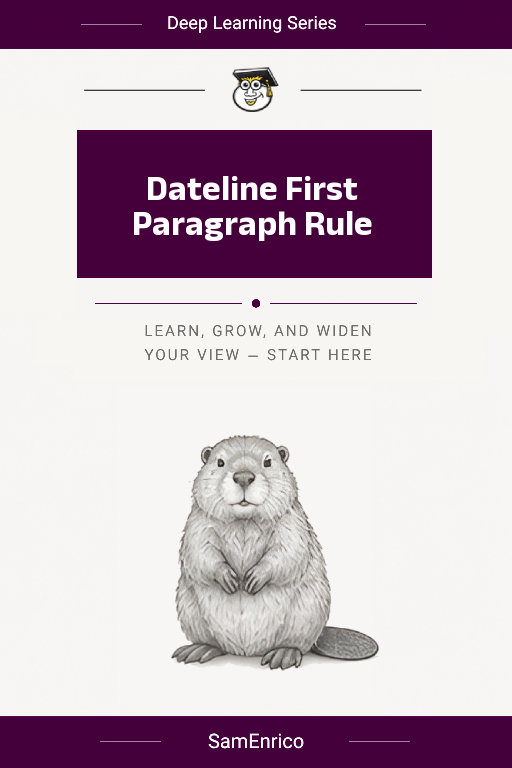
Dateline First Paragraph Rule eBook
Start with city, date, then your most newsworthy s
Start with city, date, then your most newsworthy sentence in 25 words or fewer.
Formats
Free sample
Chapter 1: The Buried Lead...-- The most expensive sentence you will ever write is the one your reader never reads. It sits there, perfectly grammatical, logically structured, and completely invisible—because by the time you finish your eighth word, the person you needed to convince has already scrolled, deleted, or clicked away. Every day, millions of professionals write thousands of sentences that die exactly this way: alone, unread, and entirely preventable.This book exists because of a single, fixable problem. Most writers—whether journalists, executives, bloggers, or founders—bury their most important information somewhere after the reader has already decided to leave. They start with throat-clearing.
They begin with context. They open with background, with pleasantries, with “As you may recall,” with “It is worth noting that,” with “In the current environment of unprecedented change.” By the time they arrive at the actual news, the reader is gone. The dateline-first paragraph rule—starting with city, date, and a newsworthy sentence of twenty-five words or fewer—is not a journalistic relic. It is a neurological lever. It is a structural guarantee that your reader knows, within two seconds, three things: where this happened, when this happened, and why they should care.Before we dismantle the anatomy of the rule, we must first understand the enemy it defeats.
That enemy is the buried lead.The Thousand-Dollar Throat Clear In 2019, a technology startup founder named Marcus sent an email to seventeen potential investors. He had been working on the email for three days. He had run it past his head of product, his communications lead, and two external advisors. The email was four hundred and seventy-two words long. Its first sentence read: “Following a period of significant internal evaluation and strategic alignment with our long-term roadmap, we are excited to announce a series of operational adjustments that will position us for sustained growth in the coming fiscal cycle.”Marcus was proud of that sentence.
It sounded professional. It sounded careful. It sounded like every other email those investors received.Fourteen of the seventeen investors never replied. Two replied with polite “thanks, but not at this time” messages. One scheduled a call—and then canceled.Six months later, Marcus rewrote that same announcement as a dateline-first paragraph.
He had learned the rule from a former Associated Press reporter who had joined his company as a content lead. The new version read: “SAN FRANCISCO, March 12—We are cutting 12% of staff and shutting our Atlanta office.” That was it. Twenty-one words. City, date, news.He sent it to the same seventeen investors, plus three new ones. Twelve replied within twenty-four hours.
Six asked for calls. Two offered bridge financing.The facts had not changed. The company was still cutting staff. The Atlanta office was still closing. But the first version had buried that news so deep inside corporate throat-clearing that no one trusted it—or even read it.
The second version delivered the news immediately. The difference was not tone or truth. The difference was architecture.The buried lead is not a moral failing. It is a structural error. And like all structural errors, it can be fixed with a rule.The Reader’s Deal: Eight Seconds or Nothing Before we examine the components of the rule, we must accept an uncomfortable fact about the person on the other side of your sentence.
That person is not patient. That person is not grateful. That person is not sitting in a quiet library with a cup of tea, waiting to savor your carefully constructed opening paragraph.That person is scrolling.Eye-tracking studies conducted by the Poynter Institute and the Nielsen Norman Group have consistently found that the average reader spends between eight and fourteen seconds on a typical article or email before deciding whether to continue. On mobile devices, that window shrinks to six to eight seconds. On social media feeds, it is closer to three seconds.
These numbers are not opinions. They are measurements of how human attention actually behaves when faced with an endless stream of competing content.Here is what happens in those eight seconds. The reader’s eyes land on the first few words of your first sentence. If those words do not immediately provide a location, a time, or a reason to care, the eyes begin to drift toward the next item in the feed, the next email in the inbox, the next headline in the queue. The decision to leave is not a conscious rejection of your writing.
It is an automatic filtering mechanism—the same mechanism that prevents you from reading every billboard, every sign, every notification that crosses your peripheral vision.The dateline-first paragraph works because it speaks directly to that filtering mechanism. It does not ask the reader to wait. It does not demand context or patience or trust. It gives the reader what they need in the order they need it: place first, time second, significance third. This order is not arbitrary.
It mirrors how the human brain orients itself to new information.Imagine someone grabs your arm and says, “Listen to this.” Your first question is not “What happened?” Your first question is “Where are we?” and “When did this happen?” You need to orient yourself in space and time before you can evaluate the significance of an event. The dateline-first paragraph answers those orientation questions before you even have to ask them.The Three Components, Defined and Defended The rule has three components. Under the Strict Rule—which applies to breaking news, business emails, crisis communications, and any time-sensitive writing—all three are mandatory and must appear in the same paragraph. Under the Flex Rule—which applies to features, evergreen content, and creative writing—the date is optional, but its omission carries a warning: no date signals lower urgency, so use it only when timeliness is irrelevant to your reader.Component One: The City The city anchors the reader geographically. It answers the question “Where am I?” before the reader has to ask it.
In a news context, the city is typically rendered in all caps: “LONDON.” “TOKYO.” “SAN FRANCISCO.” This convention dates back to the telegraph era, when all-caps datelines helped operators distinguish location metadata from story content. In digital contexts, mixed case is increasingly common, but the function remains the same.The city you choose matters enormously. It is not simply the place where something happened. It is a signal of credibility, access, and relevance. A story datelined “KYIV” during a war signals that the reporter is either on the ground or has access to on-the-ground sources.
A story datelined “NEW YORK” for an event that occurred in New Jersey signals something else: convenience. The writer chose the famous city because it sounded more impressive, not because it was accurate.Chapter 3 will explore the Access × Relevance matrix in detail, but for now, remember this: the city in your dateline is a promise. It promises that the event happened there, or that you were there, or that the location is essential to understanding the story. If you cannot keep that promise, choose a different city—or drop the dateline entirely and use the Flex Rule.Component Two: The Date The date answers the question “When…
This is the end of the free sample. Get the eBook to keep going. Buy now
About this book
Details
- Author
- Dooley Glynis
- Publisher
- SamEnrico
- Language
- English
- Genre
- Non-Fiction, Professional's Cheat Sheet, Press Release Format, Dateline Strategy
- Released
- 2026-05-30
- Pages (approx.)
- 151
- Available as
- eBook, Audiobook

Read better in the ZLOADR app
Your eBooks on your phone or tablet. Sign in with your SamEnrico account and start reading.
More by Dooley Glynis
 Wholesaling Tax Strategy GuideDooley Glynis$11.99
 Email Distraction BatchingDooley Glynis$11.99
 The Perfectionism Recovery WorkbookDooley Glynis$11.99
 Spin Sprint Finish DrillsDooley Glynis$11.99
 Dream Journal for Recurring ThemesDooley Glynis$11.99
 Wholesaling HUD Properties GuideDooley Glynis$11.99
 Carpool Lane Stress GuideDooley Glynis$11.99
 Pain Breath Tolerance PracticeDooley Glynis$11.99
 Howard Schultz ReturnDooley Glynis$11.99
 Quetzalcoatl’s Flute: The Serpent’s Divine MelodyDooley Glynis$11.99
 Oscar Wilde: The Wit, the Scandal, and the MasterpieceDooley Glynis$11.99
 The Green Book of Greenwood: How a Community Built Wealth Beyond the PagesDooley Glynis$11.99
You may also like
 Hong Kong Handover 1997Dunn Johnnie$11.99
 Zumba For Postnatal Recovery CourseNeal Christian$11.99
 Zumba for BeginnersLadner Nikia$11.99
 YouTube Comment Mining GuideHumes Pandora$12.99
 Worry Box MeditationCarlin Rudy$11.99
 Workplace Stress MeditationNguyen Lynn$11.99
 Workplace Stress and Sleep RepairHawley Ivory$11.99
 Workplace Perfectionism CureDelaney Jeffry$11.99
 Workplace Injustice Anger GuideWallen Isabelle$11.99
 Work Addiction and Burnout LinkGreenwood Ester$11.99
 Women in Yoga and WellnessBeattie Galina$11.99
 Women in Stand Up ComedyChun Evangeline$11.99