
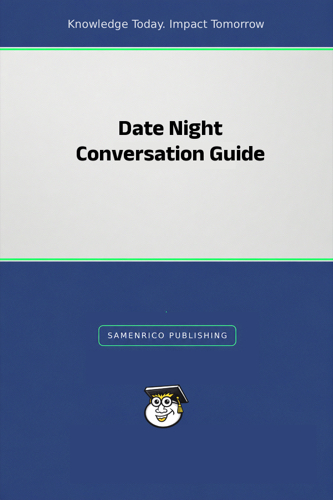
Date Night Conversation Guide eBook
Avoid awkward silences on first dates and long ter
Avoid awkward silences on first dates and long term relationships using this practical workbook.
Formats
Free sample
Chapter 1: The Hidden Truth...--–- Most people think awkward silences happen because they have nothing to say. That is wrong. Awkward silences happen because you have something to say but you are afraid to say it. The pause before the risky question. The hesitation before the vulnerable confession.
The moment when your brain serves up a perfect, meaningful follow-up – and your mouth refuses to launch it. That gap between knowing what to say and saying it is where every awkward silence is born. This chapter is about closing that gap.The Fear Beneath the Quiet Let us start with an experiment. Think back to the last time you sat across from someone – a first date, a partner of ten years, a friend you wanted to know better – and the conversation died. Not the comfortable silence of two people who trust each other.
The other kind. The kind where you start scanning the room for a rescue. The kind where you suddenly become very interested in the texture of your napkin or the temperature of your water glass. The kind where your internal monologue screams, "Say something, anything, you absolute fool."What were you afraid of in that moment?If you are like most people, your answer falls into one of three categories. First, the fear of being boring: "I have nothing interesting to contribute." Second, the fear of rejection: "If I say what I am really thinking, they will judge me." Third, the fear of conflict: "If I ask that question, we might end up fighting."Here is the hidden truth that every best-selling relationship book confirms but almost no one says out loud: those three fears are not separate problems.
They are all the same problem wearing different masks. The fear of being boring, the fear of rejection, and the fear of conflict are all just the fear of emotional risk. You are not bad at conversation. You are scared of what might happen if you actually try.And here is the second hidden truth: the person across from you is equally scared. That is why most conversations stay shallow.
Two people, each waiting for the other to take the first risk, each mistaking the other's caution for disinterest. The result is not a conversation. It is a standoff. And the silence that fills the space between you is not empty. It is full of everything you are both too afraid to say.Why Information Exchange Is Not Connection Here is a distinction that changes everything.
There are two completely different things that people call "conversation." The first is information exchange. This is the world of facts, schedules, logistics, and surface-level reporting. "I had a busy day." "The meeting got moved to Thursday." "We need milk." "My sister called." Information exchange is useful. It is necessary. It keeps households running and projects on track.
But it does not create emotional connection.The second is emotional connection. This is the world of feelings, dreams, vulnerabilities, and shared meaning. "I had a busy day and honestly, I felt invisible in that meeting." "My sister called and I realized I miss her more than I admit." "I have been thinking about what I want to be when I grow up, and I am terrified I am already there." Emotional connection is risky. It requires you to be seen. It requires you to admit that you have fears, desires, regrets, and hopes that might sound silly out loud.Most awkward silences happen not because people have nothing to say, but because they do not know how to transition from information exchange to emotional connection.
You are sitting across from someone, exchanging facts like two people passing notes through a slot in a door, and somewhere inside you, there is a voice saying, "This is not enough. I want to actually feel something with this person." But you do not know how to open the door.So you stay on the surface. And the silence that follows a surface-level exchange – after the "how was your day" has been answered with "fine" – is not a failure of words. It is a failure of courage.The Three-Word Question That Changes Everything Before we go any further, I need you to understand something about this workbook. It is not going to give you a script for every possible situation.
That would be impossible, and it would also make you a robot. What it is going to give you is a handful of small, repeatable, almost absurdly simple tools that work in almost every situation. The first tool is three words long."Tell me more."That is it. Those three words are the single most powerful phrase in the entire English language for transforming shallow conversation into deep connection. And almost no one uses them.Here is why they work.
When someone shares something with you – even something small – they are almost always sharing only the tip of the iceberg. "I had a rough day at work" is the tip. Beneath it is a whole mountain of specifics: what made it rough, who said what, how it felt in your body, what it reminded you of, what you wish had happened instead. But most people stop at the tip because they are not sure you want to hear the rest. They are testing the waters.
"Tell me more" is your way of saying, "I am not just tolerating you. I am genuinely interested. The water is warm. Go deeper."Try this tonight. The next time someone says anything to you – "I am tired," "I have been thinking about my mom," "I am excited about this project" – instead of responding with your own parallel story (which is what most people do), say "tell me more." And then be quiet.
Let them talk. Watch what happens. I promise you, they will light up. Because almost no one ever gives them permission to be more than the tip of the iceberg.This chapter is not just about understanding the problem. It is about practicing the first solution.
By the time you finish this chapter, you will have used "tell me more" at least five times. Keep a tally. I am serious.The Attachment Style That Shapes Every Conversation You Have Let us get a little bit uncomfortable. Everything you just read about fear and risk and silence? It does not affect everyone the same way.
Your attachment style – the pattern of relating to others that you learned before you could talk – determines how you experience conversational risk. This comes from decades of research on attachment theory, most famously from the book Attached by Amir Levine and Rachel Heller, and it explains why some people panic in silence while others feel relieved.There are four attachment styles. Read the descriptions below and see which one sounds most like you.Secure attachment (roughly 50% of people). You are generally comfortable with intimacy and with independence. You believe that most people have good intentions.
When a conversation hits a rough patch or a silence stretches too long, you assume it is temporary and fixable. You can ask for what you need without spiraling. You can hear difficult things without collapsing. If you are securely…
This is the end of the free sample. Get the eBook to keep going. Buy now
About this book
Details
- Author
- Jessup Roseline
- Publisher
- SamEnrico
- Language
- English
- Genre
- Non-Fiction, Self-Help, Dating
- Released
- 2026-06-06
- Pages (approx.)
- 129
- Available as
- eBook, Audiobook

Read better in the ZLOADR app
Your eBooks on your phone or tablet. Sign in with your SamEnrico account and start reading.
More by Jessup Roseline
 Meeting Free Fridays GuideJessup Roseline$11.99
 Flow for Healthcare WorkersJessup Roseline$11.99
 Food Addiction Journal PromptsJessup Roseline$11.99
 The Boredom Eating GuideJessup Roseline$11.99
 The Last Broadcast: How a 1920s Radio Station Predicted the FutureJessup Roseline$11.99
 Understanding White Sponge NevusJessup Roseline$17.99
 Transport EngineerJessup Roseline$11.99
 How to Start a Blast Freezing for Land Transport Business (Beginners Guide)Jessup Roseline$11.99
 Ghana Agritech GuideJessup Roseline$12.99
 Founder Therapy While BuildingJessup Roseline$12.99
You may also like
 Hong Kong Handover 1997Dunn Johnnie$11.99
 Zumba For Postnatal Recovery CourseNeal Christian$11.99
 Zumba for BeginnersLadner Nikia$11.99
 YouTube Comment Mining GuideHumes Pandora$12.99
 Worry Box MeditationCarlin Rudy$11.99
 Workplace Stress MeditationNguyen Lynn$11.99
 Workplace Stress and Sleep RepairHawley Ivory$11.99
 Workplace Perfectionism CureDelaney Jeffry$11.99
 Workplace Injustice Anger GuideWallen Isabelle$11.99
 Work Addiction and Burnout LinkGreenwood Ester$11.99
 Women in Yoga and WellnessBeattie Galina$11.99
 Women in Stand Up ComedyChun Evangeline$11.99