
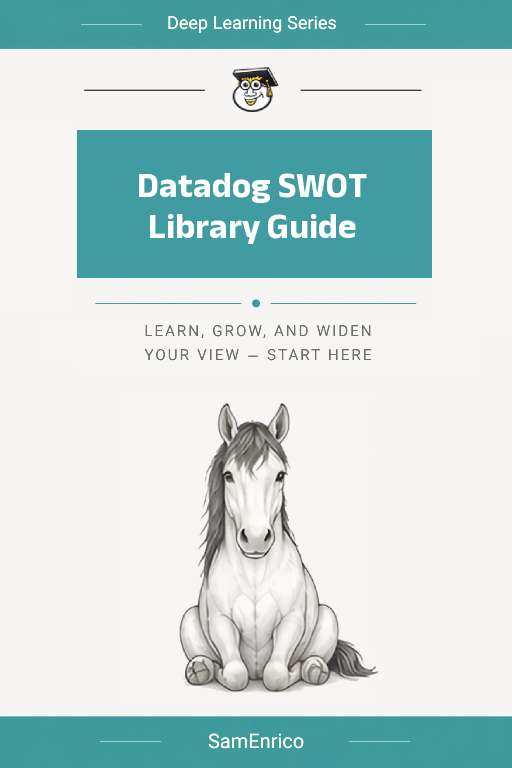
Non-FictionStrategic AtlasObservability
Datadog SWOT Library Guide Audiobook
Evaluate observability platform, cloud-native focu
by Nance Linn
Evaluate observability platform, cloud-native focus, competition from Dynatrace and New Relic, and margin profile.
Formats
Free sample
Chapter 1: The Four Signals--The first time a production database falls over at 2 AM and you cannot figure out why, you stop believing in monitoring. You start believing in observability.For a decade, the industry sold us monitoring as the answer. Nagios alerts. Zabbix dashboards. Solar Winds maps.
The premise was simple: if you collected enough metrics from enough servers and set enough thresholds, you would know when something broke. And for static infrastructure—physical servers with names like db-prod-01 that lived for years—it worked. The server had an IP address. The IP address had a CPU utilization. The CPU utilization had a threshold.
When the threshold crossed, an email went out. An on-call engineer woke up, SSH'd into the server, and fixed the problem.That world is gone.In its place are Kubernetes pods that live for ninety seconds, serverless functions that execute in 187 milliseconds, and service meshes where a single HTTP request touches seventeen different containers across three cloud providers. The server named db-prod-01 no longer exists. In its place are payment-service-v2-7b8f9c-d7xk2 and payment-service-v2-7b8f9c-lq3m9—identical, ephemeral, and gone before you can type kubectl logs. The IP address changes with every deployment.
The CPU utilization is meaningless because the container only lives for ninety seconds. And the threshold? Good luck defining one.This is not a technology problem. It is a philosophical problem. And the philosophy has a name: observability.The Formal Definition In control theory, observability is a formal property of a system.
A system is observable if its internal state can be determined from its external outputs. Translated from engineering mathematics into the language of software: you should be able to understand what is happening inside your distributed system without SSH-ing into individual machines, without guessing, and without restarting things at random.The difference between monitoring and observability is the difference between a speedometer and a diagnostic computer. A speedometer tells you that you are going too fast. A diagnostic computer tells you that cylinder three is misfiring because the fuel injector is clogged, which is causing the engine to run lean, which is why the check engine light came on. Monitoring tells you that something is wrong.
Observability tells you what, where, and why.This distinction matters because cloud-native architectures are fundamentally unobservable by default. When a request traverses seventeen services, each running in an ephemeral container…
This is the end of the free sample. Get the Audiobook to keep going. Buy now
About this book
Details
- Author
- Nance Linn
- Publisher
- SamEnrico
- Language
- English
- Genre
- Non-Fiction, Strategic Atlas, Observability
- Released
- 2026-05-28
- Pages (approx.)
- 150
- Available as
- eBook, Audiobook

Listen in the VoxFlicks app
Audiobooks and audio dramas wherever you go. Sign in with your SamEnrico account and press play.
More by Nance Linn
 Imposter Syndrome Thought LogNance Linn$11.99
 Food Desert FamilyNance Linn$11.99
 The Joy of ArtNance Linn$11.99
 Mindfulness for Chronic Pain BeginnersNance Linn$11.99
 Assertive Sales CommunicationNance Linn$11.99
 The Inferno of Dante: A Divine Vision in VerseNance Linn$11.99
 How to Start a Bagpipes and Reeds Business (Beginners Guide)Nance Linn$11.99
 Call Center RepresentativeNance Linn$11.99
 Contribution Margin Formula HandbookNance Linn$12.99
 Understanding Myoglobinuria RecurrentNance Linn$17.99
You may also like
 Hong Kong Handover 1997Dunn Johnnie$11.99
 Zumba For Postnatal Recovery CourseNeal Christian$11.99
 Zumba for BeginnersLadner Nikia$11.99
 YouTube Comment Mining GuideHumes Pandora$12.99
 Worry Box MeditationCarlin Rudy$11.99
 Workplace Stress MeditationNguyen Lynn$11.99
 Workplace Stress and Sleep RepairHawley Ivory$11.99
 Workplace Perfectionism CureDelaney Jeffry$11.99
 Workplace Injustice Anger GuideWallen Isabelle$11.99
 Work Addiction and Burnout LinkGreenwood Ester$11.99
 Women in Yoga and WellnessBeattie Galina$11.99
 Women in Stand Up ComedyChun Evangeline$11.99