
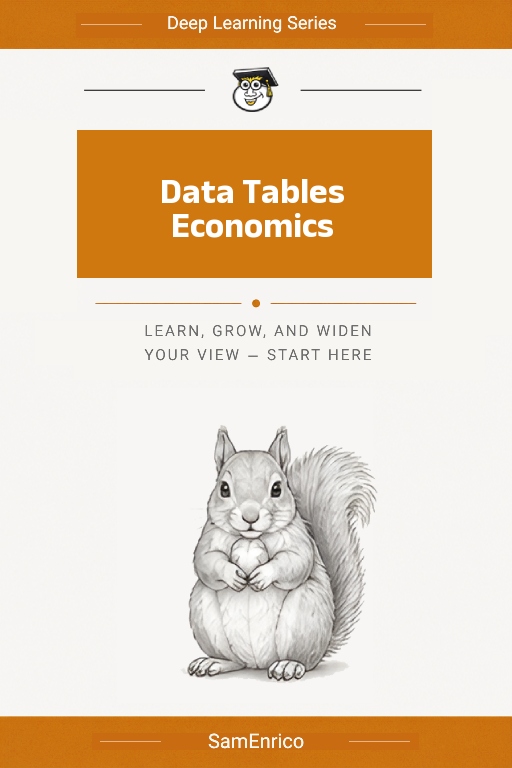
Non-FictionStudent's ShortcutTables
Data Tables Economics Audiobook
Create one variable and two variable data tables f
Create one variable and two variable data tables for sensitivity analysis in economics exams.
Formats
Free sample
Chapter 1: The $50,000 Typo--The email arrived at 11:47 PM on a Tuesday. Sarah, a second-year analyst at a mid-sized investment firm, had been working eighteen-hour days for three weeks on a $50 million real estate acquisition. Her discounted cash flow model was perfect—every formula checked, every assumption sourced from reputable market reports, every scenario analyzed. She clicked send on the investment committee memo recommending rejection. The projected return fell 0.4% short of the firm’s hurdle rate.The next morning, her managing director called her into his office.
“Change the interest rate assumption from 6.0% to 6.5%,” he said. “The Fed just signaled a hike. Run it again.”Sarah opened her model, changed one cell, and watched the return fall even further. She changed it back to 6.0%, then tried 5.8%. Nothing worked.
The deal was dead.But what she didn’t know—and what she would learn three months later when a competitor acquired the same property and generated a 22% annual return—was that her single-point estimate of the vacancy rate was off by just 1.2%. That one assumption, changed by less than one percentage point, would have flipped her recommendation from “reject” to “strong buy.” She had never tested it. She had never built a data table.This book exists to ensure that never happens to you.The Illusion of Certainty in Economic Decision-Making Every economic model you will ever build—whether for an exam, a business proposal, or a multi-billion dollar investment decision—rests on a foundation of assumptions. These assumptions are, by definition, guesses about the future. Some guesses are educated.
Some are based on decades of historical data. But all of them share one characteristic: they are almost certainly wrong.The question is not whether your assumptions will be incorrect. The question is which assumptions, when wrong, will destroy your decision—and which ones barely matter.Let us consider a simple example that appears on economics exams worldwide. A company is considering a direct mail marketing campaign. The analyst projects a response rate of 8%, generating 15profitperresponder.Thefixedcostsofthecampaignare15 profit per responder.
The fixed costs of the campaign are 15profitperresponder.Thefixedcostsofthecampaignare200,000. The net present value calculation shows a negative $50,000. The student writes “reject” and moves to the next question.But what if the response rate is actually 10%? At 10%, the same calculation yields a positive 30,000NPV—an30,000 NPV—an 30,000NPV—an80,000 swing from a two-percentage-point change in a single assumption. The recommendation flips from “reject” to “accept.” The…
This is the end of the free sample. Get the Audiobook to keep going. Buy now
About this book
Details
- Author
- Silvers Marin
- Publisher
- SamEnrico
- Language
- English
- Genre
- Non-Fiction, Student's Shortcut, Tables
- Released
- 2026-05-28
- Pages (approx.)
- 153
- Available as
- eBook, Audiobook

Listen in the VoxFlicks app
Audiobooks and audio dramas wherever you go. Sign in with your SamEnrico account and press play.
More by Silvers Marin
 Loneliness After Moving Back HomeSilvers Marin$11.99
 Time Saving Kitchen HacksSilvers Marin$11.99
 P 8 Poseidon PilotSilvers Marin$11.99
 The Immigrant AI PioneerSilvers Marin$11.99
 Medication For Seasonal DepressionSilvers Marin$11.99
 Problem Framing TechniquesSilvers Marin$11.99
 Nutrition For ConcentrationSilvers Marin$11.99
 Grit for Remote WorkersSilvers Marin$11.99
 The Vanishing Witness: How Lucky Luciano’s Informant Disappeared ForeverSilvers Marin$11.99
 The Phantom Bank Robber of Buenos Aires: The Untouchable Outlaw of the 1920sSilvers Marin$11.99
 How to Become a Pug-mill-operator HelperSilvers Marin$11.99
 A Collector's Handbook to the Marendaz 70, 13Silvers Marin$11.99
You may also like
 Hong Kong Handover 1997Dunn Johnnie$11.99
 Zumba For Postnatal Recovery CourseNeal Christian$11.99
 Zumba for BeginnersLadner Nikia$11.99
 YouTube Comment Mining GuideHumes Pandora$12.99
 Worry Box MeditationCarlin Rudy$11.99
 Workplace Stress MeditationNguyen Lynn$11.99
 Workplace Stress and Sleep RepairHawley Ivory$11.99
 Workplace Perfectionism CureDelaney Jeffry$11.99
 Workplace Injustice Anger GuideWallen Isabelle$11.99
 Work Addiction and Burnout LinkGreenwood Ester$11.99
 Women in Yoga and WellnessBeattie Galina$11.99
 Women in Stand Up ComedyChun Evangeline$11.99