
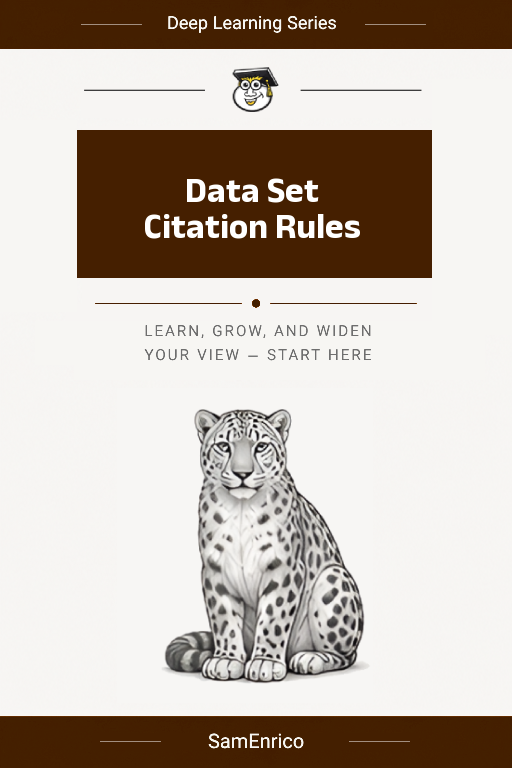
Data Set Citation Rules
Cite statistical data and research datasets from r
Cite statistical data and research datasets from repositories like ICPSR.
Formats
About this book
Free sample
Chapter 1: The Authorship Trap--–- Dr. Elena Vasquez had spent eighteen months cleaning her longitudinal health dataset. She had secured IRB approval, negotiated data use agreements with three hospitals, and written custom R scripts to merge disparate electronic health records. When she finally submitted her paper to the American Journal of Public Health, she felt the quiet satisfaction of a job done right. Two weeks later, the desk rejection arrived.
The editor's note was brief: "Your data citation attributes authorship to 'ICPSR' rather than the principal investigators. Please correct and resubmit." Eighteen months of work, held up by a name.Elena's story is not unusual. In fact, it is so common that data librarians have a name for it: the Authorship Trap. It happens when a researcher assumes that the repository hosting the data is also the author of the data. It happens when a reference manager automatically populates the author field with "ICPSR" or "Figshare" or "Zenodo" because that is what the metadata says.
And it happens every day, in labs and libraries and graduate student carrels across the world, costing researchers weeks of revision time and, in some cases, outright rejection.But here is the truth that most style guides will not tell you: there is no single correct answer to the question "Who is the author of a dataset?" The answer depends on three variables—the repository's metadata schema, the style guide you are using, and the nature of the data itself. This chapter provides a unified decision tree that resolves these variables into a single, repeatable process. By the end of this chapter, you will never again guess who to list as the author of a dataset.The Three Faces of Data Authorship Before we can build a decision tree, we must understand why data authorship is so confusing in the first place. Traditional publishing has a relatively straightforward model: the person who writes the words is the author. Datasets, however, are produced through complex chains of labor.
Consider a typical ICPSR dataset. A principal investigator (PI) designs the study and secures funding. A team of graduate students…
This is the end of the free sample. Get the eBook to keep going. Buy now
Contents
- Chapter 1
- Chapter 2
- Chapter 3
- Chapter 4
- Chapter 5
- Chapter 6
- Chapter 7
- Chapter 8
- Chapter 9
- Chapter 10
- Chapter 11
- Chapter 12
Details
- Author
- Dunham Kassie
- Publisher
- SamEnrico
- Language
- English
- Genre
- Non-Fiction, Student's Shortcut
- Released
- 2026-05-29
- Pages (approx.)
- 150
- Available as
- eBook, Audiobook

Read better in the ZLOADR app
Your eBooks on your phone or tablet. Sign in with your SamEnrico account and start reading.
More by Dunham Kassie
 Financial Stress And Relationships GuideDunham Kassie$11.99
 Snapchat Perfection Pressure GuideDunham Kassie$11.99
 Rivalry Fuel Performance BoostDunham Kassie$11.99
 Carson Pennsylvania HomeDunham Kassie$11.99
 Multitasking Burnout MythDunham Kassie$11.99
 Habit for DepressionDunham Kassie$11.99
 The Boundary Setting TeenDunham Kassie$11.99
 The Golden Child Burden WorkbookDunham Kassie$11.99
 Imposter Syndrome For WomenDunham Kassie$11.99
 The Lost Tongues of the Pamirs: A Linguist’s Perilous Quest in the Roof of the WorldDunham Kassie$11.99
 The Day the Internet Almost Broke: The 2016 Dyn Cyberattack ExposedDunham Kassie$11.99
 Nefertem's Golden Breath: The Lotus-Born Healer of the NileDunham Kassie$11.99
You may also like
 LSE Online Program LengthAgee Letisha$11.99
 Harvard Extension School for Working AdultsRoush Yer$11.99
 LSE Online Reading ListAshford Ludivina$11.99
 LSE Online Language RequirementsWhitten Daphine$11.99
 LSE Online Class SizeHughey Garret$11.99
 LSE Online Alumni MentorshipWild Lyla$11.99
 London School of Economics Alumni NetworkDutton Chantal$11.99
 Harvard Extension School Student SupportCantrell Christene$11.99
 Harvard Extension School Library AccessSantana Adah$11.99
 Harvard Extension School Degree CompletionBray Wyatt$11.99
 Harvard Extension School Course AuditingAbbott Craig$11.99
 Harvard Extension School Extension DiplomaNew Joane$11.99