
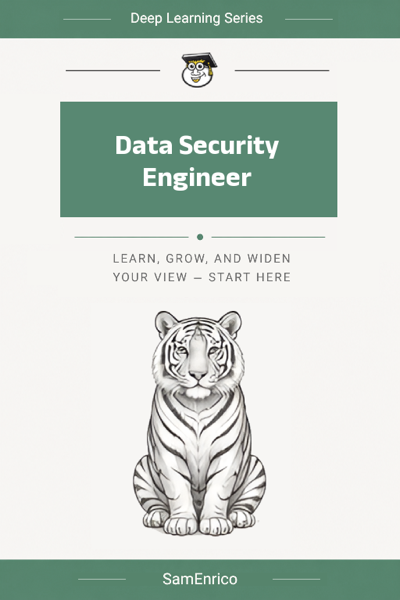
Data Security Engineer eBook
A Coursebook on Data Security Engineer
A Coursebook on Data Security Engineer
Formats
Free sample
Chapter 1: The $10,000,000 Blindspot...--It was 2:47 AM on a Tuesday when Maria, the lead security analyst at a Fortune 500 financial services firm, realized something was terribly wrong. Her SIEM dashboard had been quiet for eleven days. Not "low activity" quiet. Completely silent. Zero alerts.
Zero anomalies. Zero anything.Her stomach dropped.She pulled up the raw log feed from the company's core trading servers. Nothing. She checked the collectors. Running.
She checked the network. Connected. The logs were simply... gone.For eleven days, an attacker had been moving laterally through the organization's most sensitive infrastructure. They had disabled logging on seventeen critical servers.
They had covered their tracks so completely that the SIEM—a $3 million investment—had been showing Maria a beautiful, green, "all clear" dashboard while the breach happened in plain sight.The total cost of that incident, including regulatory fines, customer compensation, and emergency response contractors: $47 million.The root cause? Not a failure of technology. Not a lack of tools. A failure of data.This is the problem that the Data Security Engineer exists to solve.The Great Illusion of Modern Cybersecurity Walk into any cybersecurity conference, and you'll see a familiar pattern. Vendors promise the impossible: "AI-powered threat detection." "Zero-day prevention." "Autonomous response." Organizations spend millions on these tools, stacking firewalls behind firewalls, deploying endpoint detection and response (EDR) on every laptop, and subscribing to dozens of threat intelligence feeds.And yet, the average time to detect a breach remains 277 days according to the 2024 IBM Cost of a Data Breach Report.
That's nearly nine months. Nine months of attackers reading email, stealing credentials, and exfiltrating intellectual property while the security team looks at a dashboard that says everything is fine.Here's the uncomfortable truth that no vendor wants you to hear: your SIEM is not broken. Your data is.The security industry has spent the last decade building better mousetraps without stopping to ask whether there are any mice in the room. We've invested in sophisticated detection rules, machine learning models, and orchestration playbooks—all of which depend on a single, fragile prerequisite: high-quality, complete, timely telemetry.When that telemetry is missing, corrupted, or delayed, the most expensive security tool in the world becomes a very expensive paperweight.Defining the Data Security Engineer Let me introduce you to a role that didn't exist five years ago but is now one of the fastest-growing positions in cybersecurity. The Data Security Engineer sits at the intersection of two traditionally separate disciplines: data engineering and security operations.The Security Analyst eats the food.
They interpret alerts, hunt for threats, and respond to incidents. They can tell you what happened, but they often cannot tell you why the data that would have revealed the attack was missing in the first place.The Data Engineer cooks the food but doesn't taste it. They build pipelines for business intelligence, analytics, and reporting. They understand data structures, throughput, and latency, but they don't understand attacker behavior, detection logic, or forensic requirements.The Data Security Engineer builds the kitchen, cooks the food, AND tastes for poison. They design and operate the pipelines that collect, normalize, encrypt, and enrich security telemetry.
They understand both the technical details of log shipping AND the detection use cases that depend on that data. They are the bridge between the SOC and the infrastructure team—and they are the single most under-hired role in cybersecurity today.The compensation reflects this scarcity. According to industry salary surveys from 2024-2025, Data Security Engineers in the United States earn between 140,000and140,000 and 140,000and200,000, with senior roles exceeding 250,000atmajortechcompanies.Forcomparison,atraditionalsecurityanalystaverages250,000 at major tech companies. For comparison, a traditional security analyst averages 250,000atmajortechcompanies.Forcomparison,atraditionalsecurityanalystaverages80,000–110,000, and a data engineer averages $100,000–140,000. The hybrid skillset commands a significant premium.But this book is not about chasing a salary.
It is about solving a problem that costs organizations billions of dollars annually. And it starts with understanding what has gone wrong—so you can fix it.The Telemetry Problem: Why Your SIEM Is Lying to You Most security professionals believe that their SIEM (Security Information and Event Management) system is a reliable source of truth. It is not. In fact, a 2023 study of 500 organizations found that 73% of SIEM deployments failed to detect intrusions within the first 24 hours—not because detection rules were poorly written, but because the required log fields were missing, late, or corrupted.Let me give you a concrete example.Imagine you're trying to detect a brute force password attack. Your detection rule is simple: count failed login attempts for a single user from a single source IP address.
If the count exceeds ten within five minutes, generate an alert.For this rule to work, you need three fields in every authentication log: user.name (who tried to log in), source.ip (where they came from), and event.outcome (did it succeed or fail?). If any of these fields is missing, your rule is blind.Now consider what actually happens in most organizations:Windows logs call the source IP Source Network Address. Linux logs call it src. AWS Cloud Trail calls it source IPAddress. Without normalization, your SIEM sees three different fields and cannot correlate them.Syslog over UDP drops packets when the network gets congested.
At 2:47 AM, when a backup job saturates the link, you lose 5% of your authentication logs. Your rule now sees only nine failed attempts instead of ten, and the alert never fires.The logging agent on a critical server crashes and restarts, but the buffer was misconfigured. Thirty minutes of logs are lost forever. The attacker's activity occurs during that window and leaves no trace.A developer pushes a configuration change that accidentally filters out all FAILED_LOGIN events because they were "too noisy." Nobody notices until the incident response post-mortem.This is the Telemetry Problem in its full, ugly glory. It is not a single failure but a cascade of failures across collection, transmission, normalization, and storage.
And it is the reason that organizations with million-dollar security budgets still get breached.I have a name for this phenomenon: Garbage In, Gospel Out.Analysts trust their SIEM dashboards because they look authoritative. The charts are green. The numbers update in real time. But if the underlying data is incomplete, the conclusions drawn from it are not just wrong—they are dangerously wrong. You cannot detect what you never collected.
You cannot hunt for what you never stored. You cannot respond to what you never saw.The Secure Pipeline Framework (SPF)Throughout this book, we will build solutions to the Telemetry Problem using a unified mental model called the Secure Pipeline Framework (SPF) . This framework is simple enough to remember on a sticky note but powerful enough to guide enterprise-scale deployments.The SPF has three pillars:Shield – Encrypt data in transit and at rest; authenticate every source. An attacker who compromises your network should not be able to sniff log traffic or inject fake logs into your pipeline. This pillar covers transport security (TLS, m TLS), collector authentication, and encrypted storage.Parse – Normalize chaotic logs into structured, schematized JSON.
A Windows security event, a Linux auth.log line, and an AWS Cloud Trail record should all look the same before they reach your…
This is the end of the free sample. Get the eBook to keep going. Buy now
About this book
Details
- Author
- Withrow Kiersten
- Publisher
- SamEnrico
- Language
- English
- Genre
- Non-Fiction, Informative, Educational
- Released
- 2026-05-11
- Pages (approx.)
- 160
- Available as
- eBook, Audiobook

Read better in the ZLOADR app
Your eBooks on your phone or tablet. Sign in with your SamEnrico account and start reading.
More by Withrow Kiersten
 Networking for Legal ProfessionalsWithrow Kiersten$11.99
 Gut Brain Axis and AutismWithrow Kiersten$11.99
 Stress and Stepfamily DynamicsWithrow Kiersten$11.99
 Endometriosis And Hormonal ControlWithrow Kiersten$11.99
 Silicon Samurai: The Rise and Fall of Japan's Forgotten Tech KingWithrow Kiersten$11.99
 How to Start a Photographic Film (sensitized) Business (Beginners Guide)Withrow Kiersten$11.99
 Chinese Payment Platforms GuideWithrow Kiersten$12.99
 How to Produce Basketball HoopsWithrow Kiersten$11.99