
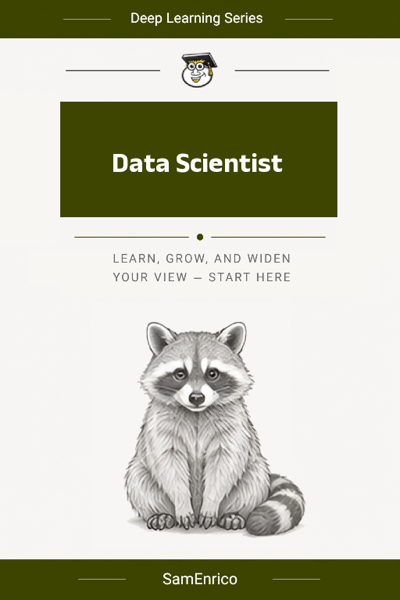
Data Scientist eBook
A Coursebook on Data Scientist
by Fowler Robyn
A Coursebook on Data Scientist
Formats
Free sample
Chapter 1: The 80% Reality...--–- The email arrived at 11:47 PM on a Tuesday. “Urgent: We need a churn prediction model by Friday. Data is in the warehouse. Thanks.” Sarah, a newly promoted data scientist at a mid-sized fintech company, stared at the screen. She had spent the last six months mastering random forests, acing online courses in deep learning, and memorizing the syntax of three different neural network frameworks.
She knew how to build a model. She opened her laptop Wednesday morning, connected to the data warehouse, and found… chaos. Column names like usr_ regi_str_ dt and txn_amnt___v2. Dates stored as strings. Negative transaction amounts.
Missing values in critical fields. Duplicate customer IDs. By Thursday afternoon, she had cleaned exactly two of the seven required tables. The model? She hadn’t written a single line of modeling code.
On Friday, she delivered something—a hastily assembled logistic regression with suspiciously high accuracy. The business team asked, “What does this coefficient mean?” She couldn’t explain it in plain English. The model never saw production. And that, dear reader, is how most data science projects fail: not because of bad algorithms, but because of bad preparation, wrong questions, and missing translation.This book exists to ensure that does not happen to you.Welcome to The Data Scientist: A Coursebook on Theory, Application, & Production Systems. Before we write a single line of Python or fit our first model, we must understand a fundamental truth that separates successful data scientists from those who merely know how to call sklearn.fit().
Data science is not about algorithms. It is not about coding. It is about solving problems with data, and the path from a messy database to a business-changing insight is long, winding, and filled with traps that have nothing to do with machine learning.In this opening chapter, we will dismantle the myths sold by bootcamps and social media influencers. We will define what a data scientist actually does—and does not do—by distinguishing this role from analysts and engineers. We will introduce the OSEMN framework, a five-step roadmap that will guide every project in this book.
We will confront the ethical responsibilities that come with wielding data as a weapon. And most importantly, we will learn how to ask the right question before touching a single row of data. By the end of this chapter, you will write a Data Science Project Charter—a contract with yourself and your stakeholders—that will save you weeks of wasted effort. Let us begin.The Great Misunderstanding: What Data Science Is Not If you search online for “data scientist,” you will find a bewildering array of definitions. Some say it is “the sexiest job of the 21st century.” Others describe it as “a statistician who lives in San Francisco.” Job postings demand proficiency in a dozen tools, five years of experience, and a Ph D.
But beneath the hype lies a simpler, less glamorous truth.Data science is not about knowing the most libraries. It is not about building the most complex neural network. It is not about memorizing the hyperparameters of XGBoost. These are tools—important tools, to be sure—but they are means, not ends. The end is always the same: using data to make better decisions.
Sometimes that means a sophisticated ensemble model. Sometimes it means a bar chart. Sometimes it means telling a stakeholder, “We don’t have enough data to answer that question.”The most dangerous myth is that data science begins with modeling. In reality, modeling is often the shortest and least variable phase of a project. Consider the breakdown from hundreds of real-world data science projects:Data preparation (obtaining, scrubbing, exploring): 70–85% of total time Modeling (selecting, training, tuning algorithms): 10–20%Interpretation and communication: 5–15%Yes, you read that correctly.
The work that gets all the attention—the algorithms, the accuracy scores, the “deep learning” buzzwords—accounts for at most one-fifth of the effort. The rest is the unglamorous, painstaking work of finding data, cleaning it, understanding its quirks, and then translating the results into something another human can act upon.This is the 80% reality. Embrace it now, and you will save yourself years of frustration.The Three Tribes: Data Analyst, Data Scientist, Data Engineer Before we go further, we must draw clear boundaries. Organizations often blur the lines between roles, and job titles vary wildly. But understanding the distinctions will help you navigate your career and collaborate effectively.Data Analyst: The retrospective detective.
Analysts answer “What happened?” and “Why did it happen?” They work with historical data, create dashboards, write SQL queries, and produce reports for business stakeholders. Their tools are primarily SQL, Excel, Tableau, Power BI, and light Python or R scripting. Analysts focus on descriptive and diagnostic analytics. They are essential—without them, the business flies blind—but they typically do not build predictive models or deploy production systems.Data Scientist: The predictive and prescriptive oracle. Data scientists answer “What will happen?” and “How can we make it happen?” They build models that forecast future events, segment customers, detect anomalies, and recommend actions.
They work with statistical inference, machine learning algorithms, and experimental design (A/B testing). Their toolkit includes Python (pandas, scikit-learn, Py Torch/Tensor Flow), R, SQL, and often cloud platforms. Unlike analysts, data scientists deal with uncertainty, probabilistic predictions, and the messy reality of real-world data. They are also expected to communicate complex results to non-technical audiences.Data Engineer: The infrastructure architect. Data engineers answer “How can we make data available, reliable, and fast?” They build and maintain the pipelines that extract data from source systems, transform it into usable formats, and load it into warehouses or data lakes.
They work with distributed systems (Spark, Kafka), cloud infrastructure (AWS, GCP, Azure), and data warehousing solutions (Snowflake, Big Query, Redshift). Without data engineers, data scientists would have nothing to work with—or would spend 90% of their time just getting the data.Here is the critical insight: these roles are not hierarchical. A data scientist is not a “senior analyst,” and a data engineer is not a “support role.” They are complementary. The best data scientists understand enough engineering to not break production systems, and enough analysis to ask meaningful questions. They also know when to hand off a task to a specialist.Throughout this book, we will train you to be a data scientist who can:Write SQL to extract your own data (without waiting for an engineer)Clean and wrangle data with pandas (without crying)Apply statistical reasoning to avoid false discoveries Build and validate predictive models Interpret model outputs using SHAP and other techniques Deploy models to production (or collaborate effectively with engineers who do)Present findings so stakeholders actually listen That is a tall order.
But it is achievable, and this book is your roadmap.The OSEMN Framework: A Five-Step Project Roadmap Over the years, practitioners have developed several process models for data science: CRISP-DM, KDD, and others. For this book, we adopt the OSEMN framework (pronounced “awesome”), originally coined by data scientist Hilary Mason and popularized in Data Science for Business by Provost and Fawcett. OSEMN stands for Obtain, Scrub, Explore, Model, and i Nterpret. Note the capital “N”—the…
This is the end of the free sample. Get the eBook to keep going. Buy now
About this book
Details
- Author
- Fowler Robyn
- Publisher
- SamEnrico
- Language
- English
- Genre
- Non-Fiction, Informative, Educational
- Released
- 2026-06-02
- Pages (approx.)
- 160
- Available as
- eBook, Audiobook

Read better in the ZLOADR app
Your eBooks on your phone or tablet. Sign in with your SamEnrico account and start reading.
More by Fowler Robyn
 Panic Disorder Cognitive Restructuring GuideFowler Robyn$11.99
 Teacher Presentation Anxiety GuideFowler Robyn$11.99
 Motion Tracking with Neural NetworksFowler Robyn$11.99
 Meth Psychosis Prevention GuideFowler Robyn$11.99
 Delivery Driver KidnappedFowler Robyn$11.99
 The Atlantic Rift: Predicting the UnpredictableFowler Robyn$11.99
 Shadows Over Dhaka: The Unseen Hand Behind Sheikh Mujibur Rahman's AssassinationFowler Robyn$11.99
 Understanding Brachydactyly AFowler Robyn$17.99
 Notion Remote Productivity InternFowler Robyn$12.99
 Executive Summary Formatting StandardsFowler Robyn$12.99
 Ultimate Handbook Guide to Qianjiang : (China) Travel GuideFowler Robyn$11.99