
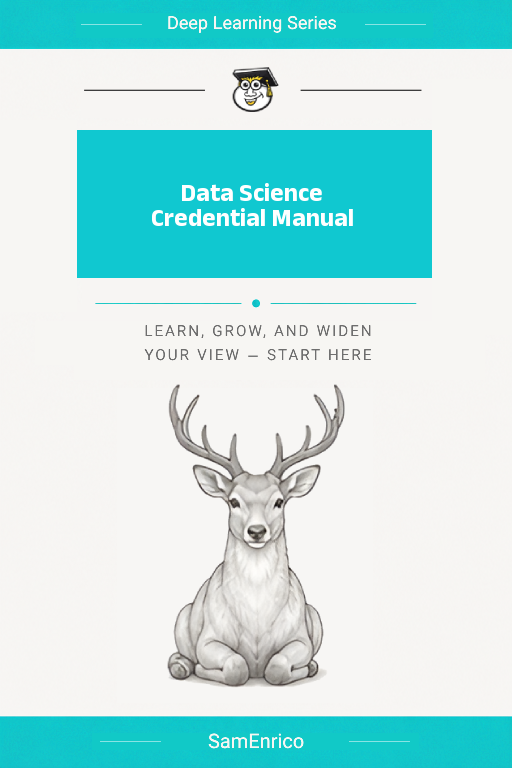
Non-FictionNon-Obvious CareerEducation AnalysisData Guide
Data Science Credential Manual eBook
Compare IBM, Google, and Microsoft data certs cost
Compare IBM, Google, and Microsoft data certs costing under 400versus400 versus 400versus60k master's degrees. Includes portfolio project requirements, hiring manager surveys, and interview prep.
Formats
Free sample
Chapter 1: The Price Tag Paradox--–- The email arrived on a Tuesday. "We appreciate your application, but we have decided to move forward with other candidates." That made forty-seven. Forty-seven rejections since graduating with a Master's degree in Data Science from a respectable university. Forty-seven times I had watched my $60,000 investment—two years of my life, countless sleepless nights, and a mountain of debt—fail to open a single door.The irony was almost cruel. I had been told, repeatedly, that this degree was the golden ticket.
"Data scientists are the sexiest job of the 21st century," Harvard Business Review declared. "There's a massive shortage of talent," every tech recruiter on Linked In announced. "Get the degree, and the jobs will come," my academic advisor promised. None of them mentioned that the degree alone was worthless. None of them mentioned that the thousands of other graduates flooding the market every year had the exact same piece of paper.Six months later, desperate and disillusioned, I tried something different.
I removed the Master's degree from my resume. I replaced it with a $400 certification from Google and three small projects I had built in my spare time. The result was not subtle. In the two weeks that followed, I received twelve interview requests. Twelve.
From companies that had ignored me when I led with the degree.This chapter is not an indictment of higher education. It is an autopsy of a broken signaling system. And it is the story of why a 400certification,whenpairedwithastrategicportfolio,nowsendsastrongersignaltoemployersthana400 certification, when paired with a strategic portfolio, now sends a stronger signal to employers than a 400certification,whenpairedwithastrategicportfolio,nowsendsastrongersignaltoemployersthana60,000 Master's degree for the vast majority of data science roles.The Broken Promise of the Credential Arms Race Let us begin with a simple question: What were you actually buying when you paid for that degree?If you are like most people, you were buying a signal. You were telling the world, "I am smart enough to be admitted. I am disciplined enough to complete the program.
I have been vetted by an institution that has existed for a hundred years." That signal has value. It always has. But here is the problem that no one in academia wants to discuss: the signal is degrading.Think of credentials like currency. When everyone has a high school diploma, a high school diploma becomes worthless. When everyone has a bachelor's degree, a bachelor's degree becomes the new baseline.
We are now living through the exact same inflation with Master's degrees. In 2000, approximately 380,000 Master's degrees were awarded in the United States. By 2020, that number had nearly doubled to over 730,000. Data science programs alone have exploded from a handful a decade ago to over 200 today, each churning out hundreds of graduates every year.Table 1: The Credential Inflation Curve Credential1990 (holders per 100 jobs)2020 (holders per 100 jobs)Signal Strength High School Diploma78%91%Near zero Bachelor's Degree22%38%Weak (baseline)Master's Degree4%14%Degrading rapidly Data Science Master's~0%2%Still positive, but falling This is not a mystery. This is supply and demand applied to the labor market.
When you make something more abundant, its value decreases. Universities have a powerful financial incentive to keep increasing supply—each new data science program is a revenue stream of millions of dollars. They have zero incentive to tell you that the market is becoming saturated.The $60,000 Question: What Does a Master's Degree Actually Cost?Before we compare certification to degrees, let us be brutally honest about what a Master's degree actually costs. Not the sticker price. The real price.Direct Costs (The Number on the Brochure)A typical two-year Master's program in data science costs between 40,000and40,000 and 40,000and80,000 in tuition alone.
The average across public and private institutions lands at approximately 60,000.Thisdoesnotincludefees,textbooks,softwarelicenses,orthecomputingresourcesyouwillneed.Addthose,andyouareeasilyat60,000. This does not include fees, textbooks, software licenses, or the computing resources you will need. Add those, and you are easily at 60,000.Thisdoesnotincludefees,textbooks,softwarelicenses,orthecomputingresourcesyouwillneed.Addthose,andyouareeasilyat65,000.But the direct costs are the least painful part.Opportunity Costs (The Number They Do Not Print)Opportunity cost is the income you forego by being in school instead of working. For a two-year Master's program, the math is straightforward:Average entry-level data analyst salary: $65,000Two years of foregone income: $130,000Plus lost raises, promotions, and 401(k) matching: approximately $150,000 in total opportunity cost Now add the direct costs of 65,000,andyouarelookingatatotaleconomiccostofapproximately∗∗65,000, and you are looking at a total economic cost of approximately **65,000,andyouarelookingatatotaleconomiccostofapproximately∗∗215,000** for that Master's degree. And that is before we discuss interest on student loans, which at current rates adds another 15,000−15,000-15,000−25,000 over a ten-year repayment period.Sector Warning Box – Read This Before Continuing If your target industry is banking, government, healthcare administration, academic research, or any role that explicitly requires a Master's degree for regulatory or HR reasons, the argument in this chapter may not fully apply to you.
These sectors still favor traditional credentials. However, even if you fall into these categories, read Chapter 12 first—the "sponsored degree" strategy (getting your employer to pay for the Master's) is far smarter than paying for it yourself. For everyone else, continue reading.The Certification Alternative: $400 and Six Months Now let us examine the alternative. The three major certifications we will cover in this book—Google Data Analytics Professional Certificate, IBM Data Science Professional Certificate, and Microsoft Certified: Power BI Data Analyst Associate—range in sticker price from 165toapproximately165 to approximately 165toapproximately400.Table 2: Certification Sticker Price vs. Actual Cost Certification Sticker Price Typical Out-of-Pocket (with strategies from Chapter 4)Google Data Analytics Professional180(3monthsat180 (3 months at 180(3monthsat59/month)$49 (with Coursera Plus annual plan or financial aid)Microsoft Power BI Data Analyst$165 (exam fee only)$165 (no subscription, no discount)IBM Data Science Professional~400(7monthsat400 (7 months at 400(7monthsat59/month)$100-200 (with accelerated completion and financial aid)The time commitment?
For someone studying part-time (10-15 hours per week), each certification takes 3-5 months to complete. That means you can earn your first certification and begin applying for jobs in less than half the time of a single semester of graduate school.And here is the critical difference: while you are studying for that certification, you are also building your portfolio. The capstone projects included in these programs are not just exams—they are portfolio assets. By the time you finish the certification, you already have 2-3 projects ready to show employers. This is the "cert + portfolio" flywheel, and it is the engine that beats the Master's degree.The Skills-Based Hiring Revolution (With Actual Data)You do not need to take my word for this shift.
The data is overwhelming and consistent across every major labor market analysis.The 73% Threshold In 2022, a landmark study by Intelligent.com surveyed 800 hiring managers across the United States. The finding that shook the HR world: 73% of employers now prioritize demonstrable skills over traditional degrees when evaluating candidates. This was up from 56% just two years earlier. The trend is accelerating, not slowing.Why? Because companies have finally done the math.
A candidate with a degree has proven they can sit in a classroom. A candidate with a skills assessment has proven they can do the actual job. The correlation between degree and job performance is weak. The correlation between skills assessment score and job performance…
This is the end of the free sample. Get the eBook to keep going. Buy now
About this book
Details
- Author
- Treadwell Isabella
- Publisher
- SamEnrico
- Language
- English
- Genre
- Non-Fiction, Non-Obvious Career, Education Analysis, Data Guide
- Released
- 2026-05-29
- Pages (approx.)
- 136
- Available as
- eBook, Audiobook

Read better in the ZLOADR app
Your eBooks on your phone or tablet. Sign in with your SamEnrico account and start reading.
More by Treadwell Isabella
 Post Surgical Pain PNETreadwell Isabella$11.99
 Anger Trigger Journal PromptsTreadwell Isabella$11.99
 Mayor of the FreezeTreadwell Isabella$11.99
 Financial Stress and RelationshipsTreadwell Isabella$11.99
 The Last Message of the Beagle: Darwin's Forgotten DispatchTreadwell Isabella$11.99
 The Last Empress: How a Teenage Girl Outmaneuvered Europe’s Greatest PowersTreadwell Isabella$11.99
 Telehealth Equity Outlook 2026Treadwell Isabella$12.99
 Understanding Hyperbilirubinemia Type 2Treadwell Isabella$17.99
 A Beginners Guide to Basque traditional weightlifting (Volume 1)Treadwell Isabella$11.99
 Collections OfficerTreadwell Isabella$11.99
You may also like
 Hong Kong Handover 1997Dunn Johnnie$11.99
 Zumba For Postnatal Recovery CourseNeal Christian$11.99
 Zumba for BeginnersLadner Nikia$11.99
 YouTube Comment Mining GuideHumes Pandora$12.99
 Worry Box MeditationCarlin Rudy$11.99
 Workplace Stress MeditationNguyen Lynn$11.99
 Workplace Stress and Sleep RepairHawley Ivory$11.99
 Workplace Perfectionism CureDelaney Jeffry$11.99
 Workplace Injustice Anger GuideWallen Isabelle$11.99
 Work Addiction and Burnout LinkGreenwood Ester$11.99
 Women in Yoga and WellnessBeattie Galina$11.99
 Women in Stand Up ComedyChun Evangeline$11.99