
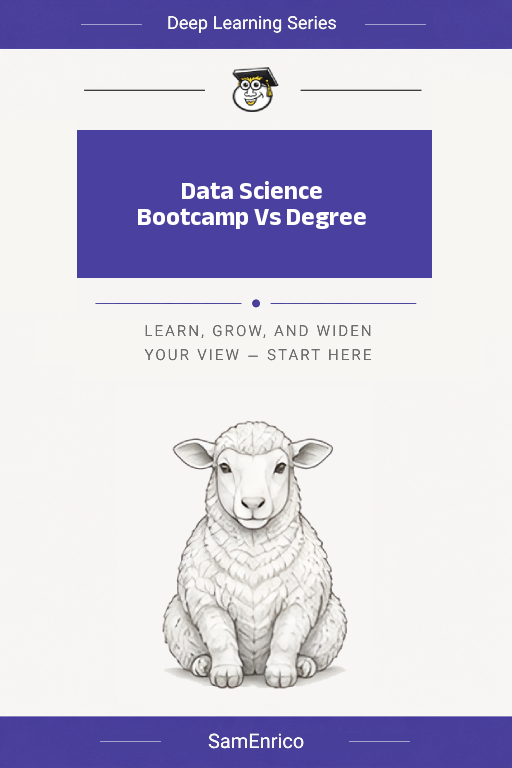
Non-FictionStudent's ShortcutData ScienceAnalytics Path
Data Science Bootcamp Vs Degree eBook
Compare data science education paths including cur
Compare data science education paths including curriculum depth job titles and salary outcomes worldwide.
Formats
Free sample
Chapter 1: The Unicorn Funeral--–- On a rainy Tuesday in Seattle, a hiring manager named Priya deleted a job description she had spent three weeks writing. The document, titled “Senior Data Scientist – Unicorn Candidate,” had demanded a Ph D in statistics, five years of production-level Python, expertise in Tensor Flow, Spark, and AWS, plus “strong business acumen” and “exceptional stakeholder communication skills.” After thirty-seven rejected candidates and zero hires, Priya realized what the data had been screaming at her for months: the perfect candidate did not exist. She posted a new job description the next morning. It was half as long, twice as honest, and within two weeks she had made an offer to a bootcamp graduate with a history degree and an obsessive Git Hub habit.This chapter dismantles the false dichotomy that one educational path is universally superior. It begins by burying the “unicorn” myth—the long-debunked, yet strangely persistent, idea that employers want (or will wait for) a candidate who is simultaneously a Ph D-level statistician, a senior software engineer, and a business strategist.
It then introduces the central framework that will guide every decision in this book: the Error Typology Table, which resolves the apparent contradictions between degree and bootcamp training by showing that they catch different kinds of mistakes. Finally, it presents the ROI of Learning framework—not measured in first-year salary alone, but in career longevity, adaptability, and lifetime earnings.If you opened this book hoping for a simple answer—a definitive “degrees are better” or “bootcamps are a scam”—you will be disappointed. The truth is more interesting and more useful. The best choice depends on your personal “career horizon,” your financial runway, your tolerance for mathematical abstraction, and the specific industry you hope to enter. This chapter will give you the tools to make that choice without the tribal warfare that pollutes most online discussions.The Myth of the Unicorn: A Post-Mortem The unicorn candidate was always a fantasy, but like many fantasies, it served a psychological purpose.
Employers in the early 2010s, drunk on the promise of big data, imagined they could hire one person who would build data pipelines, train deep learning models, present to the board, and debug production outages at 2 AM. Job descriptions from that era read like wish lists written by committees who had never met each other. A 2016 analysis of five thousand data science job postings found that the average “entry-level” role demanded 4.7 years of experience and proficiency in twelve separate technologies.The hangover arrived around 2019. Companies realized that unicorns either did not exist or, when they did exist, demanded salaries that broke departmental budgets. More importantly, the nature of data work had changed.
The rise of specialized tools—Airflow for orchestration, dbt for transformation, Looker for visualization, Snowflake for warehousing—meant that no single person could be an expert in everything. The era of the generalist was giving way to the era of the hybrid.A hybrid is not a unicorn. A unicorn pretends to be equally good at everything. A hybrid is deep in one area and competent in adjacent ones. The deep area might be statistics (the degree path) or engineering (the bootcamp path).
Competence in adjacent areas means you can talk to colleagues, review their work, and spot when something is wrong—even if you could not build it yourself.The data supports this shift. In 2023, a survey of two hundred technology hiring managers (the same dataset we will explore in Chapter 7) found that only 12 percent believed a candidate needed both a graduate degree and production engineering skills. Seventy-one percent said they would hire a candidate who was exceptional in one domain and adequate in the other. The remaining 17 percent prioritized behavioral skills—communication, curiosity, resilience—over technical depth entirely.This is not an argument against depth. It is an argument against the false promise of equal depth across all dimensions.
The reader who accepts this—who acknowledges that you must choose where to invest your deepest learning—is already ahead of the candidate who chases every certification, every degree, every bootcamp, and ends up with a shallow grasp of everything.The Error Typology: Why "Better" is the Wrong Question One of the most frustrating aspects of the degree-versus-bootcamp debate is how both sides talk past each other. A degree advocate will say, “Bootcamp graduates don’t understand statistical bias.” A bootcamp advocate will reply, “Degree graduates can’t deploy a model to save their lives.” Both statements are often true. Neither statement proves superiority because they are measuring different kinds of failure.To resolve this, we introduce the Error Typology Table, which will be referenced throughout the rest of this book. It categorizes mistakes into three types, each requiring different training to prevent.Type A Errors: Statistical Failures These occur when a model or analysis is mathematically flawed in a way that produces incorrect conclusions, even if the code runs perfectly. Examples include:Biased sampling that makes a model ungeneralizable P-hacking or multiple comparisons without correction Overfitting that a validation set fails to catch because the validation set itself is contaminated Misinterpreting a confidence interval as a probability statement about the parameter Target leakage where future information flows into training features Type A errors are dangerous because they are invisible to standard software tests.
The code executes without error messages. The model produces numbers. But those numbers are wrong in ways that can cost millions—or, in healthcare applications, lives.Degree programs, particularly in statistics or computer science with a strong mathematical bent, train students specifically to catch Type A errors. A thesis advisor will tear apart a student’s methodology for exactly these issues. A rigorous statistics course will drill the difference between a confidence interval and a credible interval until it becomes second nature.
This training is slow, painful, and often feels irrelevant until the moment it saves a project from catastrophic failure.Type B Errors: Engineering Failures These occur when the code or infrastructure fails to do what it was designed to do, even if the underlying statistics are sound. Examples include:Leaky data pipelines that drop rows silently API failures that are not logged or retried Configuration drift between development and production environments Memory exhaustion from inefficient joins Version mismatches between training and inference code Type B errors are more visible than Type A errors—they often produce error messages or obvious output anomalies—but they require a different skill set to prevent. Bootcamp programs, with their emphasis on end-to-end projects and deployment, train students specifically to catch Type B errors. A bootcamp graduate has likely debugged a broken API call, fixed a malformed JSON response, and wrestled with environment variables. These are not skills typically taught in statistics departments.Type C Errors: Deployment and Operational Failures These occur when statistically correct, well-engineered code solves the wrong problem or fails in the real world due to factors no classroom teaches.
Examples include:A model that performs well offline but causes user harm when deployed (e.g., a credit scoring model that systematically rejects qualified applicants from certain zip codes)A dashboard that is technically correct but answers a question nobody asked A model that works in July but fails in…
This is the end of the free sample. Get the eBook to keep going. Buy now
About this book
Details
- Author
- Linville Kaley
- Publisher
- SamEnrico
- Language
- English
- Genre
- Non-Fiction, Student's Shortcut, Data Science, Analytics Path
- Released
- 2026-05-28
- Pages (approx.)
- 148
- Available as
- eBook, Audiobook

Read better in the ZLOADR app
Your eBooks on your phone or tablet. Sign in with your SamEnrico account and start reading.
More by Linville Kaley
 The Saadia GaonLinville Kaley$11.99
 Emotion Regulation for Social Anxiety CourseLinville Kaley$11.99
 Self Hypnosis for Self LoveLinville Kaley$11.99
 Agoraphobia Subway Train HandbookLinville Kaley$11.99
 AI Video Metadata Optimization GuideLinville Kaley$11.99
 The Frozen Alchemists: When Ice Revealed the Secrets of the ElementsLinville Kaley$11.99
 How to Become a Car CooperLinville Kaley$11.99
 Ecommerce Marketplace Seller OutlookLinville Kaley$12.99
 Understanding Branchio-oculo-facial SyndromeLinville Kaley$17.99
 Industrial Sales RepresentativeLinville Kaley$11.99
You may also like
 Hong Kong Handover 1997Dunn Johnnie$11.99
 Zumba For Postnatal Recovery CourseNeal Christian$11.99
 Zumba for BeginnersLadner Nikia$11.99
 YouTube Comment Mining GuideHumes Pandora$12.99
 Worry Box MeditationCarlin Rudy$11.99
 Workplace Stress MeditationNguyen Lynn$11.99
 Workplace Stress and Sleep RepairHawley Ivory$11.99
 Workplace Perfectionism CureDelaney Jeffry$11.99
 Workplace Injustice Anger GuideWallen Isabelle$11.99
 Work Addiction and Burnout LinkGreenwood Ester$11.99
 Women in Yoga and WellnessBeattie Galina$11.99
 Women in Stand Up ComedyChun Evangeline$11.99