
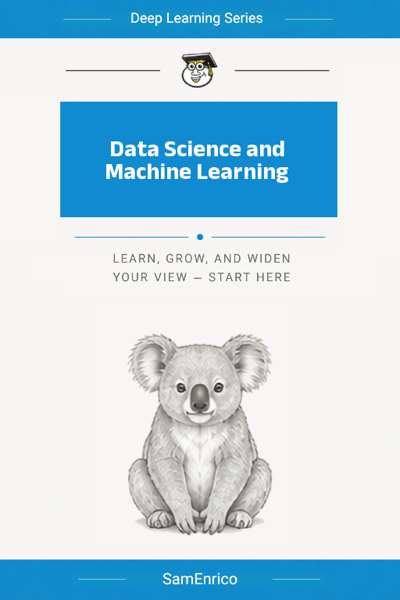
Data Science and Machine Learning eBook
A Coursebook on Data Science and Machine Learning
by Tabor Yi
A Coursebook on Data Science and Machine Learning
Formats
Free sample
Chapter 1: The Algorithm’s Apprentice--You are about to become an apprentice to one of the most powerful forces in the modern world. Not a wizard pulling potions from smoke, not a engineer welding steel into bridges, but something more subtle and perhaps more transformative: a data scientist. Before you write a single line of code, before you train your first model, before you even open a Jupyter notebook, you need to understand what you are actually doing when you practice data science. This chapter is your apprenticeship oath.Data science is not, despite what breathless headlines declare, a magic wand that turns raw numbers into gold. It is a discipline of structured curiosity, rigorous skepticism, and iterative craft.
The single biggest mistake beginners make is opening a dataset and immediately trying to fit a model. They skip the questions that matter: What problem am I actually solving? How do I know if I have solved it? Who will be affected by my answer? And crucially, how will this work fail when I am not looking?This chapter strips away the hype and builds the foundation you will return to in every subsequent chapter.
We will define data science, machine learning, and artificial intelligence with surgical precision. We will introduce the CRISP-DM framework, which is not academic theory but a battle-tested project lifecycle used by data teams at Amazon, Netflix, and thousands of other companies. We will differentiate the roles you will encounter or step into—data scientist, data engineer, ML engineer—so you understand where you fit. And we will introduce the Quick Cart case study, a fictional but realistic e-commerce company whose customer churn problem will follow us through every chapter of this book. By the end, you will think like a data scientist before you act like one.1.1 What Data Science Actually Is (And Is Not)Let us begin with a demolition.
Walk into any bookstore or scan any online course catalog, and you will find a thousand definitions of data science. Most of them are wrong, or at least uselessly vague. Here is the definition we will use throughout this book:Data science is the systematic process of extracting actionable insights from data using a combination of statistical methods, computational algorithms, and domain expertise.Notice what this definition does not say. It does not say "artificial intelligence." It does not say "big data." It does not say "deep learning." Those are tools and subfields, not the discipline itself. A data scientist might use a deep neural network, or a simple average, or a hand-labeled spreadsheet.
The unifying thread is not the complexity of the tool, but the rigor of the process.Let us draw the boundaries clearly. Artificial intelligence (AI) is the broadest circle: the pursuit of machines that can perform tasks typically requiring human intelligence. Machine learning (ML) is a subset of AI: algorithms that improve their performance on a task as they are exposed to more data. Data science overlaps with ML but extends beyond it to include data engineering, exploratory analysis, visualization, communication, and deployment. You can be a brilliant machine learning engineer and a terrible data scientist if you cannot formulate the right question or explain your results to a business stakeholder.
And you can be an excellent data scientist without touching deep learning at all—most real-world projects still use linear regression, decision trees, and ensembles like random forests.Here is the rule of thumb you will carry forward: AI is the ambition, ML is the method, and data science is the practice. An AI researcher dreams of general intelligence. An ML engineer optimizes a loss function. A data scientist delivers a recommendation to a product manager who needs to decide whether to launch a feature next Tuesday. This book trains you for the third role, with enough of the first two to make you dangerous in the right ways.1.2 The CRISP-DM Framework: Your Project Compass You will hear many project management frameworks in your data science journey, but one towers above the rest in industry adoption: CRISP-DM, which stands for Cross-Industry Standard Process for Data Mining.
Developed in the late 1990s by a consortium of companies including NCR, Teradata, and Daimler-Benz, it has survived because it works. It describes data science not as a straight line but as a cycle of six phases, with loops and jumps between them. Throughout this book, every modeling chapter will explicitly label which CRISP-DM phase it addresses. You will internalize this framework so deeply that you forget you learned it.Phase 1: Business Understanding The most important phase, and the one most beginners skip. Before you look at a single row of data, you must answer: What problem are we solving?
For whom? How will success be measured? A data scientist who delivers a model with 99% accuracy that does not solve the business problem has failed completely.Business understanding asks concrete questions. What is the cost of a false positive versus a false negative? In a spam filter, a false positive (blocking a real email) is far worse than a false negative (letting spam through).
In a cancer detection model, the reverse is true. What is the baseline we need to beat? Predicting that tomorrow's sales will equal today's sales is a trivial baseline; your model must outperform it. Who owns the decision? A recommendation system for a streaming service has different constraints than a credit approval model subject to fair lending laws.In our Quick Cart case study, which will appear in every chapter, the business problem is customer churn.
Quick Cart is a mid-sized e-commerce company. Its executives have noticed that 30% of new customers stop buying within three months, and the cost of acquiring a new customer is five times higher than retaining an existing one. The business question is: Can we predict which customers are about to churn, so we can intervene with a targeted discount or personalized recommendation before they leave? Success will be measured not by model accuracy alone, but by the reduction in churn rate after deploying the intervention.Phase 2: Data Understanding Once the business question is clear, you turn to the data. Data understanding means locating available data sources, describing their contents, and exploring their properties.
You ask: What data do we have? What data do we wish we had? What are the basic statistics—minimum, maximum, mean, missing values—for each variable? Are there obvious errors or anomalies?This phase is almost always messier than textbooks admit. You will discover that customer signup dates are stored as strings in three different formats.
You will find that the "revenue" column contains negative numbers (returns) and missing values (system outages). You will learn that the data you need—customer service interaction logs—is locked in a separate database controlled by another department. These are not failures of data science; they are the normal conditions of data science.In Quick Cart, data understanding reveals that we have six months of transaction history for 50,000 customers, including purchase amounts, product categories, and timestamps. We also have demographic data (age, location, account age) but 15% of it is missing. We have customer service call records, but they are unstructured text notes.
We do not have direct competitor information, though we might infer it from purchase gaps.Phase 3: Data Preparation Data preparation…
This is the end of the free sample. Get the eBook to keep going. Buy now
About this book
Details
- Author
- Tabor Yi
- Publisher
- SamEnrico
- Language
- English
- Genre
- Non-Fiction, Informative, Educational
- Released
- 2026-06-02
- Pages (approx.)
- 160
- Available as
- eBook, Audiobook

Read better in the ZLOADR app
Your eBooks on your phone or tablet. Sign in with your SamEnrico account and start reading.
More by Tabor Yi
 Typical Dreams AnalysisTabor Yi$11.99
 Networking for Nonprofit LeadersTabor Yi$11.99
 Drug Dependency Child Custody RightsTabor Yi$11.99
 Crowd Anxiety MeditationTabor Yi$11.99
 Burmese Rohingya EscapeTabor Yi$11.99
 Self Hypnosis For Equestrian SportsTabor Yi$11.99
 The Retirement Anxiety GuideTabor Yi$11.99
 Press Release ROI CalculatorTabor Yi$11.99
 Anapanasati for ADHDTabor Yi$11.99
 The Sun King's Silk and Steel: Louis XIV and the Art of WarTabor Yi$11.99
 Kicks & Kings: The Lost Sneaker Heist of the PharaohsTabor Yi$11.99
 How to Produce a Bicycle ChainTabor Yi$11.99