
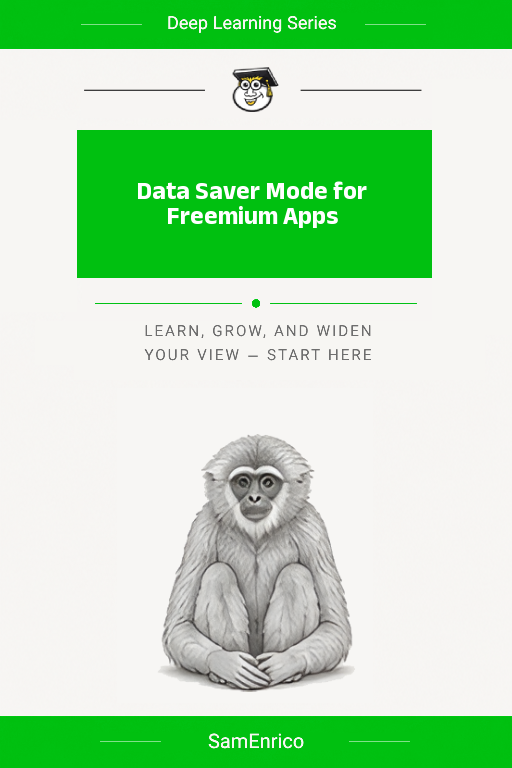
Data Saver Mode for Freemium Apps eBook
Add toggle that reduces image quality and disables
Add toggle that reduces image quality and disables auto-play, keeping free tier usable for users with expensive metered connections.
Formats
Free sample
Chapter 1: The Silent Shunt--–- The user did not storm out. She did not write a one-star review. She did not tweet her frustration or post a Tik Tok explaining her decision. She simply stopped coming back. Three weeks ago, she opened the app seventeen times per day.
Yesterday, she opened it zero times. Tomorrow, she will delete it—not out of anger, but out of a quiet, rational calculation that her limited mobile data is better spent elsewhere. Her name is Priya, she lives in Mumbai, and she is the most dangerous kind of churned user: the one who leaves without telling you why.Priya is not a fictional composite. She is a real person whose behavioral data appears in thousands of analytics dashboards around the world, masked by anonymity but unmistakable in her patterns. She installs apps eagerly.
She engages deeply for seven to fourteen days. Then, without warning, her usage collapses. She does not uninstall immediately—that would require intention and data she is saving for something else. Instead, she moves the app to a folder on her phone's third screen. She stops responding to push notifications.
She opens the app once more, sees an auto-playing video, and closes it. Then she never returns.Product managers call this "churn." They attribute it to poor feature-market fit, aggressive competition, or the natural decay of novelty. They are wrong. Priya is not bored. She is not confused.
She is not even dissatisfied with the app's core functionality. Priya is doing something far more rational: she is calculating the total cost of ownership for every app on her phone, and she has decided that your app costs more than it delivers.This chapter introduces the foundational concept of the Silent Shunt—the process by which users with expensive metered connections abandon apps not because the apps fail, but because the apps consume too much mobile data. Understanding the Silent Shunt is the prerequisite for everything else in this book. Without it, your Data Saver mode is just a feature. With it, your Data Saver mode becomes a growth engine.The Anatomy of a Quiet Departure The Silent Shunt follows a predictable pattern that unfolds over seven to twenty-one days.
It has five distinct stages, each visible in behavioral analytics if you know what to look for. Most product teams miss all five because they are looking at the wrong metrics.Stage One: The Enthusiastic Onboarding. The user downloads your app, completes onboarding, and engages deeply. They explore features, share content, and return multiple times per day. This stage looks identical to the behavior of users who will eventually convert to premium.
There is no warning yet.Stage Two: The First Data Anxiety Event. The user receives a notification from their phone's operating system or mobile carrier: "This app has used 150MB of mobile data in the background." Or they check their data balance before the end of the month and discover they have less remaining than expected. Or they open your app on cellular data and wait while a high-resolution image loads slowly, watching their data counter tick upward. This event is the crack in the foundation. It is not yet fatal, but it is remembered.Stage Three: The Behavioral Adjustment.
The user changes how they use your app. They stop opening it on cellular data, waiting instead for Wi Fi. They scroll past image-heavy sections. They close the app immediately when an auto-play video begins. They clear their cache more frequently.
From an analytics perspective, this stage looks like declining engagement in rich media sections but stable engagement in text sections. Product teams often misinterpret this as "users don't like our images" rather than "users cannot afford our images."Stage Four: The Rationing. The user limits your app to specific times and places. They open it only at home on Wi Fi. They open it only during off-peak hours when their carrier offers free data.
They open it only once per day instead of ten times. The app becomes a scheduled utility rather than a habitual presence. Session frequency drops sharply, but session duration may remain stable or even increase as the user "makes each session count."Stage Five: The Silent Shunt. The user stops opening the app entirely. They do not uninstall—uninstalling would require them to think about the app, and thinking about the app reminds them of their own financial constraints.
Instead, they simply let it drift to the periphery. After thirty to sixty days of zero opens, they delete it during a periodic phone cleanup. They do not leave a review. They do not respond to your re-engagement campaigns. They are gone.The Silent Shunt is invisible to traditional churn analysis because it leaves no angry signature.
Users who shunt are not writing one-star reviews. They are not contacting support. They are not tweeting about their frustration. They are simply... gone.
And when you survey them, they will tell you polite lies: "I just didn't need it anymore." "It wasn't for me." "I got busy."These lies are not malicious. They are protective. Users who shunt feel ashamed—ashamed that they cannot afford unlimited data, ashamed that they have to ration something as basic as app usage, ashamed that the app that works perfectly for their wealthy friends in America is a financial burden for them. The Silent Shunt is a self-protective exit. And it is happening in your app right now.The Economics of a Megabyte To understand why the Silent Shunt happens, we must understand what a megabyte actually costs.
Not in server bills or CDN expenses—those are your costs, not the user's. The user's cost is the price they pay to their mobile carrier for the privilege of downloading your app's content.This price varies enormously by geography, carrier, and plan type. In the United States, a user on an unlimited postpaid plan pays approximately 0.00001permegabyte—effectivelyzero.Theirmonthlybilldoesnotchangeregardlessofwhethertheyconsume5GBor50GB.Amegabyteisinvisibletothem.In Lagos,auseronaprepaidplanpaysapproximately0.00001 per megabyte—effectively zero. Their monthly bill does not change regardless of whether they consume 5GB or 50GB. A megabyte is invisible to them.
In Lagos, a user on a prepaid plan pays approximately 0.00001permegabyte—effectivelyzero.Theirmonthlybilldoesnotchangeregardlessofwhethertheyconsume5GBor50GB.Amegabyteisinvisibletothem.In Lagos,auseronaprepaidplanpaysapproximately0.12 per megabyte. That same megabyte is one hundred thousand times more expensive. In Manila, the price is 0.03permegabyte.In Nairobi,0.03 per megabyte. In Nairobi, 0.03permegabyte.In Nairobi,0.08. In Jakarta, 0.02.In Dhaka,0.02.
In Dhaka, 0.02.In Dhaka,0.15.These numbers are not abstract. They translate directly into user behavior. A user who pays 0.12permegabytewilltreata5MBimageasa0.12 per megabyte will treat a 5MB image as a 0.12permegabytewilltreata5MBimageasa0.60 transaction. They will treat a 30-second auto-playing video ad as a 3.60transaction.Theywilltreatatypicalappsessionthatloadstenimagesandonevideoadasa3.60 transaction. They will treat a typical app session that loads ten images and one video ad as a 3.60transaction.Theywilltreatatypicalappsessionthatloadstenimagesandonevideoadasa10.20 transaction.
That is more than the daily wage for millions of mobile users in emerging economies.The product team that does not know these numbers is building in the dark. They are making decisions about image quality, video autoplay, and background preloading without understanding that each decision carries a price tag for their users. They are optimizing for engagement metrics that measure attention but ignore cost. And they are…
This is the end of the free sample. Get the eBook to keep going. Buy now
About this book
Details
- Author
- Holland Ismael
- Publisher
- SamEnrico
- Language
- English
- Genre
- Non-Fiction, Business Brief
- Released
- 2026-05-30
- Pages (approx.)
- 157
- Available as
- eBook, Audiobook

Read better in the ZLOADR app
Your eBooks on your phone or tablet. Sign in with your SamEnrico account and start reading.
More by Holland Ismael
 Voice Actor Animal Noises LifeHolland Ismael$11.99
 Stimulant Recovery Financial PlanningHolland Ismael$11.99
 Slack Notification GuideHolland Ismael$11.99
 Teen Coach Esteem BuilderHolland Ismael$11.99
 Aging in Place Home ModificationHolland Ismael$11.99
 Gambling Addiction And RetirementHolland Ismael$11.99
 Emotional Regulation for OCDHolland Ismael$11.99
 Baby Naming After LossHolland Ismael$11.99
 The Blood Oath of the Cape: The Russian Mafia's Phantom Syndicate in Colonial AfricaHolland Ismael$11.99
 Bollywood Meets the Olympics: The Birth of Dance in Sports BroadcastingHolland Ismael$11.99
 How to Produce MopsHolland Ismael$11.99
 How to Start a Hobby in BMXHolland Ismael$11.99
You may also like
 Hong Kong Handover 1997Dunn Johnnie$11.99
 Zumba For Postnatal Recovery CourseNeal Christian$11.99
 Zumba for BeginnersLadner Nikia$11.99
 YouTube Comment Mining GuideHumes Pandora$12.99
 Worry Box MeditationCarlin Rudy$11.99
 Workplace Stress MeditationNguyen Lynn$11.99
 Workplace Stress and Sleep RepairHawley Ivory$11.99
 Workplace Perfectionism CureDelaney Jeffry$11.99
 Workplace Injustice Anger GuideWallen Isabelle$11.99
 Work Addiction and Burnout LinkGreenwood Ester$11.99
 Women in Yoga and WellnessBeattie Galina$11.99
 Women in Stand Up ComedyChun Evangeline$11.99