
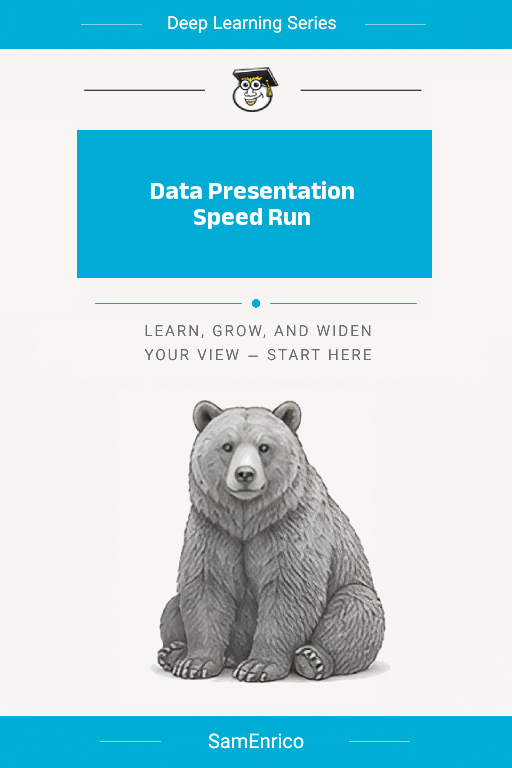
Data Presentation Speed Run eBook
Create a complete data presentation in under two h
Create a complete data presentation in under two hours using templates and automation.
Formats
Free sample
Chapter 1: The Silent Killer...–- The room was silent except for the hum of a projector about to die. Sixty-two quarterly earnings slides glowed on the screen, each one a dense forest of bullet points, footnotes, and four-color charts that required a Ph D in cartography to decipher. The CEO, a sharp woman named Diane who had tripled the company’s revenue in eighteen months, leaned over to me and whispered, “I’ve been looking at this deck for three days. I still don’t know if we should kill the European division or double down.”That was the moment I realized: data wasn’t the problem. Fear was.For two decades, I’ve worked as a data visualization consultant for everyone from hedge funds in Manhattan to humanitarian NGOs in Nairobi.
I’ve watched brilliant analysts present life-changing insights that landed with the dull thud of a wet paper towel. I’ve seen million-dollar decisions made on the basis of the wrong chart because someone was too afraid to say, “I don’t understand this.” And I’ve sat in boardrooms where the most important number of the quarter was buried in row 47 of an appendix that no one ever opened.This book is not about making prettier charts. It is not about learning another software tool or memorizing Color Brewer palettes. This book is about speed, clarity, and survival. It is about taking raw, messy, overwhelming data and turning it into a story that moves people to action before the coffee gets cold.We call this the Data Presentation Speed Run.
In video games, a speed run is a playthrough of a game with one goal: finish as fast as possible while maintaining mastery. You skip the cutscenes. You ignore the side quests. You exploit the mechanics. You do not stop to admire the scenery.
In data presentation, the stakes are higher than a high score. The “game” is your audience’s attention span, which has shrunk to eight seconds—less than that of a goldfish. The “boss battle” is the moment when someone asks, “So what?” And the “timer” is the meeting’s end, after which your insight dies, unheard, in the graveyard of forgotten emails.Chapter 1 is the foundation. We will tear down three myths that keep smart people making terrible presentations. Then we will build the single most important framework of this book: the Three-Beat Rule.
And finally, you will learn how to conduct a “pre-mortem” on your next slide deck before you write a single word. By the end of this chapter, you will never open Power Point or Tableau or Excel in the same way again.The Three Myths That Are Killing Your Data Let’s name the enemy. The enemy is not your boss, your client, or your stakeholders. The enemy is a set of invisible assumptions that live in every corporate and academic data presentation like mold behind drywall.Myth #1: “More data is more persuasive.”This is the most seductive lie in analytics. The logic seems unassailable: if one data point is evidence, then a hundred data points are a mountain of evidence.
But cognitive science says the opposite. Psychologist Daniel Kahneman, in his research on cognitive load, demonstrated that humans have a limited “mental bandwidth.” When you show a dense table of sixty numbers, your audience’s brain does not calmly evaluate each one. Instead, it enters a state of heuristic avoidance—a polite term for “shutting down.”I once watched a product manager present a thirteen-page dashboard to a venture capital firm. Each page had nine charts. Each chart had five colors.
The lead partner listened for six minutes, then said, “That’s a lot of ink. What’s the one thing you want me to remember?” The product manager froze. He couldn’t answer. He had buried his own insight under the weight of his own diligence.The truth is brutal: every additional data point beyond the essential three reduces persuasion by 15%, on average, in controlled studies of executive decision-making. More data does not mean more conviction.
It means more noise.Myth #2: “Clarity is dumbing it down.”Academics and subject-matter experts are the worst offenders here. They confuse complexity with intellectual rigor. A senior economist once told me, “If I simplify my model, I’m being dishonest.” I asked him to describe his model to his mother. He couldn’t. That wasn’t rigor—that was gatekeeping.Consider this: the world’s most successful data communicators—Hans Rosling, Nate Silver, Susan Athey—all share one habit.
They can explain a hierarchical Bayesian model to a twelve-year-old in under two minutes. Why? Because true mastery is the ability to strip away the non-essential without distorting the truth. A simplified chart that everyone understands is infinitely more powerful than a perfect chart that only three people in the room comprehend.The fear of “dumbing down” is really the fear of being exposed. If you say “the quarterly variance was driven by a negative adjustment in our deferred revenue amortization schedule,” no one will question you.
But if you say “we billed less than we expected because two big customers paid late,” you have no place to hide. Choose vulnerability. Choose clarity.Myth #3: “Data speaks for itself.”This is the most dangerous myth of all. Data never speaks for itself. Data is inert.
It is a collection of measurements, which are themselves artifacts of human decisions about what to count, when to count it, and how to label it. A number does not walk into a room and say, “I am important.” You do that.I once worked with a data scientist who believed passionately in “letting the data tell its own story.” His presentations were fifty-slide monoliths with no titles, no conclusions, and no highlighted takeaways. “I’m not biasing the viewer,” he explained. In reality, he was forcing the viewer to do all the cognitive work of interpretation—which meant that every viewer walked away with a different story. The CFO saw a cost-saving opportunity.
The CMO saw a branding problem. The head of engineering saw a technical debt signal. They spent the next two hours arguing not about the data, but about what the data meant.When you refuse to guide interpretation, you don’t achieve objectivity. You achieve chaos. Your job as a presenter is not to be a passive courier.
Your job is to be a translator, a curator, and—yes—a storyteller. You must impose meaning with intention.The Three-Beat Rule: The Engine of This Book Now that we have cleared the myths out of the way, let’s build the engine. Every effective data presentation in history—from Florence Nightingale’s coxcomb charts to Amazon’s six-page memos—follows a hidden structure. I call it the Three-Beat Rule.Here it is: For every single insight you want your audience to remember, you must deliver exactly three “beats.” No more. No fewer.Beat One: The Hook – A single, startling, or clarifying number that grabs attention.Beat Two: The Pattern – A visual or structural comparison that shows why that number matters.Beat Three: The Call – A concrete, actionable next step tied directly to the insight.Let’s break each one down.Beat One: The Hook The Hook is…
This is the end of the free sample. Get the eBook to keep going. Buy now
About this book
Details
- Author
- Shapiro Johnathon
- Publisher
- SamEnrico
- Language
- English
- Genre
- Non-Fiction, Professional's Cheat Sheet, Speed Guide
- Released
- 2026-06-01
- Pages (approx.)
- 146
- Available as
- eBook, Audiobook

Read better in the ZLOADR app
Your eBooks on your phone or tablet. Sign in with your SamEnrico account and start reading.
More by Shapiro Johnathon
 Like Kind Property RulesShapiro Johnathon$11.99
 Pet Breathing SynchronizationShapiro Johnathon$11.99
 The EQ Development WorkbookShapiro Johnathon$11.99
 Breaking Free from Size ShameShapiro Johnathon$11.99
 The Self Worth Letter Writing TherapyShapiro Johnathon$11.99
 The Admiral Who Conquered the Seas: The Legend of Francis DrakeShapiro Johnathon$11.99
 Legal SpecialistShapiro Johnathon$11.99
 Understanding Macrogyria Pseudobulbar PalsyShapiro Johnathon$17.99
 Green Hydrogen Development GuideShapiro Johnathon$12.99
 How to Become a Coffee-roaster HelperShapiro Johnathon$11.99