
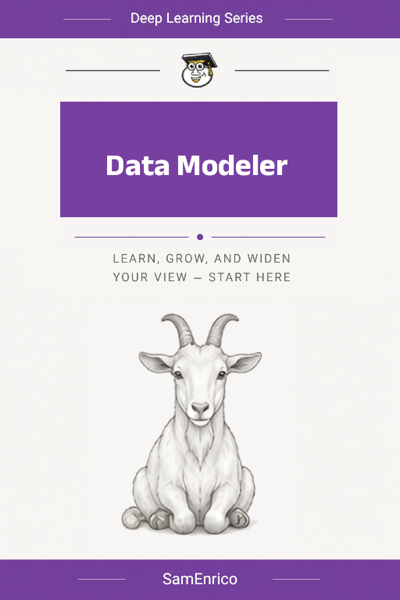
Data Modeler eBook
A Coursebook on Data Modeler
by Sowell Mazie
A Coursebook on Data Modeler
Formats
Free sample
Chapter 1: The Swamp Detective--The first time I saw a true data swamp, I was standing in a windowless conference room on the thirty-first floor of a Manhattan bank, watching a senior vice president cry.Not a single tear, mind you. A full breakdown. Shoulders shaking. Voice cracking. The kind of cry that comes after three consecutive all-nighters, after you've explained to the board that the "customer profitability" report is off by forty-seven million dollars, and after you've realized that no one—not the data team, not the vendors, not the consultants—can explain why.Her name was Margaret.
She had two Ivy League degrees, twenty years of experience, and a team of fifty data professionals reporting to her. And she was crying because she had asked a simple question: "Who is our most profitable customer in the Northeast region?"Eight days later, she still didn't have an answer. She had thirteen different answers from thirteen different reports. And she had a board meeting in three hours."What do I tell them?" she whispered.That was the moment I stopped being a database designer and started being a swamp detective.The Great Lie of Modern Data Work Here is something that every book, every course, and every certification program gets wrong: they teach you how to build beautiful, pristine data models in ideal conditions. They give you clean requirements, cooperative stakeholders, and a green-field project with no legacy baggage.
They teach you normalization forms and indexing strategies and star schemas as if you will be applying them to a blank slate.Then you get your first real job.And you discover that the "customer" table has seventeen versions. That the "revenue" column in the CRM system means something different from the "revenue" column in the ERP system. That the person who built the data warehouse left three years ago, and the documentation is a single Excel spreadsheet last updated during the Obama administration.This is the data swamp. And if you are reading this book, you are almost certainly standing in one right now.The data swamp is not a metaphor. It is a specific, diagnosable condition.
A data swamp is any environment where:The same business term has multiple conflicting technical definitions More than 20% of queries require tribal knowledge (asking someone who "just knows")Two reports on the same metric produce different numbers with no ability to reconcile Schema changes cause undocumented cascading failures Stakeholders have stopped trusting data and have started creating their own spreadsheets I have consulted for sixty-three organizations across banking, healthcare, retail, logistics, and technology. Exactly five of them did not have a data swamp. The other fifty-eight were drowning. Some had known it for years. Some were about to discover it mid-crisis, like Margaret.This book is not a theoretical exercise.
This book is a field manual for swamp detectives—the people who walk into chaos and build order, who translate between business desperation and technical possibility, who understand that data modeling is not about diagrams but about truth.Who Is the Data Modeler, Really?Let me tell you about the most successful data modeler I have ever met. Her name is Priya, and she works for a global logistics company. She does not have a Ph D in computer science. She cannot write a database engine from scratch. She has never won a "data modeling award" (these do not exist, and if they did, they would be beside the point).What Priya can do is sit in a room with the head of sales, the head of operations, and the head of finance—three people who have been actively sabotaging each other for years—and, within ninety minutes, get them to agree on a single definition of "on-time delivery."She does this without mentioning foreign keys, normalization, or any technical concept.
She draws boxes and arrows on a whiteboard. She asks questions like "what does 'on-time' mean when the customer changes the delivery window after the order is placed?" and "what happens to your bonus if we count that as late or on-time?"Priya is a data modeler.Not a database designer. Not a SQL specialist. Not a data architect. A data modeler.The distinction matters.
A database designer optimizes storage and retrieval. A SQL specialist writes efficient queries. A data architect designs system layouts. These are valuable skills. But they are not data modeling.Data modeling is the discipline of discovering, defining, and documenting the meaning of data in a way that aligns business needs with technical implementation.
It is the bridge between the boardroom and the server room. It is the practice of answering three questions before anyone writes a line of code:What are we talking about? (entities and terms)How do these things relate to each other? (business rules)What decisions will this data support? (scope and purpose)When these questions go unanswered, you get a swamp.
When they are answered poorly, you get a swamp that costs millions to drain. When they are answered well, you get something rare and precious: trust.The Data Lifecycle: Where Models Live To understand why data modeling matters, you need to understand where models fit in the larger data ecosystem. Every piece of data in your organization follows the same general journey, from its birth in a transactional system to its death in an archive or deletion.Phase One: Source (OLTP)Operational systems—your CRM, your ERP, your point-of-sale terminals, your mobile app backends—generate data one transaction at a time. These are Online Transaction Processing (OLTP) systems. They are optimized for high-volume, low-latency writes.
A customer places an order. A warehouse scans a shipment. A support agent closes a ticket. Each of these events creates a row, updates a record, or deletes a file.OLTP systems are not designed for questions. They are designed for actions.
Their data models are optimized for speed and consistency, not for analysis. A well-designed OLTP schema is highly normalized (as we will explore in Chapter 3) to prevent anomalies during rapid updates.Phase Two: Integration (ETL/ELT)Between the source and the destination, data moves. Sometimes it is extracted, transformed, and loaded (ETL). Sometimes it is extracted, loaded, and transformed (ELT). Tools like dbt, Informatica, and custom Python scripts move data from operational systems into analytical storage.This is where most swamps are created.The integration layer is where definitions drift.
A column named "customer_status" in the source system becomes "cust_stat" in the staging table, which becomes "status_cd" in the warehouse. The transformation logic is written by a junior developer who left six months ago. The business rule that "active customers are those with at least one transaction in the last 90 days" is buried in line 347 of a Python script with no comments.Phase Three: Analytics (OLAP/Data Lakehouse)Finally, data arrives in a system designed for questions. Online Analytical Processing (OLAP) systems—data warehouses, data marts, and increasingly data lakehouses like those built on Delta Lake or Apache Iceberg (Chapter 8)—are optimized for complex queries over large volumes of historical data.Here, the data model shifts from normalized (OLTP) to dimensional (Chapter 5) or vault-style (Chapter 6). The goal is no longer write speed but read comprehension.…
This is the end of the free sample. Get the eBook to keep going. Buy now
About this book
Details
- Author
- Sowell Mazie
- Publisher
- SamEnrico
- Language
- English
- Genre
- Non-Fiction, Informative, Educational
- Released
- 2026-05-07
- Pages (approx.)
- 160
- Available as
- eBook, Audiobook

Read better in the ZLOADR app
Your eBooks on your phone or tablet. Sign in with your SamEnrico account and start reading.
More by Sowell Mazie
 Ghana Consumer GuideSowell Mazie$11.99
 Megalophobia Large ObjectsSowell Mazie$11.99
 Affirmations For Loneliness CourseSowell Mazie$11.99
 The DBT Self Soothe Skill GuideSowell Mazie$11.99
 Emotional Trigger Grounding GuideSowell Mazie$11.99
 The Mariner's Compass: How Henry the Navigator Charted the New WorldSowell Mazie$11.99
 How to Become a Lead Pony RiderSowell Mazie$11.99
 LinkedIn Profile Makeover for MentorshipSowell Mazie$12.99
 Guillaume Faury GuideSowell Mazie$12.99
 Understanding PanhypopituitarismSowell Mazie$17.99