
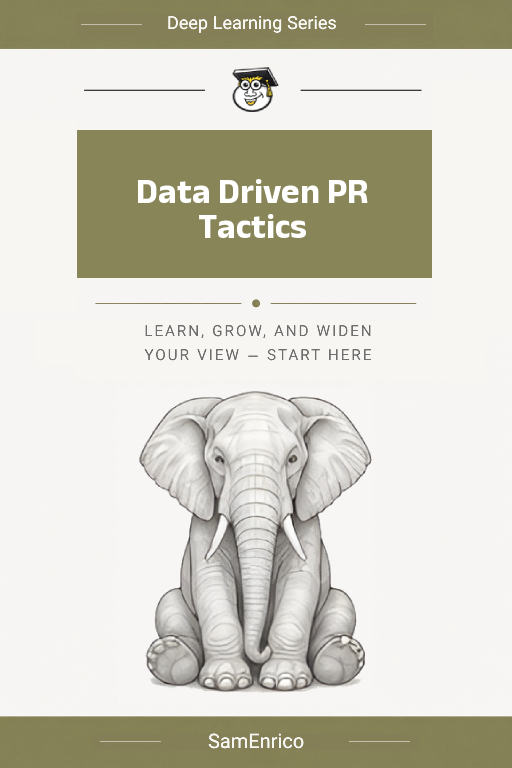
Data Driven PR Tactics eBook
Use original data and surveys to get PR coverage.
by Miller Steve
Use original data and surveys to get PR coverage. Research-driven angles that journalists can't ignore.
Formats
Free sample
Chapter 1: The Gut Is Lying--–- In 2018, a well-funded tech startup hired a top-tier PR agency. They paid $35,000 per month for a team of ten seasoned professionals. The agency had decades of relationships with journalists at Tech Crunch, Wired, and The Verge. They had a beautiful office. They had a client list that glittered.
They had everything except one thing: results.For six months, the agency pitched story after story. They sent embargoed announcements. They arranged executive briefings. They hosted a launch event with catered tacos and branded swag. The journalists came, ate the tacos, took the swag, and left.
Not a single Tier-1 story ran. One reporter finally replied to an email with three words that became the startup CEO’s permanent nightmare: “So what? Seriously.”The CEO fired the agency and hired a different kind of firm—one that didn’t have a beautiful office or decades of relationships. What that firm had was a spreadsheet. Specifically, they had a survey of 2,000 small business owners that asked one deceptively simple question: “What keeps you up at night?” The answers became a story about the hidden epidemic of payroll anxiety among American entrepreneurs.
That story ran in the Wall Street Journal. Then in Inc. Then in five regional business journals. Then the CEO got a book deal.The difference between the two agencies was not relationships. It was not budget.
It was not experience. It was evidence.Welcome to the new currency of public relations. This book is the difference between tacos and a Wall Street Journal byline.The Great Unraveling of Traditional PRFor three decades, the public relations industry operated on a simple premise: journalists need stories, and PR people have stories. The relationship was symbiotic, if not always harmonious. PR professionals would build relationships with reporters over coffee, lunches, and industry events.
When a client had news, the PR person would pick up the phone, call their contact, and say, “Hey, I’ve got something for you.” And more often than not, the reporter would at least read the email.That world is dead. It died slowly at first, then all at once.Between 2005 and 2023, more than 2,500 newspapers shuttered in the United States alone. The newsrooms that survived did so by cutting staff—massively. Business Insider cut 21 percent of its workforce. Reach PLC eliminated hundreds of editorial positions.
ITV announced redundancy after redundancy. According to the Pew Research Center, newsroom employment dropped by more than 25 percent between 2008 and 2020, and the decline has only accelerated since.Here is what that means for you: the journalist you are trying to reach is not sipping a latte and leisurely reviewing pitches. That journalist is doing the work that three people did five years ago. They are writing, editing, fact-checking, managing social media, recording podcasts, and attending meetings—all before lunch. They have, on average, twenty minutes to file each story.
They do not have time to develop your narrative. They do not have time to find the angle in your press release. They do not have time to call you back and ask clarifying questions.What they have time for is copy and paste.Journalists today are not looking for partners. They are looking for primary sources. They are looking for ready-made, credible, verifiable evidence that they can drop directly into their story with minimal friction.
They are looking for data. And if you do not provide it, your competitor will.The Statistic That Should Terrify You (And Inspire You)In 2024, Cision published its annual State of the Media Report, surveying more than 3,000 journalists across nineteen markets. The report asked a simple question: “What types of content from PR professionals do you find most valuable?”The answer was unmistakable. Sixty-one percent of journalists said original research reports, including trends data and market surveys. That placed original research above executive thought leadership pieces, above product announcements, and above every other form of PR content except basic press releases—which, as we will see, are valued for speed, not substance.Let me repeat that: nearly two-thirds of journalists actively want the one thing most PR professionals rarely provide.The same report revealed another devastating statistic: forty-two percent of journalists ranked “maintaining credibility as a trusted news source” and “combating fake news” as their biggest challenges.
Think about what that means. Journalists are terrified of being wrong. They are terrified of being duped. They are terrified of publishing something that will later be debunked on Twitter or, worse, in a competitor’s fact-check column.And yet, most PR professionals send them press releases full of unverifiable claims. “Our product is revolutionary.” “Our CEO is a visionary.” “Our company is changing the world.” These statements are not evidence.
They are opinions dressed up as facts. And journalists, who are fighting for their professional lives against the accusation of “fake news,” cannot afford to publish them.Original research is the antidote. When you send a journalist a survey finding—“Sixty-two percent of Americans have stopped dining out due to inflation, up from forty-one percent last year”—you are not asking them to trust you. You are giving them something they can verify, cite, and defend. You are making their job easier.
You are making them look smarter. You are giving them cover.That is the secret of data-driven PR. It is not about manipulation. It is about alignment—aligning your interests with the journalist’s interests so completely that they would be foolish not to cover your story.The So What Test Before we go any further, I need to introduce you to a simple but brutal exercise. I call it the So What Test.Here is how it works.
Take any sentence you plan to put in a press release, a pitch email, or a survey question. Read it out loud. Then ask yourself: “So what?” If the answer is obvious, boring, or self-evident, delete the sentence and start over.Let me give you an example. A typical PR professional might write: “Consumers are concerned about inflation.”Apply the So What Test. So what?
Of course consumers are concerned about inflation. Inflation has been the dominant economic story for two years. Every single person reading that sentence already knows it to be true. There is nothing new here. There is nothing surprising.
There is nothing a journalist can hang a story on.Now consider an alternative: “Sixty-two percent of Americans have stopped dining out due to inflation—up from forty-one percent last year.”Apply the So What Test. So what? So this is not just concern. This is behavioral change. This is a trend.
This is a comparison over time. This is a specific number attached to a specific action. This is a story about what people are doing, not what they are feeling. This is publishable.The So What Test is the single most important filter you will ever apply to your work. It separates the pitches that get deleted from the pitches that get published.
It separates amateur survey design from professional research. It separates the PR person who gets a book deal from the PR person who gets fired.Throughout this book, we will return to the So What Test again and…
This is the end of the free sample. Get the eBook to keep going. Buy now
About this book
Details
- Author
- Miller Steve
- Publisher
- SamEnrico
- Language
- English
- Genre
- Non-Fiction, Startup Guide, Media Outreach
- Released
- 2026-06-01
- Pages (approx.)
- 140
- Available as
- eBook, Audiobook

Read better in the ZLOADR app
Your eBooks on your phone or tablet. Sign in with your SamEnrico account and start reading.
More by Miller Steve
 Pyramid HIIT Workout GuideMiller Steve$11.99
 Nonviolent Communication EmpathyMiller Steve$11.99
 Twelve Step for ProfessionalsMiller Steve$11.99
 The New Parent Anger GuideMiller Steve$11.99
 The Retainer Pricing Model GuideMiller Steve$11.99
 The Montreal Cartel: Canada's Hidden War Crimes NetworkMiller Steve$11.99
 How to Start a Blueprinting Service BusinessMiller Steve$11.99
 High Volume Retention GuideMiller Steve$12.99
 The Breeder's Guide to Magpie DucksMiller Steve$11.99
 JukskeiMiller Steve$11.99
You may also like
 Social Media PR StrategyEasterling Robbi$12.99
 Shoestring Startup PR GuideLeblanc Zena$12.99
 PR Success StoriesNewsom Georgie$12.99
 PR for Tech StartupsBankston Fonda$12.99
 PR for Solo FoundersAlderman Edie$12.99
 PR for SaaS StartupsDietz Tosha$12.99
 PR for Minority FoundersRea Delcie$12.99
 PR for Healthtech StartupsMerrick Ashlea$12.99
 PR for Green StartupsCade Jenise$12.99
 PR for Fintech StartupsRedd Aletha$12.99
 PR for Ecommerce StartupsStyles Rob$12.99
 PR Failures to AvoidMarrero Jolynn$12.99