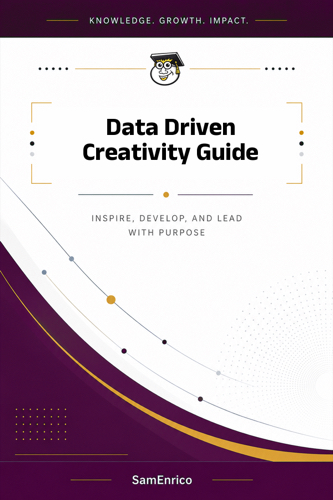
Data Driven Creativity Guide eBook
Use analytics and A/B testing to guide creative bu
Use analytics and A/B testing to guide creative business decisions.
Formats
Free sample
Chapter 1: The Creativity Delusion--–- Every creative professional has felt it: the quiet, terrifying moment when a project you poured your soul into fails. Not a small failure—a catastrophic, expensive, public failure. The kind where the client calls a meeting without snacks. The kind where your boss uses the phrase “reassess our approach.” The kind where, in the darkness of 3 a.m., you ask yourself: “Was I ever any good, or have I just been lucky?”This chapter exists because that moment is not your fault. And it is entirely your fault.
Both things are true. Let me explain.For the past twenty years, creative industries have been dominated by a seductive, romantic, and utterly destructive myth: the myth of the lone genius. You know the story. A brilliant creative—an art director, a copywriter, a designer, a filmmaker—sits alone, perhaps in a dimly lit studio or a coffee shop with excellent espresso, and waits. Then, like a bolt of lightning from a clear sky, the Idea arrives.
Fully formed. Perfect. The genius sketches it on a napkin, shows it to the client, and everyone applauds. The end.This is a lie.Not a harmless lie, like “the check is in the mail.” A dangerous lie. A lie that has destroyed careers, wasted billions of dollars, and turned talented, passionate people into anxious impostors convinced that their inability to conjure perfection on demand means they are frauds.
The lone genius myth is the single greatest enemy of consistent, reliable, scalable creativity. And it is the first thing this book will ask you to abandon.The $10 Million Napkin Let me tell you a true story. In the early 2000s, a global beverage brand—one of the most famous in the world—was preparing a Super Bowl advertisement. The budget was approximately $10 million for production and media. The creative director, a man with multiple awards and a reputation for “vision,” had a breakthrough at 2 a.m.
in a hotel room. He sketched his idea on a napkin. The next morning, he presented the napkin to the client, who cried tears of joy. No research. No testing.
No second opinions. The Idea was too pure to be sullied by data.The ad aired. It was beautiful. It was art. It generated zero measurable sales lift.
Zero. Not a small number—statistically indistinguishable from zero. The brand lost $10 million. The creative director kept his job because, as one executive later said, “You can’t argue with his passion.”Yes, you can. You absolutely can.
And you should.Now consider a different story. In 2017, a two-person startup selling custom-printed phone cases was struggling to convert traffic. They had a decent product, decent photos, decent copy. Nothing worked. They had no budget for a creative director, no awards, no napkin moments.
What they had was Google Optimize, a free A/B testing tool. They ran a simple test: two versions of their “Add to Cart” button. Version A said “Add to Cart.” Version B said “Get Yours Now.”Version B won. By 34 percent. They changed one button, doubled their conversion rate within a week, and eventually sold the company for eight figures.The difference between these two stories is not talent, budget, or intelligence.
The difference is a belief system. The beverage brand believed in the lone genius. The phone case startup believed in iteration. One worshipped inspiration; the other worshipped evidence.This chapter is about dismantling the lone genius myth and replacing it with something far more powerful, far more reliable, and far less terrifying: the Scientific Creative Method.Why Your Gut Is Lying to You Let’s start with an uncomfortable truth. Your gut instinct—the thing you have relied on throughout your career, the thing that has won you praise and promotions—is not magic.
It is pattern recognition. Your brain has, over years of experience, unconsciously catalogued millions of inputs: successful projects, failed projects, client reactions, audience responses. When you have a “gut feeling,” your brain is performing a rapid, unconscious statistical analysis of those memories and spitting out a probability.This is useful. It is not infallible.In fact, under specific, predictable conditions, your gut will betray you every single time. Psychologists have identified dozens of cognitive biases that systematically distort human judgment.
Three of them are particularly lethal to creative work.Confirmation Bias is the tendency to seek out, believe, and remember information that confirms what you already believe, while ignoring, dismissing, or forgetting information that contradicts you. When you fall in love with your own idea, you will unconsciously filter the world for evidence that the idea is brilliant. You will remember the one person who laughed at your headline and forget the nine who were confused. You will show your design to friendly colleagues who will tell you what you want to hear. You will run a poll and phrase the questions to get the answer you desire.Confirmation bias is not a character flaw.
It is a feature of how human brains work. And it is the reason that solo genius, working in isolation, is statistically guaranteed to produce failure over time. No single human can overcome their own confirmation bias without an external check.The Sunk Cost Fallacy is the tendency to continue investing in a failing course of action because you have already invested resources—time, money, ego, reputation—and cannot bear to “waste” them. It is why agencies keep polishing a campaign that tested poorly. It is why designers spend three months on a redesign that should have been abandoned in week two.
It is why clients demand to launch the ad they paid for, even when pre-launch research shows it will bomb.The sunk cost fallacy is the voice that whispers, “But we’ve already come this far.” That voice is a liar. Past investment is irrelevant to future decisions. The only question that matters is: given what we know now, what is the best course of action moving forward?The Hi PPO Effect—Highest Paid Person’s Opinion—is the tendency for organizations to defer to the most senior person in the room, regardless of evidence. The Hi PPO may be brilliant. The Hi PPO may have decades of experience.
The Hi PPO is also human, which means the Hi PPO suffers from confirmation bias and the sunk cost fallacy, just like everyone else. But unlike everyone else, the Hi PPO can fire you.The result is that most creative decisions in most organizations are made not by evidence, but by organizational hierarchy. The loudest voice wins. The most confident voice wins. The voice with the most impressive title wins.
And because confidence and accuracy are uncorrelated—confident people are not more likely to be right; they are simply more likely to speak loudly—organizations consistently make worse decisions than any individual within them would make alone.The Scientific Creative Method There is an antidote to all of this. It is not complicated, but it is difficult. It requires humility, discipline, and a willingness to be wrong in public. It is called the Scientific Creative Method, and it has five steps.Step One: Observe. Before you create anything, you must observe.…
This is the end of the free sample. Get the eBook to keep going. Buy now
About this book
Details
- Author
- Christenson Tobi
- Publisher
- SamEnrico
- Language
- English
- Genre
- Non-Fiction, Self-Help, Data Creativity
- Released
- 2026-06-09
- Pages (approx.)
- 144
- Available as
- eBook, Audiobook

Read better in the ZLOADR app
Your eBooks on your phone or tablet. Sign in with your SamEnrico account and start reading.
More by Christenson Tobi
 Natural Movement LifestyleChristenson Tobi$11.99
 Eat That Frog TechniqueChristenson Tobi$11.99
 Chronic Pain Self CompassionChristenson Tobi$11.99
 The Graham Greene StoryChristenson Tobi$11.99
 Cognitive Restructuring Anger JournalChristenson Tobi$11.99
 Blue Zones Master GuideChristenson Tobi$11.99
 Gut Brain Axis AgingChristenson Tobi$11.99
 The Silk and the Sword: A Love Letter Across EmpiresChristenson Tobi$11.99
 The Alchemist's Ledger: How a 17th-Century Merchant Outsmarted the Dutch East India CompanyChristenson Tobi$11.99
 How to Produce Eye Makeup RemoverChristenson Tobi$11.99
 Timing Your Promotion RequestChristenson Tobi$12.99
 Selling to Gulf Power SectorChristenson Tobi$12.99