
Non-FictionInformativeEducational
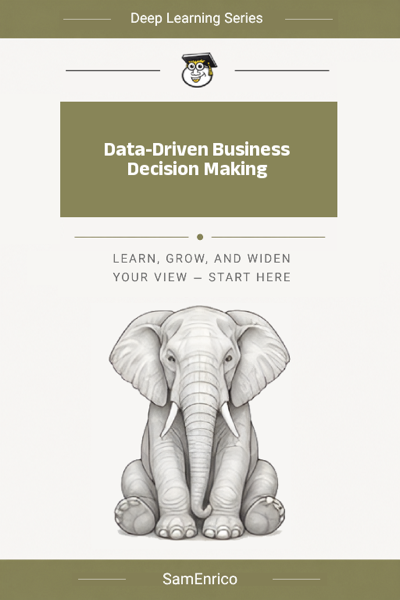
Data-Driven Business Decision Making eBook
A Coursebook on Data-Driven Business Decision Maki
by Woo Taisha
A Coursebook on Data-Driven Business Decision Making
Formats
Free sample
Chapter 1: The Last Mile--Every year, across the global economy, companies spend more than $200 billion on data infrastructure, analytics software, and data science talent. They build lakes and warehouses. They hire quants and chief data officers. They buy dashboards that glow with real-time metrics. And then, in meeting room after meeting room, a curious ritual unfolds.
Someone projects a chart onto a white wall. The chart shows something important—a 15 percent drop in customer retention, say, or a sudden spike in logistics costs. The presenter says, "The data suggests we have a problem." The room nods. Someone says, "We should look into this further." Someone else says, "Can we see more data?" And then the meeting ends. No decision is made.
No action is taken. The chart disappears into the same digital graveyard where all charts eventually go to die.This book has a name for that distance between seeing a number and changing a behavior. It is called the last mile. And it is where 80 percent of the value of data analytics is lost.Let me tell you about a retail chain that learned this lesson in the most expensive way possible. In the early 2010s, a well-known American department store chain—let us call it Premium Goods—had everything a data-driven executive could dream of.
They had a ten-terabyte data warehouse. They had a team of twenty-three analysts with advanced degrees. They had complex predictive models that forecasted demand at the SKU level for every store in the chain. By any technical measure, they were a best-in-class analytics organization.They went bankrupt eighteen months later.How does that happen? How does a company with more data than 99 percent of its competitors collapse while smaller, "dumber" competitors survive?
The answer is not that their data was wrong. Their data was exquisitely correct. The answer is that their decision-making process was still operating in 1987 while their data infrastructure was operating in 2017. Every Tuesday morning, the CEO convened the leadership team. The analysts would present their findings with beautiful charts.
The CEO would listen, nod, and then ask the same question he had asked for twenty years: "What does your gut tell you?" The vice presidents, trained in a culture that rewarded decisive confidence over analytical humility, would offer their opinions. The meeting would end with a compromise between the strongest voices, not a resolution driven by the strongest evidence.The last mile, in this case, was not a technical problem. It was a cultural and procedural chasm. The company had invested millions in the first ninety-nine miles of the analytics journey—collecting, cleaning, storing, modeling, and visualizing data—but had spent almost nothing on the one mile that matters: the machinery that turns an insight into a decision.This chapter is about that machinery. It will give you a vocabulary for understanding what it truly means to be a data-driven organization.
It will introduce a taxonomy that the rest of this book will rely on—a way of distinguishing between companies that merely collect data and companies that use data to change outcomes. It will give you a practical tool—the Decision Audit—that you can complete in thirty minutes and that will forever change how you see your own organization. And it will introduce the concept of the "last mile," which will reappear in every subsequent chapter of this book, each time in a different form: the governance last mile, the visualization last mile, the cultural last mile.But before we go anywhere, we need to talk about the most seductive trap in all of data-driven decision-making. It has a name. It has ruined more analytics careers than bad math.
And you have almost certainly fallen into it.The Behavioral Trap: Analysis Paralysis In 2004, the United States Department of Defense ran a simulation exercise called "Project Alpha." They gathered thirty of the military's most experienced logistics officers. They gave each officer a simulated supply chain problem: a humanitarian crisis in a fictional country, with limited information about road conditions, fuel availability, and population locations. The officers had four hours to make a recommendation about where to position supply depots.Then they gave the exact same problem to a simple rules-based algorithm that had been programmed by a summer intern in two weeks.The algorithm beat the officers. Not by a little—by a lot. It positioned depots faster and with better coverage.
But here is the detail that matters for this chapter. After the exercise, the researchers interviewed the officers. They asked them to describe their decision-making process. Almost every officer said the same thing: "I needed more information. I wanted satellite imagery.
I wanted ground reports. I wanted more time."The algorithm, of course, used none of those things. It used the incomplete, messy, imperfect data it had been given. And it made a better decision faster.This is analysis paralysis. It is the belief that you need 100 percent of the data—perfect data, complete data, certified data—before you can act.
It is the voice in your head that says, "Let's wait for one more report," or "We should validate these numbers with the finance team first," or "I'm not comfortable making a call until we understand the margin of error better."Analysis paralysis is not caution. Caution says, "Let me check the most important three assumptions before I move." Analysis paralysis says, "Let me check every possible assumption, including the ones that don't matter, until the opportunity passes."I have seen analysis paralysis kill more data initiatives than any other single cause. A product manager asks, "What feature should we build next?" The data team says, "We need to run a full customer segmentation analysis. Give us six weeks." The product manager waits. Six weeks later, a competitor launches the feature.
The data team's analysis is still not complete because they are still arguing about how to define "high-value customer."A marketing director asks, "Which of our ten campaign concepts should we test first?" The analytics team says, "We need to model the expected ROI of each concept. That will take three weeks." The marketing director waits. Three weeks later, the quarter is almost over. The analytics team delivers a beautifully formatted report with confidence intervals and p-values. The marketing director has no time left to run the campaign.A supply chain executive asks, "We have a shortage of critical component X.
Should we air-freight it or wait for ocean shipping?" The data team says, "Our demand forecasting model is being recalibrated. We'll have an answer in ten days." The executive waits. Ten days later, the factory has shut down. The model's recalibration was, of course, irrelevant.Analysis paralysis is not a technical failure. It is a psychological one.
It is the fear of making the wrong decision masquerading as the discipline of making a rigorous one. And it is fueled by a misunderstanding of what "data-driven" actually means, which brings us to the core argument of this chapter.The Core Argument: Data is Not the Goal Let me say something that will sound strange coming from a book titled Data-Driven Business Decision Making. Here it is:Data has no value.I do not mean that data is worthless. Obviously…
This is the end of the free sample. Get the eBook to keep going. Buy now
About this book
Details
- Author
- Woo Taisha
- Publisher
- SamEnrico
- Language
- English
- Genre
- Non-Fiction, Informative, Educational
- Released
- 2026-05-09
- Pages (approx.)
- 154
- Available as
- eBook, Audiobook

Read better in the ZLOADR app
Your eBooks on your phone or tablet. Sign in with your SamEnrico account and start reading.
More by Woo Taisha
 Nobel Laureates In GPS TechnologyWoo Taisha$11.99
 The Nobel Laureate LifespansWoo Taisha$11.99
 The No Spend Anniversary GuideWoo Taisha$11.99
 Body Scan For Trauma SafetyWoo Taisha$11.99
 Arm Crossing as BarrierWoo Taisha$11.99
 Meditation For Panic BeginnersWoo Taisha$11.99
 Sleeping Bear Dunes VanishedWoo Taisha$11.99
 Reid Hoffman LinkedInWoo Taisha$11.99
 Love Letters from the Front: The Secret Plays of Sarah Bernhardt and Victorien SardouWoo Taisha$11.99
 The Harmonies of the Nile: Egypt's Forgotten Maestros of the Pharaonic CourtWoo Taisha$11.99
 The Mineral Guide to AheyliteWoo Taisha$11.99
 How to Become a Briquette-machine OperatorWoo Taisha$11.99
You may also like
 Hong Kong Handover 1997Dunn Johnnie$11.99
 Zumba For Postnatal Recovery CourseNeal Christian$11.99
 Zumba for BeginnersLadner Nikia$11.99
 YouTube Comment Mining GuideHumes Pandora$12.99
 Worry Box MeditationCarlin Rudy$11.99
 Workplace Stress MeditationNguyen Lynn$11.99
 Workplace Stress and Sleep RepairHawley Ivory$11.99
 Workplace Perfectionism CureDelaney Jeffry$11.99
 Workplace Injustice Anger GuideWallen Isabelle$11.99
 Work Addiction and Burnout LinkGreenwood Ester$11.99
 Women in Yoga and WellnessBeattie Galina$11.99
 Women in Stand Up ComedyChun Evangeline$11.99