
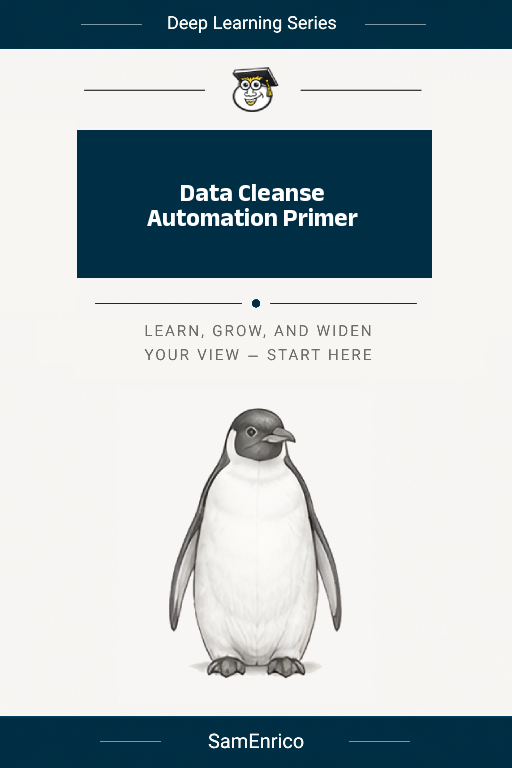
Non-FictionAI OperatorProcess OptimizationData Guide
Data Cleanse Automation Primer eBook
Automate the detection and correction of duplicate
by Conger Gerri
Automate the detection and correction of duplicates, missing fields, and formatting errors in spreadsheets and databases. Includes validation rules, exception logs, and approval triggers.
Formats
Free sample
Chapter 1: The Friday Night Horror--It was 4:57 PM on a Friday when Michelle, a marketing operations manager at a mid-sized e-commerce company, made a discovery that would ruin her weekend. She had just finished a manual merge of customer data from three different sources—Salesforce, Shopify, and a spreadsheet her boss kept on a shared drive labeled "Master_Customer_FINAL_v12_FINAL.xlsx." The report she needed for Monday’s board meeting was complete. Or so she thought.A junior analyst knocked on her door. "Hey, Michelle... I ran a quick sanity check.
Did you know that customer ID 44782 appears six times with six different addresses? And there are 847 rows where the state doesn’t match the ZIP code. Oh, and someone formatted the dates as MM/DD/YYYY in the Salesforce extract but DD/MM/YYYY in the Shopify export, so the last purchase dates are all off by up to eleven months."Michelle looked at her watch. Then at the clock. Then at the bottle of wine she had been saving for Saturday night.
She reopened her files and started clicking. Find. Replace. Sort. Scroll.
Copy. Paste. Repeat.She left the office at 9:30 PM. She worked four hours on Saturday. She presented her report on Monday morning, and within thirty minutes, the CFO asked why the customer churn numbers contradicted the finance team’s calculations.
The answer, as Michelle would later discover after another sixteen hours of detective work, was a single trailing space in a VLOOKUP key that caused 1,200 rows to misalign.Eighteen hours. One space character. A weekend gone.This is not a story about incompetence. Michelle was smart, diligent, and under-resourced. This is a story about a systemic failure that affects nearly every organization that touches data.
And this book is the antidote.The Staggering Scale of Manual Data Cleaning Let us begin with a number that should make you uncomfortable: 88 percent of spreadsheets contain errors. This is not an internet statistic from a dubious source. This comes from a peer-reviewed study by Raymond Panko at the University of Hawaii, who analyzed dozens of operational spreadsheets across industries and found that nearly nine out of ten contained material mistakes. Not typos. Material mistakes—errors that changed business decisions.Extrapolate that across the global economy, and you arrive at another number: an estimated **3trillionperyearinlossesattributabletopoordataquality.∗∗Thatisroughly3percentofglobal GDP.Toputthisinperspective,3 trillion per year in losses attributable to poor data quality.** That is roughly 3 percent of global GDP.
To put this in perspective, 3trillionperyearinlossesattributabletopoordataquality.∗∗Thatisroughly3percentofglobal GDP.Toputthisinperspective,3 trillion exceeds the annual economic output of the United Kingdom. It is more than the combined market capitalization of every company in Germany. It is, in human terms, the equivalent of every working adult on earth losing a full week of wages every single year because the data they rely on is wrong.But statistics like these numb the mind. Let us make this personal.If you are a data analyst, business intelligence professional, marketer, operations manager, or anyone who spends more than five hours per week in spreadsheets, you are likely wasting 40 percent of your working time on data cleaning tasks. Not analysis.
Not insight. Not strategy. Cleaning. Fixing dates. Deduplicating lists.
Standardizing categories. Chasing down missing values. Explaining why last month’s report says something different from this month’s report.A 2022 survey of 2,000 data professionals found that the average respondent spent 14 hours per week on data preparation and cleansing—tasks that are repetitive, rule-based, and almost entirely automatable. Fourteen hours. That is nearly two full working days.
That is a month per quarter. That is a career of lost potential.And here is the cruelest irony: manual cleaning does not just waste time. It creates new errors. Every time a human being manually edits a cell, types a formula, or copies data from one column to another, they introduce an error rate of roughly 1-2 percent per operation. After ten manual steps, your error rate compounds to 10-20 percent.
You are not cleaning data. You are digging a hole while trying to fill one.Why "I Will Clean It Later" Is a Lie You Tell Yourself There is a phrase that data professionals whisper to themselves like a prayer: "I will clean it later. It will be fine. I just need to get this analysis done first."This is the Technical Debt Fallacy—the belief that manual shortcuts today can be fixed with manual effort tomorrow. But technical debt in data does not depreciate.
It compounds.Every hour you delay cleaning is an hour that a duplicate record becomes the source of truth. Every day you postpone standardization is another day that a new data source enters your ecosystem with its own idiosyncratic formatting. Every week you tolerate missing values is another week that downstream reports embed those gaps as assumptions.Consider the lifecycle of a single error. A customer service representative enters "John Smith" into the CRM. A salesperson enters "J.
Smith" into the opportunity tracker. An accountant enters "Smith, John" into the billing system. None of these are wrong individually. But when you try to join these three systems to calculate customer lifetime value, you have a disaster. You cannot tell how many customers you have.
You cannot reconcile payments. You cannot forecast churn.And now imagine that instead of fixing the root cause—automated deduplication at ingestion—you assign an intern to manually reconcile these three lists every month. That intern spends eight hours per month on the task. After six months, they graduate or quit. The next person starts from scratch, learning nothing from the previous efforts.
The error persists. The manual process repeats. The organization has spent hundreds of hours solving the same problem over and over again without ever actually solving it.This is not data cleaning. This is data sweeping—moving dirt from one corner of the room to another.Introducing Data Quality Engineering There is a better way. But it requires a fundamental shift in mindset.Most organizations approach data quality as a reactive cleaning problem.
Something breaks. Someone investigates. Someone manually fixes it. Someone documents the fix in a Slack channel no one reads. Two weeks later, the same thing breaks again.Data Quality Engineering flips this model.
Instead of cleaning data after it breaks, you build systems that prevent, detect, and correct data issues automatically—ideally before the data ever reaches an analyst’s desk.This is not magic. It is engineering. And like all engineering disciplines, it requires a framework.The Three Pillars of Automated Data Cleanse Throughout this book, we will build every technique, tool, and workflow on a foundation of three core capabilities. I call them the Three Pillars because everything else rests upon them.Pillar One: Detection Before you can fix a problem, you must know that it exists. Detection is the science of identifying data quality issues automatically, without human inspection.Detection includes:Formatting linting: Identifying date fields that mix MM/DD and DD/MM formats Duplicate identification: Finding both exact and fuzzy duplicates across columns Constraint validation: Checking that values obey rules (e.g., price > 0, email contains @)Missing value detection: Locating nulls, blanks, and placeholders like "N/A" or "Unknown"The goal of detection is not to fix.…
This is the end of the free sample. Get the eBook to keep going. Buy now
About this book
Details
- Author
- Conger Gerri
- Publisher
- SamEnrico
- Language
- English
- Genre
- Non-Fiction, AI Operator, Process Optimization, Data Guide
- Released
- 2026-05-30
- Pages (approx.)
- 150
- Available as
- eBook, Audiobook

Read better in the ZLOADR app
Your eBooks on your phone or tablet. Sign in with your SamEnrico account and start reading.
More by Conger Gerri
 Burnout Prevention for Helpers CourseConger Gerri$11.99
 Workplace Stress for New HiresConger Gerri$11.99
 Earle's Underwater LaboratoryConger Gerri$11.99
 The RLS Sleep Position Optimization GuideConger Gerri$11.99
 Mindful Listening MBSR PracticeConger Gerri$11.99
 The Immortal Admiral: Yi Sun-sin and the Turtle Ships of MyeongnyangConger Gerri$11.99
 How to Start a Oleine Business (Beginners Guide)Conger Gerri$11.99
 AI Automation Talent ImpactConger Gerri$12.99
 TaxidermistConger Gerri$11.99
You may also like
 Hong Kong Handover 1997Dunn Johnnie$11.99
 Zumba For Postnatal Recovery CourseNeal Christian$11.99
 Zumba for BeginnersLadner Nikia$11.99
 YouTube Comment Mining GuideHumes Pandora$12.99
 Worry Box MeditationCarlin Rudy$11.99
 Workplace Stress MeditationNguyen Lynn$11.99
 Workplace Stress and Sleep RepairHawley Ivory$11.99
 Workplace Perfectionism CureDelaney Jeffry$11.99
 Workplace Injustice Anger GuideWallen Isabelle$11.99
 Work Addiction and Burnout LinkGreenwood Ester$11.99
 Women in Yoga and WellnessBeattie Galina$11.99
 Women in Stand Up ComedyChun Evangeline$11.99