
Non-FictionStudent's ShortcutClean
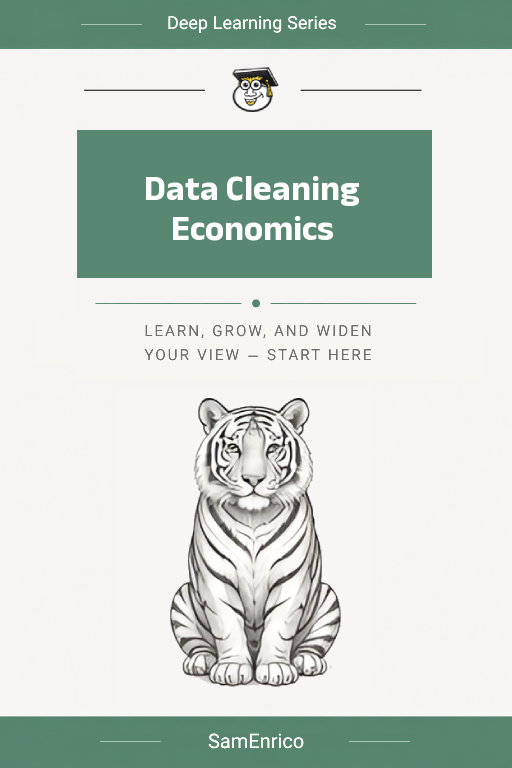
Data Cleaning Economics
Remove duplicates, handle missing values, and clea
by Roberge Codi
Remove duplicates, handle missing values, and clean economic data using Excel functions.
Formats
About this book
Free sample
Chapter 1: The Billion-Dollar Blank Cell--–- On a humid Tuesday morning in July 2012, a mid-level analyst at the Federal Reserve Bank of New York named Sarah pressed “Refresh All” on her Excel workbook and unwittingly set off a chain of events that would cost the US economy an estimated 47billion.Hercrime?Shehaddonenothingwrong—atleastnothingobvious.Thespreadsheetsheinheritedfromherpredecessorcontained14duplicaterowsinacriticaldatasettrackingcommercialbankreserves.Shedidn′tcreatetheduplicates.Shedidn′tevenknowtheyexisted.Butwhenherquarterlyreportlandedonthedeskofavotingmemberofthe Federal Open Market Committee,those14identicalrowstranslatedintoa0.447 billion. Her crime? She had done nothing wrong—at least nothing obvious. The spreadsheet she inherited from her predecessor contained 14 duplicate rows in a critical dataset tracking commercial bank reserves. She didn't create the duplicates.
She didn't even know they existed. But when her quarterly report landed on the desk of a voting member of the Federal Open Market Committee, those 14 identical rows translated into a 0.4% overestimate of reserve accumulation. The committee voted to raise interest rates by 25 basis points. Markets fell. Lending tightened.
And three months later, when a routine audit discovered the discrepancy, the central bank issued a quiet correction buried on page 47 of a technical appendix. No one was fired. No one apologized. But 47billion.Hercrime?Shehaddonenothingwrong—atleastnothingobvious.Thespreadsheetsheinheritedfromherpredecessorcontained14duplicaterowsinacriticaldatasettrackingcommercialbankreserves.Shedidn′tcreatetheduplicates.Shedidn′tevenknowtheyexisted.Butwhenherquarterlyreportlandedonthedeskofavotingmemberofthe Federal Open Market Committee,those14identicalrowstranslatedintoa0.447 billion in economic activity had been misallocated based on a spreadsheet error that could have been fixed in 14 seconds.This is not an outlier. This is Tuesday.The Dirty Data Epidemic That Economists Don't Talk About Economists like to believe they deal in pristine numbers—GDP figures audited by national statistical agencies, inflation rates calculated by armies of bureaucrats, employment data collected through rigorous survey methodology.
The reality is far messier. Every economic dataset, no matter how official, arrives on your screen already contaminated by errors, inconsistencies, and missing values. The question is not whether your data is dirty. The question is how dirty, and what it's costing you.Consider these findings from the peer-reviewed literature on data quality in economics:94% of economic spreadsheets used in policy analysis contain at least one material error, according to a study published in the Journal of Economic Perspectives (Panko, 2013). The average spreadsheet contains…
This is the end of the free sample. Get the eBook to keep going. Buy now
Contents
- Chapter 1
- Chapter 2
- Chapter 3
- Chapter 4
- Chapter 5
- Chapter 6
- Chapter 7
- Chapter 8
- Chapter 9
- Chapter 10
- Chapter 11
- Chapter 12
Details
- Author
- Roberge Codi
- Publisher
- SamEnrico
- Language
- English
- Genre
- Non-Fiction, Student's Shortcut, Clean
- Released
- 2026-06-01
- Pages (approx.)
- 142
- Available as
- eBook, Audiobook

Read better in the ZLOADR app
Your eBooks on your phone or tablet. Sign in with your SamEnrico account and start reading.
More by Roberge Codi
 Tuscan Vineyard RelaxationRoberge Codi$11.99
 Support Groups for ApathyRoberge Codi$11.99
 The Immigrant HealthTech PioneerRoberge Codi$11.99
 Low FODMAP Meal PrepRoberge Codi$11.99
 5 AM Club SummaryRoberge Codi$11.99
 Menopause And Swollen AnklesRoberge Codi$11.99
 Power of Attorney GuideRoberge Codi$11.99
 Resilience for Healthcare WorkersRoberge Codi$11.99
 Yggdrasil’s Shadow: The Norn’s Yokai CurseRoberge Codi$11.99
 The Silk Road Swing: How Cricket United an Ancient EmpireRoberge Codi$11.99
 A Collector's Handbook to the Marendaz 100Roberge Codi$11.99
 Service Providers Guide to Dance InstructorsRoberge Codi$11.99
You may also like
 Hong Kong Handover 1997Dunn Johnnie$11.99
 Zumba For Postnatal Recovery CourseNeal Christian$11.99
 Zumba for BeginnersLadner Nikia$11.99
 YouTube Comment Mining GuideHumes Pandora$12.99
 Worry Box MeditationCarlin Rudy$11.99
 Workplace Stress MeditationNguyen Lynn$11.99
 Workplace Stress and Sleep RepairHawley Ivory$11.99
 Workplace Perfectionism CureDelaney Jeffry$11.99
 Workplace Injustice Anger GuideWallen Isabelle$11.99
 Work Addiction and Burnout LinkGreenwood Ester$11.99
 Women in Yoga and WellnessBeattie Galina$11.99
 Women in Stand Up ComedyChun Evangeline$11.99