
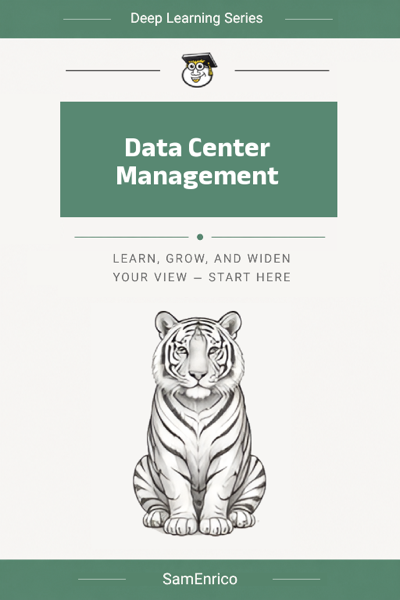
Data Center Management eBook
A Coursebook on Data Center Management
A Coursebook on Data Center Management
Formats
Free sample
Chapter 1: Beyond the Noise...--– The first time the power failed, I was holding a coffee cup and watching a dashboard that said everything was green. The dashboard lied. The alarm that should have screamed was configured with a threshold so wide that a generator running on fumes still counted as operational. By the time anyone noticed, the UPS batteries had been draining for forty-seven minutes, and the temperature in the hot aisle had climbed past the point where servers begin to lie about their own health. That day taught me something no textbook ever could: data center management is not about technology.
It is about hunger. The hunger for certainty in an environment designed to produce surprise.Most people who enter this field believe they are here to manage servers, or networks, or power distribution units. They are wrong. You are here to manage the gap between what your systems promise and what reality delivers. And reality, as you will learn, is endlessly creative in finding ways to break things.
This chapter strips away the polite fictions that surround data center operations and introduces the functional domains, standards, and hard-won lessons that form the foundation of everything that follows. No theory without scars. No advice without a story behind it.The Four Questions That Will Haunt Your Career Before we discuss technology, before we discuss standards or architectures or cooling curves, you must internalize four questions. Every decision you make as a data center manager will be a variation of these questions, whether you realize it or not.What can go wrong? This is not a rhetorical question.
It is an engineering question that demands specific answers. For every component in your data center—every circuit breaker, every fan in every power supply, every crimped fiber connector in every patch panel—you need to know its failure modes. Not in the abstract. Specifically. Does this capacitor bulge before it fails?
Does this hard drive click? Does this UPS transfer relay weld shut in the open position or the closed position? The difference between a manager who has asked these questions and one who has not is the difference between a planned maintenance window and a three-am phone call.How will I know before it breaks? Monitoring is not about dashboards. Dashboards are for executives who need to feel informed.
Monitoring is about physics. Temperature, vibration, current draw, timing drift. Every component announces its impending failure, but most announcements are in a language you have not bothered to learn. The hum of a fan changes pitch before it seizes. The power supply draws slightly more current as its capacitors age.
The network switch drops one packet in ten thousand before it drops one in ten. Your job is to build the systems that translate these whispers into alerts before the screaming starts.What is the real cost of downtime? Not the number your CFO asks for. The real number. For a financial trading desk, one minute of downtime might cost two million dollars in missed transactions.
For a hospital, thirty seconds of network latency might cost a life. For a university registrar, an hour of downtime during course registration costs irritated students and a few angry emails. These are not the same thing, and pretending they are leads to overbuilding or underbuilding. You need to know, for every system you manage, what failure actually costs. Not in theory.
In the specific currency your organization values: dollars, safety, reputation, or sleep.Who decides when I am overruled? This is the question no one wants to ask. There will come a night when you need to take down a production system for emergency maintenance. Your technical judgment says do it now. Someone above you—a vice president, a client, a board member—will say no.
Who wins that argument? If you do not know the answer before that night, you will learn it in the worst possible way. Document the escalation chain. Test it. Make sure everyone knows that when the data center manager says "stop," the only acceptable answer is "how high."These four questions will appear in every chapter of this book.
The specific answers change with the technology, but the questions themselves are eternal. Carry them like tools in a belt. Use them early. Use them often.Defining the Modern Data Center: A Map of the Territory Let us clear up a common confusion. When most people say "data center," they mean a room with servers in it.
That is like saying "city" means a collection of buildings. Technically true. Practically useless. The modern data center is not a place. It is a capability.
It is the ability to transform electricity and glass fibers into computing outcomes that someone, somewhere, values enough to pay for.This capability manifests in several forms, and you need to know the difference because the management implications are radically different.Enterprise on-premise data centers are the traditional model. A company builds or retrofits a facility on property they own or lease exclusively for themselves. The management challenge here is total ownership. You control everything from the utility feed to the building HVAC to the cafeteria coffee. That sounds liberating until you realize you also own every failure from the utility feed to the building HVAC to the cafeteria coffee.
Nothing happens without your approval. Nothing gets fixed without your labor. The upside is control. The downside is control.Colocation facilities are the landlord model. You rent space, power, and cooling from a provider who manages the building infrastructure.
Your servers live in cages or cabinets alongside other tenants' equipment. The management challenge here is sovereignty without control. You own your gear. You do not own the power distribution upstream of your panel. You do not own the cooling system that feeds your aisle.
You do not own the physical security other than your own locks. Everything you depend on is a service level agreement with a vendor who has other customers and other priorities. The term "remote hands" refers to the colo provider's personnel who perform physical tasks on your behalf—rebooting a hung server, replacing a failed drive, tracing a suspect cable. You will learn to love remote hands. You will also learn to verify everything they do, because they serve lunch to twenty other tenants while you are waiting on hold.Edge data centers are the distributed model.
Small facilities placed close to users—in cell tower bases, retail stores, factory floors, or dedicated micro-sites. The management challenge here is scale and autonomy. You cannot send a technician to every edge location every time a fan fails. The equipment must be more reliable, more self-healing, and more remotely manageable than anything in a traditional data center. Edge is where the shift from hardware-centric to service-centric management becomes not optional but survival.Cloud regions are the abstraction model.
You do not manage the facility at all. You manage APIs that provision virtual resources in facilities owned and operated by Amazon, Microsoft, Google, or others. The management challenge here is loss of visibility. You cannot walk the floor. You cannot hear the fans.
You cannot smell the burning capacitor. Everything you know about the physical infrastructure comes through dashboards and APIs that show…
This is the end of the free sample. Get the eBook to keep going. Buy now
About this book
Details
- Author
- Gainey Arcelia
- Publisher
- SamEnrico
- Language
- English
- Genre
- Non-Fiction, Informative, Educational
- Released
- 2026-05-04
- Pages (approx.)
- 160
- Available as
- eBook, Audiobook

Read better in the ZLOADR app
Your eBooks on your phone or tablet. Sign in with your SamEnrico account and start reading.
More by Gainey Arcelia
 Confronting Avoidance BehaviorsGainey Arcelia$11.99
 The Mediterranean Diet for HeartGainey Arcelia$11.99
 Lean Six Sigma CreativityGainey Arcelia$11.99
 Age Related Dismissal AngerGainey Arcelia$11.99
 Name Letter Effect InfluenceGainey Arcelia$11.99
 The Queen of Hearts: How a Singaporean Scammer Stole Millions Through LoveGainey Arcelia$11.99
 How to Start a Camelid Raising and Breeding Business (Beginners Guide)Gainey Arcelia$11.99
 VAT and Real EstateGainey Arcelia$12.99
 YC African Startup Team GuideGainey Arcelia$12.99