
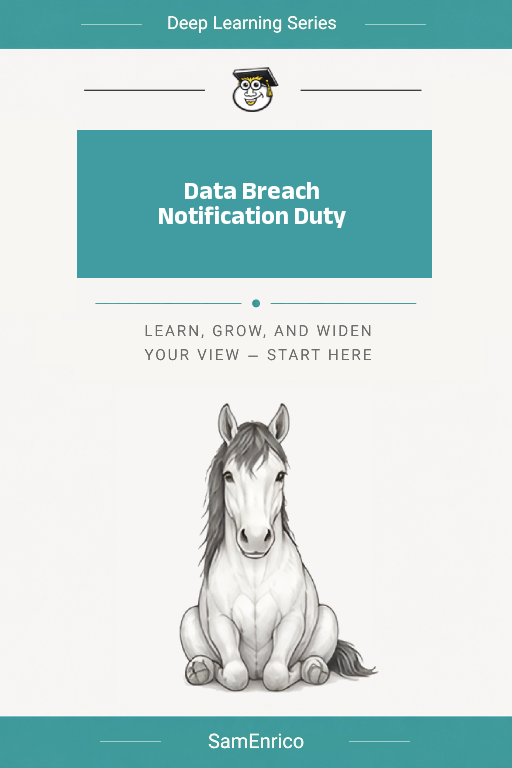
Data Breach Notification Duty eBook
Report employee data breaches (SSNs, bank info) to
by Haney Tania
Report employee data breaches (SSNs, bank info) to affected workers and state regulators within required hours, applying from the first W-9 collected.
Formats
Free sample
Chapter 1: The Toxic Asset--–- The laptop was sitting in the back seat of a Honda Civic parked outside a dentist's office in suburban Columbus, Ohio. Inside the laptop were the Social Security numbers and bank account details of seven people. The woman who owned the laptop, a practice manager named Carol, thought she had lost nothing more than a piece of equipment. She was wrong.Carol had called me because she needed to know whether to report the theft to the police. She had already filed a report for the stolen laptop itself.
What she wanted to know was whether she needed to do anything else. “It’s just a computer,” she said. “I have backups. I’ll get a new one.”I asked her what was on the hard drive.“Patient schedules,” she said. “Some old emails.
And my payroll files.”“What’s in the payroll files?”“You know, names, addresses, Social Security numbers for my staff. Bank account numbers for direct deposit. Nothing I can’t re-enter.”She said nothing I can’t re-enter the way you might say nothing a little soap won't fix. Like it was a chore. An inconvenience.
A few hours of data entry and everything would be back to normal.I had to tell Carol that she had just lost something far more valuable than a laptop. She had lost the permanent, unchangeable financial identities of every person who worked for her. And she had no idea.This book is for Carol. It is for the restaurant owner who keeps W-9s in a filing cabinet under the cash register. It is for the startup founder who stores payroll data in the same Google Drive folder as the company pitch deck.
It is for the HR manager at a two-hundred-person company who assumed “IT handles that.” And it is for the CEO of a multinational corporation who just discovered that a vendor in Southeast Asia has been storing employee Social Security numbers in an unencrypted spreadsheet named “staff_final_FINAL_v3.xlsx.”Here is the truth that almost no one understands until it is too late: the duty to protect employee data and the duty to notify when that data is breached do not begin when you hire a security team or when you cross a revenue threshold or when a lawyer tells you to write a policy. They begin the moment you collect your first W-9.The First W-9 Rule Let me say that again because it is the single most important sentence in this book. The duty attaches the moment you collect the first W-9.Not when you have five hundred employees. Not when you have a million dollars in revenue. Not when a client demands a security audit.
The moment you ask a human being for their Social Security number and their bank account information so that you can pay them for their labor, you become a fiduciary. You are not a custodian of data. You are not a processor of information. You are a trustee of someone's financial identity.Every state with a data breach law has different thresholds for when notification is required. Some states care about the number of affected residents.
Some states care about the type of data exposed. But here is what they all share: the duty to protect begins with possession, not with size. If you have one employee, you have the same duty to protect that employee's Social Security number as a Fortune 500 company has to protect its fifty thousand employees. The only difference is that the Fortune 500 company probably has a lawyer on retainer and a cyber insurance policy. You, the small business owner, are likely reading this at eleven o'clock at night after closing the shop, trying to figure out if you just ruined someone's life.The good news is that the law, for all its complexity, is actually merciful in one regard.
It does not require you to be perfect. It requires you to be reasonable, and when you fail at reasonableness, to be fast. The duty to notify is the law's way of saying, We know breaches happen. What matters is what you do next.But before we get to what you do next, we need to understand what you are holding. Because most employers, and I mean the vast majority, have no idea what they are sitting on.
They see a folder of files. The law sees a weapon.The Taxonomy of Toxic Data Not all employee data is created equal. If you lose a list of employee birthdays, that is unfortunate. If you lose a list of employee email addresses, that is annoying. If you lose a list of employee home addresses, that is concerning.
But those are what I call low-toxicity data. They can be changed. They can be mitigated. They do not, by themselves, enable financial ruin.Then there is the toxic tier. And the toxic tier has exactly two occupants.Social Security Numbers.Your Social Security number is the master key to your financial life.
With it, a criminal can file a tax return in your name and steal your refund. They can open credit cards, take out loans, apply for unemployment benefits, rent an apartment, get a driver's license, and even receive medical care, all while appearing to be you. The Internal Revenue Service does not know you are not you until you file your legitimate return and get rejected because someone else already filed. The banks do not know you are not you until the collection calls start. The state workforce agency does not know you are not you until you try to claim unemployment and are told you are already receiving benefits.And here is the nightmare that keeps data privacy lawyers awake at night.
You cannot change your Social Security number. The Social Security Administration will issue a new number only in extreme cases of continuing, documented identity theft. Someone stole my W-9 from my employer is not, by itself, enough. You are stuck with the number you were issued at birth or when you became a resident. That number follows you to your grave and beyond.Bank Account Numbers.Your bank account number and routing number together form the combination to your checking account.
Unlike a credit card, which has fraud protections and a fifty-dollar liability cap under federal law, a bank account under the Electronic Fund Transfer Act has different rules. If you report unauthorized activity within two business days, your liability is capped at fifty dollars. Wait longer, up to sixty days, and your liability can go to five hundred dollars. Wait more than sixty days, and you could lose everything. There is no fifty-thousand-dollar credit limit.
The money in your checking account is the actual cash you need for rent, groceries, utilities, and your car payment. When that gets emptied, you do not have available credit. You have nothing.The routing number is not secret. It identifies your bank. The account number is the secret.
And once a criminal has your bank account number, they can set up electronic debits, create fake checks, or, in the most common payroll fraud scheme, change your direct deposit…
This is the end of the free sample. Get the eBook to keep going. Buy now
About this book
Details
- Author
- Haney Tania
- Publisher
- SamEnrico
- Language
- English
- Genre
- Non-Fiction, Data Privacy, Breach Notification
- Released
- 2026-05-30
- Pages (approx.)
- 156
- Available as
- eBook, Audiobook

Read better in the ZLOADR app
Your eBooks on your phone or tablet. Sign in with your SamEnrico account and start reading.
More by Haney Tania
 Thunberg Global South JusticeHaney Tania$11.99
 Transcranial Magnetic StimulationHaney Tania$11.99
 The Food Scale GuideHaney Tania$11.99
 Improv for HR ProfessionalsHaney Tania$11.99
 Supplier Lead Time MLHaney Tania$11.99
 Self Esteem Identity Outside WorkHaney Tania$11.99
 Names and Faces Pattern RecognitionHaney Tania$11.99
 Boundary Setting for EmpathsHaney Tania$11.99
 The Poisoned Vintage: The Deadly Deception of Victorian Wine FraudHaney Tania$11.99
 The Brush and the Battle: Healing Through Art in Colonial AustraliaHaney Tania$11.99
 How to Become a BarberHaney Tania$11.99
 Bull Terriers: The Egg-headed CompanionHaney Tania$11.99