
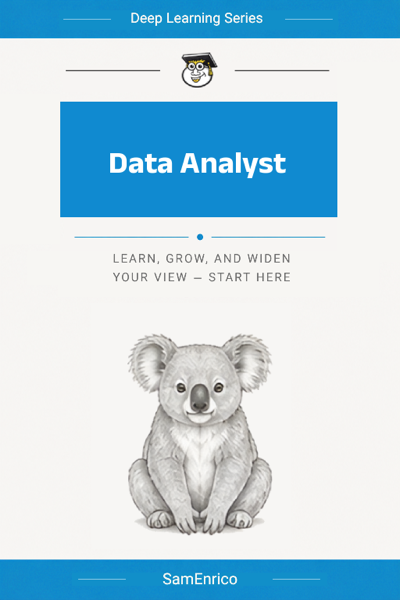
Data Analyst eBook
A Coursebook on Data Analyst
by Hazel Yuk
A Coursebook on Data Analyst
Formats
Free sample
Chapter 1: The 6 PM Epiphany...--–- Six hours. That’s how long I stared at a dashboard that nobody asked for. Six hours of carefully selecting the perfect shade of blue for each bar, adjusting the gridlines to military precision, and adding what I believed were insightful annotations. The dashboard was beautiful. It had seventeen KPIs, three interactive filters, and a real-time data connection that made me feel like a wizard.
I presented it to my manager on a Friday at 4:45 PM—prime “just before the weekend” real estate, which should have been my first warning. She looked at it for exactly eight seconds, nodded slowly, and said the six words that would change my entire career: “This is great. But what am I looking at?”I had no answer. I had built a monument to data but not a single decision. I knew every number on that screen but not one of them pointed toward an action.
The dashboard showed sales by region, by product category, by salesperson, by hour of day, by customer segment. What it didn’t show was why sales had dropped 12% in the Midwest last quarter. It didn’t tell her whether to cut marketing spend in Texas or double it in Oregon. It didn’t answer the one question she actually had: “What do I do on Monday morning?”That failure was the best thing that ever happened to my career. Because in the humiliation of that moment—the awkward silence, the pity smile, the gentle “let’s circle back next week”—I learned the single most important lesson in data analysis: Nobody pays for charts.
Nobody pays for code. Nobody pays for elegant SQL queries or perfectly normalized databases or machine learning models with 99.9% accuracy. People pay for clarity. People pay for decisions. People pay for someone who can look at a chaotic pile of numbers and say, with confidence, “Here is what is happening, here is why it matters, and here is what we should do about it.”This book exists because that lesson took me three years and countless mistakes to learn.
I wrote it to save you those three years.The Myth You Need to Unlearn Immediately Before we write a single line of code, before we open a single dataset, before we even define what a JOIN statement does, we need to burn one dangerous myth to the ground. Ready? Here it is: Data analysis is not about the data.Say that out loud. It feels wrong, doesn’t it? It feels like a contradiction.
How can a discipline called “data analysis” not be about the data? But the most successful analysts I’ve worked with—the ones who get promoted, the ones who get invited to strategy meetings, the ones whose recommendations actually change how their companies operate—spend less than half their time on technical work. The rest of their time is spent on three things that have nothing to do with Python or SQL: understanding what problem actually needs solving, figuring out which questions matter and which are distractions, and convincing other human beings that their analysis is worth acting upon.The junior analyst spends eighty percent of their time on technical work and twenty percent on thinking and communicating. The senior analyst flips those numbers. They know that the hardest part of their job isn’t writing the query—it’s figuring out what to query in the first place.
They know that the most sophisticated regression model in the world is useless if they can’t explain it to a marketing director who hasn’t taken a math class since 1998. They know that being “technically correct” is the lowest bar, and being “actually useful” is the highest.This book will teach you both sides. Part I and II will give you the technical foundation you need to survive—SQL, data cleaning, statistics, visualization. But Part IV is where you’ll learn to thrive: how to design dashboards that drive decisions, how to present findings to people who claim they “hate numbers,” and how to build a portfolio that proves you can do more than just run code. The technical skills get you in the door.
The thinking and storytelling skills get you the corner office.What a Data Analyst Actually Does (And Doesn't Do)Let’s get clear on roles, because the job market has become a swamp of overlapping titles. A Data Analyst, a Data Scientist, and a Business Analyst are not the same thing, despite what some job postings seem to believe.The Data Analyst focuses on descriptive (what happened?) and diagnostic (why did it happen?) questions. You are the detective. You look at historical data, identify patterns, spot anomalies, and explain the past and present to stakeholders. Your toolkit includes SQL for retrieving data, Excel or Python for manipulation, and BI tools like Power BI or Tableau for visualization.
Your deliverables are reports, dashboards, and presentations that answer specific business questions. When the CEO asks “Why did our customer retention drop last quarter?”, the Data Analyst is the first person they call.The Data Scientist focuses on predictive (what will happen?) and prescriptive (what should we do?) questions. They build models that forecast the future or recommend actions. Their toolkit includes Python or R, machine learning libraries like scikit-learn or Tensor Flow, and more advanced statistics. When the CEO asks “Which customers are most likely to leave next month, and what discount should we offer each of them?”, the Data Scientist builds that model.The Business Analyst sits between the two, often acting as a translator.
They might not write code at all. Instead, they use existing reports and dashboards to answer business questions, gather requirements from stakeholders, and bridge the gap between technical teams and executives. They are the diplomat.Here’s where it gets confusing—and where many books mislead you. In 2025, the lines have blurred. Many companies expect Data Analysts to do lightweight prediction.
If you can’t calculate a moving average, run a simple linear regression, or segment customers using basic clustering, you will be considered behind. But there is a clear boundary between analyst-level prediction and scientist-level prediction. That boundary is defined by three questions:Does the model need to be automated? If you’re building something that runs once a month to inform a strategic decision (an analyst task), great. If you’re building something that runs every millisecond to approve credit card transactions (a scientist or engineer task), that’s beyond scope.Does the dataset exceed 10 million rows?
If yes, you need engineering help. Analysts work with data that fits in memory on a decent laptop or runs reasonably in a cloud warehouse.Do you need deep hyperparameter tuning? If you’re tweaking dozens of parameters to squeeze out 0.1% more accuracy, you’ve left analyst territory. Analysts use default settings and interpretable models (linear regression, logistic regression, k-means clustering with small k).Throughout this book, when we venture into predictive techniques in Part III, I will explicitly flag when you are doing “analyst-appropriate prediction” versus “scientist-level complexity.” This boundary is your friend—it protects you from overpromising and underdelivering.The Framework That Runs Through This Book You need a…
This is the end of the free sample. Get the eBook to keep going. Buy now
About this book
Details
- Author
- Hazel Yuk
- Publisher
- SamEnrico
- Language
- English
- Genre
- Non-Fiction, Informative, Educational
- Released
- 2026-05-18
- Pages (approx.)
- 152
- Available as
- eBook, Audiobook

Read better in the ZLOADR app
Your eBooks on your phone or tablet. Sign in with your SamEnrico account and start reading.
More by Hazel Yuk
 Cooling Mattress MeditationHazel Yuk$11.99
 The Assertiveness HabitHazel Yuk$11.99
 Financial Goal Setting WorkbookHazel Yuk$11.99
 Phobia First Aid GuideHazel Yuk$11.99
 The Decluttering Before Downsizing ManualHazel Yuk$11.99
 Dragonheart of the Jade EmperorHazel Yuk$11.99
 How to Start a Hobby in Modern reenactmentHazel Yuk$11.99
 China B2B Sourcing Trends GuideHazel Yuk$12.99
 Brian Chesky Pivot PlaybookHazel Yuk$12.99
 Understanding Intestinal Atresia MultipleHazel Yuk$17.99