
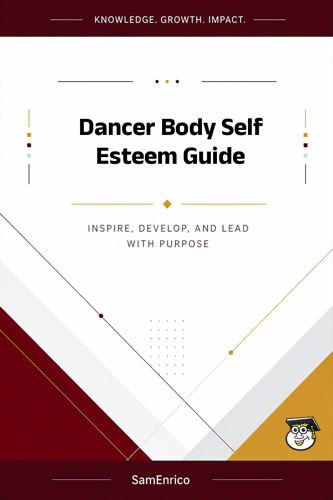
Non-FictionSelf-HelpDance Psychology
Dancer Body Self Esteem Guide eBook
Overcomes ballet-body ideal and embraces diverse d
Overcomes ballet-body ideal and embraces diverse dancer bodies.
Formats
Free sample
Chapter 1: The Invention of Thin...--The first time I was told my body was wrong, I was eleven years old. I remember the exact mirror, the exact barre, the exact shade of pink on the teacher’s cardigan. She walked behind me, placed two fingers on my lower back, and said, “You have a beautiful line, but you’re going to have to watch your weight. Ballet is visual. Every pound shows.” I nodded.
I smiled. I went home and ate half a cup of cottage cheese for dinner. That night, I lay in bed with my hand on my stomach, pressing down, trying to feel what she felt—something excessive, something that needed to disappear.I was five feet tall. I weighed ninety-seven pounds. I had never thought about my body as “too much” of anything before that moment.Twenty years later, I have sat across from dozens of dancers—teenagers, pre-professionals, company members, retirees—who can pinpoint their own version of that sentence.
Sometimes it comes from a teacher: “You have such potential, but…” Sometimes from a parent: “Are you sure you need seconds?” Sometimes from a peer: “She only got the role because she’s skinny.” Sometimes from a mirror, after a thousand repetitions of the same critical stare. The words change. The wound is identical.This book is not about weight loss. It is not about the “right” way to eat or train or pose. It is about something far more unsettling: the realization that the body you have been trying to fix, shrink, hide, or apologize for was never broken in the first place.I am going to say that again, because it is the only sentence in this book that matters more than any other: Your body was never broken.The ballet world convinced you otherwise.
It did so deliberately, systematically, and over centuries. And in this first chapter, we are going to trace exactly how that happened—not to assign blame, but to liberate you from the belief that the problem has ever been yours.The Premise You Have Been Taught to Accept Every dancer knows the list. You might not recite it aloud, but you carry it in your bones the way you carry the muscle memory of a tendu. The “perfect ballet body” has: a long neck, a short torso, long legs, hyperextended knees, flat hip bones, a small bust, narrow shoulders, a high arch, a lean muscle mass with almost no visible body fat, and a specific skeletal proportion where the legs are significantly longer than the torso. Bonus points if you have blonde hair, pale skin, and blue eyes—though those are never written into the requirements.
They simply appear in the photographs.Here is what no one tells you in your first ballet class: that list is not universal. It is not ancient. It is not derived from the laws of physics or the geometry of movement. It is a historical accident that became a dictatorship.The romantic ballet of the 1830s—think La Sylphide, think Giselle—celebrated a very different body. The romantic ballerina was soft, rounded, earthly.
She had hips, breasts, a visible belly beneath her long muslin skirt. She was not an abstraction; she was a woman who floated, yes, but a woman nonetheless. The costumes of that era—the long, bell-shaped romantic tutu—were designed to obscure the legs entirely, to create an ethereal, ghost-like silhouette. No one was looking at your hamstrings. No one was measuring your hip-to-waist ratio.
The effect was dreamlike, not athletic.Then came George Balanchine.The Balanchine Shift: How One Man Changed Every Body If you have spent any time in ballet, you know the name. Balanchine is credited with creating neoclassical ballet, with founding the New York City Ballet, with choreographing some of the most celebrated works in the canon: Serenade, Apollo, The Nutcracker (the American version you probably performed as a child). He is also the single most responsible figure for the body dysmorphia epidemic in professional dance.Balanchine famously said, “Ballet is woman.” But the woman he meant was not his romantic predecessors. He wanted something new: long, lean, almost prepubescent. He wanted dancers who looked like they had been stretched on a rack—visible collarbones, protruding hip bones, arms like wire.
He famously told one of his principal dancers, “Eat nothing. Drink nothing. You are too fat.” She was five foot five and weighed one hundred and eight pounds.Here is the critical piece of history that most dancers never learn: Balanchine did not discover a “better” body type. He selected for a rarity. He deliberately chose dancers who were naturally underweight, naturally hypermobile, naturally narrow-hipped.
Then he trained them to be even thinner. Then he put them on stages and told the world this is what a ballerina looks like. Over decades, through the sheer force of his influence and the international touring of his company, that rarity became the standard. What was once one body type among many became the body type.This is called naturalization. It is when a historical invention is made to feel inevitable, eternal, biological.
“Of course ballerinas are thin,” we say, as if thinness were a law of physics rather than a preference that emerged from the aesthetic of one man in mid-century New York.The Three Myths That Keep You Smaller Than You Could Be Now that you understand the history, let us dismantle the pseudoscience that props it up. You have heard these three statements at some point in your training. They may have come from teachers, from peers, from anonymous online forums, or from the voice inside your head that sounds suspiciously like your first ballet mistress. Every single one of them is false.Myth One: Thinness Creates Better Balance This sounds plausible, does it not? Less weight means less to hold up, which means easier balancing.
The problem is that balance is not about total weight. Balance is about the relationship between your center of gravity and your base of support. A dancer who is underweight often has a higher center of gravity (because they have lost muscle mass in their glutes and thighs) and a smaller base of support (because they are too weak to fully articulate their feet). The result is worse balance, not better.Sports science is unambiguous here. Studies comparing dancers with healthy body fat percentages to dancers with low body fat percentages show that the underweight group falls out of turns more frequently, takes longer to recover from a wobble in arabesque, and has higher rates of ankle sprains.
Your body needs a certain amount of muscle and fat to act as a counterweight and a shock absorber. Strip that away, and you are literally less stable.I have watched this play out in real time. A dancer I coached was told by her teacher that she needed to lose ten pounds to improve her fouettés. She lost fifteen. Her turns became slower, her spotting became dizzy, and she developed a stress fracture in her foot.
When she returned to her original weight—under the guidance of a nutritionist, not a ballet teacher—her fouettés returned to their previous level…
This is the end of the free sample. Get the eBook to keep going. Buy now
About this book
Details
- Author
- Lockhart Rashad
- Publisher
- SamEnrico
- Language
- English
- Genre
- Non-Fiction, Self-Help, Dance Psychology
- Released
- 2026-06-06
- Pages (approx.)
- 127
- Available as
- eBook, Audiobook

Read better in the ZLOADR app
Your eBooks on your phone or tablet. Sign in with your SamEnrico account and start reading.
More by Lockhart Rashad
 EQ For New GraduatesLockhart Rashad$11.99
 Senior Photography Self Esteem CourseLockhart Rashad$11.99
 Anger After Partner's MessinessLockhart Rashad$11.99
 The EQ Anger Management WorkbookLockhart Rashad$11.99
 The Flavor Kings: How Black Entrepreneurs Built a Global Fast Food EmpireLockhart Rashad$11.99
 Understanding Male Pseudohermaphroditism Due to 17-beta-hydroxysteroid Dehydrogenase DeficiencyLockhart Rashad$17.99
 Make a MarionetteLockhart Rashad$11.99
 Strategy Meeting Follow Up GuideLockhart Rashad$12.99
 Catalog Management Efficiency PlaybookLockhart Rashad$12.99
 How to Become a Separator OperatorLockhart Rashad$11.99
You may also like
 Hong Kong Handover 1997Dunn Johnnie$11.99
 Zumba For Postnatal Recovery CourseNeal Christian$11.99
 Zumba for BeginnersLadner Nikia$11.99
 YouTube Comment Mining GuideHumes Pandora$12.99
 Worry Box MeditationCarlin Rudy$11.99
 Workplace Stress MeditationNguyen Lynn$11.99
 Workplace Stress and Sleep RepairHawley Ivory$11.99
 Workplace Perfectionism CureDelaney Jeffry$11.99
 Workplace Injustice Anger GuideWallen Isabelle$11.99
 Work Addiction and Burnout LinkGreenwood Ester$11.99
 Women in Yoga and WellnessBeattie Galina$11.99
 Women in Stand Up ComedyChun Evangeline$11.99