
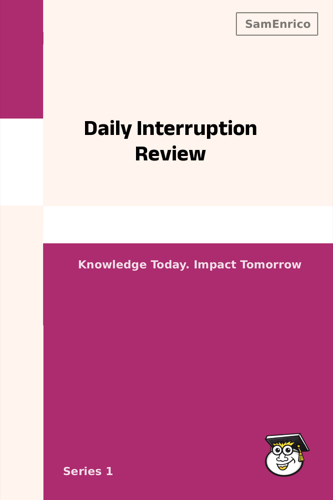
Daily Interruption Review eBook
Review daily disruptions to identify systemic chan
Review daily disruptions to identify systemic changes for improvement.
Formats
Free sample
Chapter 1: The Stolen Minute...--–- You sit down at your desk at 9:00 AM. Your coffee is hot. Your calendar is clear. You have exactly one thing you want to accomplish before your first meeting at 10:30 AM: draft a proposal that should take forty-five minutes. You open your laptop.
You take a sip of coffee. You begin.By 9:07 AM, your phone buzzes. A text from your partner: "Don't forget milk." You reply. Seventeen seconds. Back to the proposal.
By 9:12 AM, a Slack notification: a colleague has a "quick question." You answer. Two minutes. By 9:18 AM, an email lands. Your boss wants an update on a project that isn't due until next week. You feel a flicker of anxiety.
You open the email. You spend three minutes crafting a response. By 9:25 AM, you realize you have written exactly two sentences of the proposal. Your coffee is cold. You feel vaguely guilty, vaguely busy, and vaguely behind.
The meeting at 10:30 AM arrives. You have not finished the proposal. You tell yourself you will do it after lunch. After lunch, there are more pings, more questions, more emails. At 5:00 PM, you leave the office exhausted but unable to name what you actually accomplished.
You blame yourself. You are wrong.This chapter introduces the central problem that the entire book exists to solve: the gap between the work you intend to do and the work you actually do. That gap is not caused by laziness, lack of discipline, or a fundamental flaw in your character. It is caused by a measurable, predictable, and redesignable phenomenon called Switch Cost. Before you can fix anything, you must first see it.
Before you can see it, you must stop blaming yourself and start collecting data.The Myth of the Linear Day Most of us carry around an implicit model of how work should happen. It looks something like this: task A, then task B, then task C. Each task receives your full attention until completion. You move through your day like a train moving through stations—arrive, stop, depart, repeat. This model is beautiful, intuitive, and completely fictional.The modern knowledge worker does not live in a linear world.
You live in a fragmented world. Your day is not a train; it is a pinball machine. You start on one task, get bumped to another, ricochet to an email, bounce to a Slack message, careen back to the original task, only to discover you have forgotten where you left off. This is not a failure of your character. It is a feature of your environment.
And until you name it, measure it, and treat it as a problem of system design rather than personal weakness, you will continue to feel exhausted without knowing why.The concept of Switch Cost was first documented in cognitive psychology research in the early 2000s. Researchers discovered that when humans shift their attention from one task to another, the brain does not simply move smoothly from A to B. Instead, it must perform a series of operations: disengage from task A (which requires suppressing the rules, goals, and mental context of A), activate task B (which requires retrieving the rules, goals, and mental context of B), and then reorient to the environment. This process takes time. More importantly, it takes cognitive energy.
Even more importantly, it leaves a residue. When you return to task A after switching to task B, you are not picking up where you left off. You are starting over, carrying the ghost of task B with you.The research is sobering. A study published in the journal Organization Science found that after an interruption lasting less than three seconds, it takes an average of twenty-three minutes and fifteen seconds to return to the same depth of focus on the original task. Twenty-three minutes.
For an interruption that lasted less time than it takes to blink twice. Let that sink in. If you are interrupted five times in a morning, you have not lost five minutes. You have lost nearly two hours. Not to the interruptions themselves—to the Switch Cost between them.This is the first and most important number you will encounter in this book: twenty-three minutes.
Write it down. Remember it. It is the hidden tax on your attention, and it is the reason you feel exhausted at 2:00 PM despite having done nothing that feels like real work.Acute Versus Chronic: A Hierarchy of Disruption Before we go further, we need to establish a distinction that will guide the entire book. Not all disruptions are created equal. Some hit you like a rock thrown through a window—sudden, discrete, and measurable.
Others seep into your day like humidity—invisible, pervasive, and impossible to point to but undeniably destructive.This book calls the first category Acute Interruptions. These are discrete events with a clear start and end. A phone ping. A colleague stopping by your desk. A Slack notification.
An email arriving. A calendar reminder. You can point to the moment it began and the moment it ended. You can log it. You can count it.
You can measure its duration. Acute interruptions are the rocks through the window.The second category is Chronic States. These are not events but conditions. Emotional flooding—that feeling of being overwhelmed by anxiety or frustration—is not a single interruption; it is a state that can last for hours. Decision fatigue is not an interruption; it is the accumulated effect of too many micro-decisions.
Boredom is not an interruption; it is a background hum that makes you vulnerable to every ping. Physical discomfort—hunger, fatigue, poor posture—is not an event; it is a persistent drain on your cognitive resources.Both categories matter. Both destroy focus. But they require different tools. Acute interruptions can be logged, tracked, and eliminated one by one.
Chronic states must be observed as patterns, managed through system design, and addressed with different techniques (which we will cover in Chapters 5 and 10). The critical mistake most productivity books make is treating everything as an acute interruption. They tell you to turn off notifications (good for acute) but ignore the emotional flooding that makes you check your phone even when no notification has arrived (a chronic state). This book will address both, but we must keep them distinct. For the rest of this chapter, we focus on acute interruptions.
Chronic states will get their full treatment in later chapters.The 48-Hour Interruption Log: Seeing What You Cannot See Here is the uncomfortable truth about your interruptions: you do not know how many you have. You think you do. You think you have "a few" or "more than you would like." But you have no idea. Because the human brain is terrible at counting what it does not measure. Memory is not a video recorder; it is a story generator.
Your memory of your day is not a faithful log of events; it is a narrative that your brain constructs to make sense of chaos. And that narrative systematically minimizes interruptions because your brain wants to believe you are in control.The only way out of this trap is data. You must measure before you can manage. You must see…
This is the end of the free sample. Get the eBook to keep going. Buy now
About this book
Details
- Author
- Gallo Kennith
- Publisher
- SamEnrico
- Language
- English
- Genre
- Non-Fiction, Self-Help
- Released
- 2026-06-07
- Pages (approx.)
- 127
- Available as
- eBook, Audiobook

Read better in the ZLOADR app
Your eBooks on your phone or tablet. Sign in with your SamEnrico account and start reading.
More by Gallo Kennith
 Persuasive Partnership ProposalGallo Kennith$11.99
 Selenium Thyroid Health GuideGallo Kennith$11.99
 NVC for CoachesGallo Kennith$11.99
 Paternal Anger ControlGallo Kennith$11.99
 Trickster Archetype DreamsGallo Kennith$11.99
 Cancer Survivor CaregiverGallo Kennith$11.99
 Space Invasion Territorial CuesGallo Kennith$11.99
 Ron Howard OpieGallo Kennith$11.99
 The Shadow Vice President: The Untold Power of Walter MondaleGallo Kennith$11.99
 The Oxford Star: How a 17th-Century University Launched the Age of AstronomyGallo Kennith$11.99
 The Iron Chancellor: Bismarck's Gambit in Blood and SteelGallo Kennith$11.99
 How to Start a Aerial Erection (domestic) Business (Beginners Guide)Gallo Kennith$11.99
You may also like
 Hong Kong Handover 1997Dunn Johnnie$11.99
 Zumba For Postnatal Recovery CourseNeal Christian$11.99
 Zumba for BeginnersLadner Nikia$11.99
 YouTube Comment Mining GuideHumes Pandora$12.99
 Worry Box MeditationCarlin Rudy$11.99
 Workplace Stress MeditationNguyen Lynn$11.99
 Workplace Stress and Sleep RepairHawley Ivory$11.99
 Workplace Perfectionism CureDelaney Jeffry$11.99
 Workplace Injustice Anger GuideWallen Isabelle$11.99
 Work Addiction and Burnout LinkGreenwood Ester$11.99
 Women in Yoga and WellnessBeattie Galina$11.99
 Women in Stand Up ComedyChun Evangeline$11.99